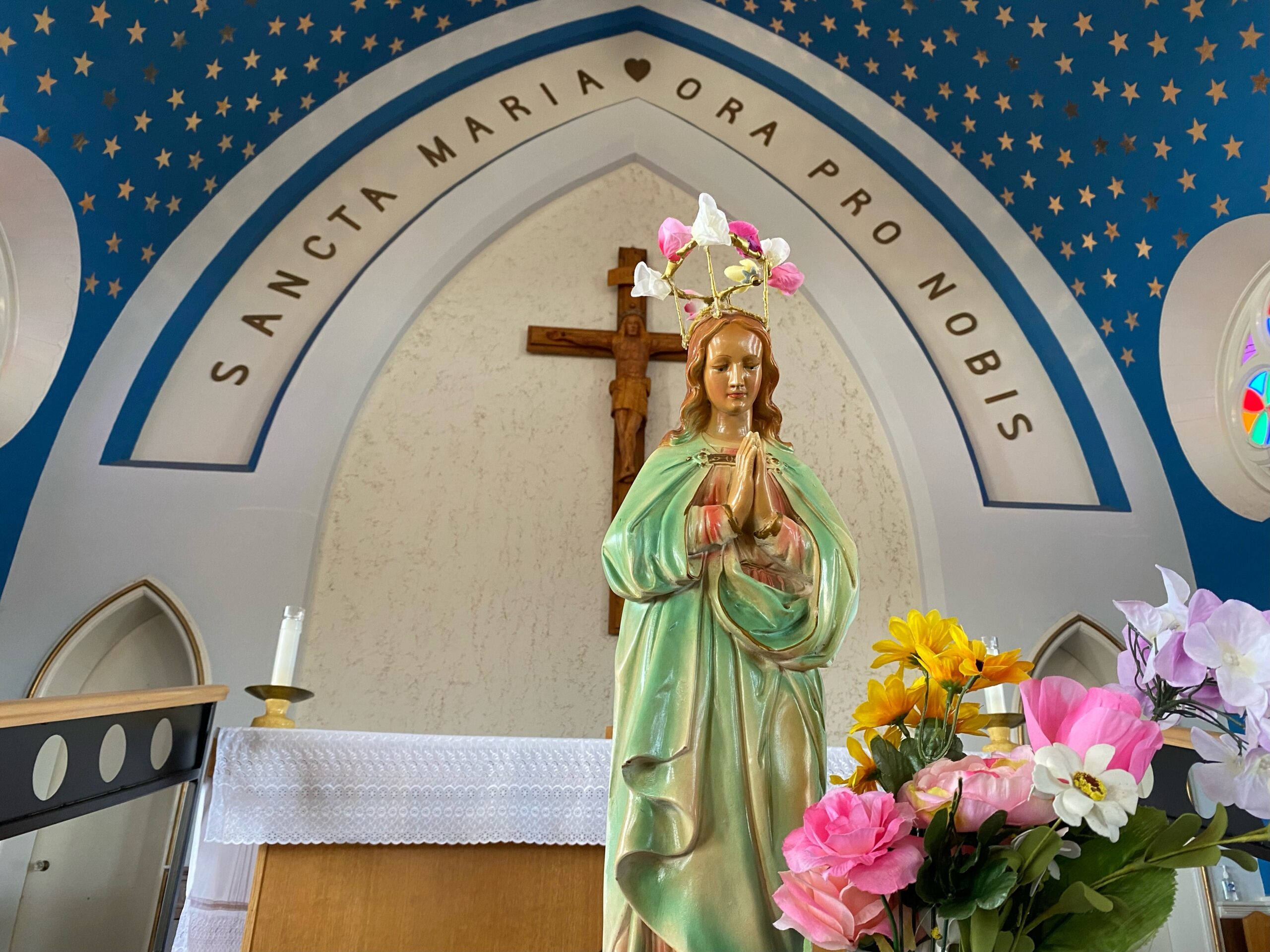

The title Our Lady of Hope couldn’t be more fitting in this jubilee year. This May — traditionally devoted to the Blessed Virgin Mary — is the perfect time to reflect on our Mother’s role in this year of hope.
Our late Holy Father Pope Francis emphasized the importance of including the Blessed Virgin in our jubilee journey. In his letter for the Year of Jubilee, he pointed to Mary’s example of hope as the Mother of God — even knowing how her Son would suffer.
“In this way, Mary cooperated for our sake in the fulfilment of all that her Son had foretold in announcing that he would have to ‘undergo great suffering, and be rejected by the elders, the chief priests, and the scribes, and be killed, and after three days rise again’ (Mk 8:31),” wrote Pope Francis. “In the travail of that sorrow, offered in love, Mary became our Mother, the Mother of Hope. It is not by chance that popular piety continues to invoke the Blessed Virgin as Stella Maris, a title that bespeaks the sure hope that, amid the tempests of this life, the Mother of God comes to our aid, sustains us and encourages us to persevere in hope and trust.”
The title Stella Maris — Latin for “Star of the Sea” — is intimately connected with the apparition of Our Lady of Hope, which took place on Jan. 17, 1871, in the village of Pontmain, France. On that winter evening, the Virgin appeared first to young Eugene Barbedette, a farm boy working with his father and brother Joseph. Eugene stepped outside for a break and looked up at the night sky to see Our Lady, clothed in a blue gown studded with golden stars, smiling at him with her hands spread open in welcome. His brother joined him, and both boys were mesmerized — deeply moved by her beauty, especially her smile.
The appearance was directed only at children. The boys’ parents could see nothing. Their mother, trusting their word, sent for the local teacher, a nun, who also saw nothing — but she brought two young girls, who were likewise entranced by the vision. The apparition, which lasted about three hours, grew in size and detail as more onlookers gathered to pray. Only the four children could see and describe the vision, which included a banner under Mary’s feet reading, “Pray, my children. God will answer before long. My Son lets Himself be moved.”
The villagers had been praying for deliverance from the imminent invasion of hostile soldiers, as France was in the midst of the Franco-Prussian War. The town was spared — shortly after the apparition, the Prussian army changed direction. A seemingly hopeless situation was turned around through Mary’s intercession and the faith of children. Hence her title, Our Lady of Hope — though she is also known locally as Our Lady of Pontmain.
Children are often fascinated by stars. Stars are symbols of hope — of reaching for something higher. Children are good at that. This is why Christ tells us to have faith like little children, and why Mary often appears to children — as with the three children of Fatima or St. Bernadette at Lourdes. The children in Pontmain described the stars as “jumping” to be closer to the Virgin Mary. Even the stars are drawn to the great Morning Star.
There’s a lesson here for all of us, young and old. Our Lady of Hope is a title for our heavenly Mother we don’t hear often enough. Pope Francis recognized that our world — full of division, greed, and the immediate dangers of disasters, suffering and sin — needs hope more than ever. Our Lady knew what the people of Pontmain needed in 1871. She knows what each of us needs today — when we wake up to a world full of threats to our hearts, our health and, most of all, our faith.
It’s up to us — especially in this year of hope — to embrace the gifts the Church offers to anchor our faith in this stormy sea of life.
Our Lady of Hope, pray for us.
Lazzuri writes from her home in Nova Scotia, where she lives with her husband, four of their six children, and her mom. She can be reached at clarelazzuri@gmail.com.