


4th Sunday of Easter, Year C
First Reading: Acts 13:14, 43–52
Second Reading: Revelation 7:9, 14b–17
Gospel Reading: John 10:14
In this Sunday’s Gospel, Jesus says he will give all who hear him “eternal life.” That promise, says the Second Reading, includes “those who have come out of the great ordeal,” having washed their robes and made them white “in the blood of the Lamb.” The First Reading makes it clear that this group includes Gentiles — non-Jews.
This was a vital message for the first Christians, who were themselves Jews — members of the people specially chosen by God, whose race God had assumed in becoming man.
The First Reading emphasizes the Jewish character of the early Church, but also describes how the Jewish authorities rejected the apostles, prompting Paul and Barnabas to turn to the Gentiles. However, once large numbers of Gentiles accepted Christianity and Peter, head of the Church on earth, moved to Rome, some Gentile Christians began to reject Jews in turn.
In feudal Europe, Jews became money-lenders because they were forbidden to own property or join guilds. At various times, nearly every Christian country exiled them — stripping them of their possessions and any money owed to them. They were condemned as “Christ-killers” by virtue of their race. No atrocity was too terrible to be attributed to them.
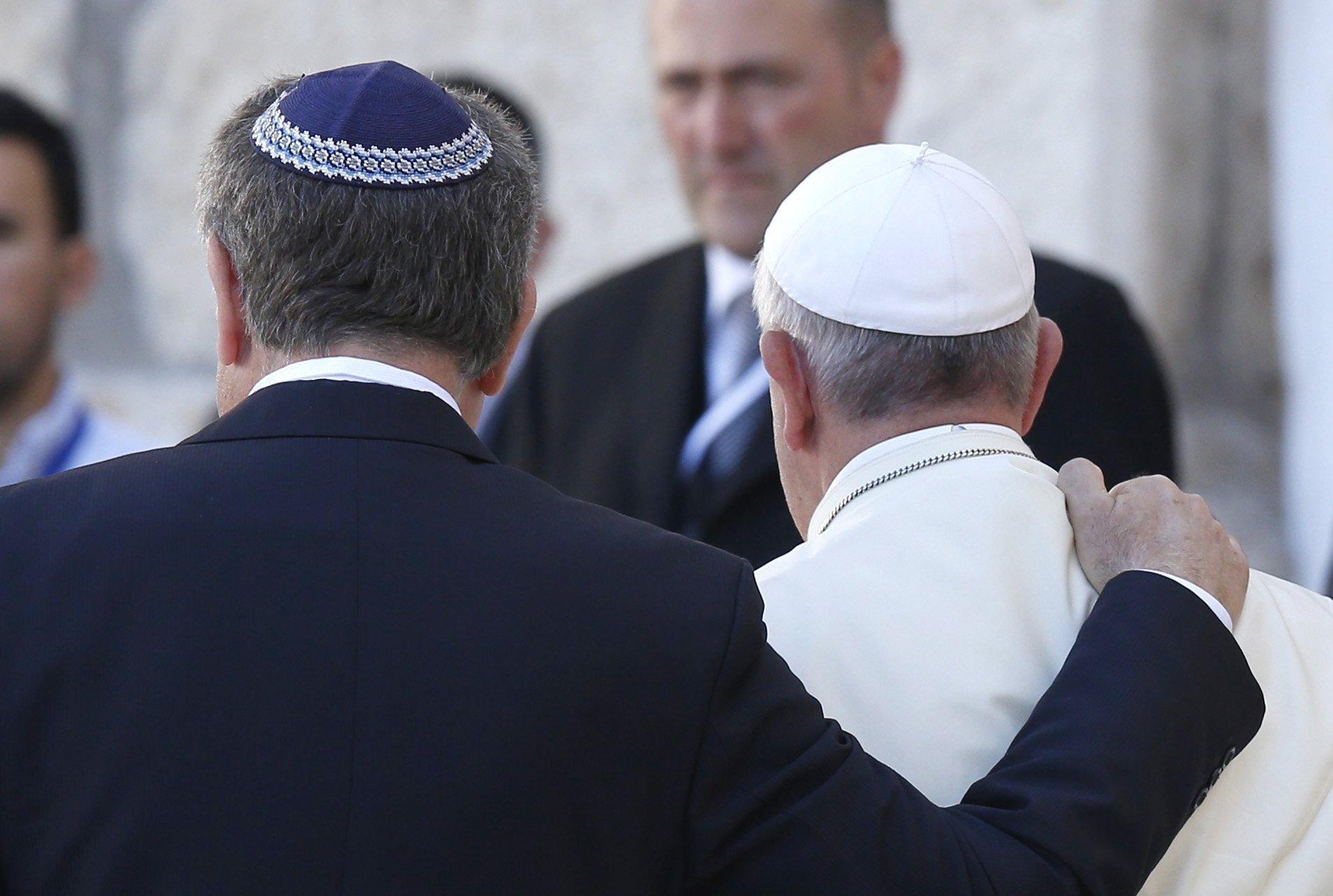
Today, we need to be reminded that God’s people includes Jews. As Pope Pius XI said, “Spiritually, we are all Semites.”
The Second Vatican Council explicitly rejected the idea that the Jewish people were guilty of deicide, or that they were rejected by God as a race. It denied that the Jews living at the time of Christ were collectively responsible for his death, or that any Jew living since then bears guilt for his crucifixion.
“Christ underwent his passion and death because of the sins of all men, so that all might attain salvation,” the Council stated. The Church “deplores all hatreds, persecutions, and displays of antisemitism levelled at any time or from any source against the Jews.”
“The Church cannot forget that she draws sustenance from the root of that good olive tree onto which have been grafted the wild shoots, the Gentiles,” said Pope St. John Paul II.
Speaking of his childhood in Poland, he recalled that a quarter of his classmates were Jewish, and that Catholics and Jews were united in “their awareness that they prayed to the same God.” He remembered saying during his first visit as pope to the principal synagogue in Rome that the Jews are “our elder brothers in the faith.”
“This extraordinary people continues to bear signs of its divine election,” he said — and recounted how an Israeli politician had once responded, “If only it could cost less!”
“When she delves into her own mystery, the Church, the People of God in the New Covenant, discovers her link with the Jewish people, the first to hear the Word of God,” teaches the Catechism of the Catholic Church.
In fact, “a better knowledge of the Jewish people’s faith and religious life as professed and lived even now can help our better understanding of certain aspects of Christian liturgy.”
“The Jewish faith, unlike other non-Christian religions, is already a response to God’s revelation in the Old Covenant. To the Jews belong the sonship, the glory, the covenants, the giving of the law, the worship, and the promises; to them belong the patriarchs, and of their race, according to the flesh, is the Christ — for the gifts and the call of God are irrevocable.”
“The spiritual bonds and historical links binding the Church to Judaism … render obligatory a better mutual understanding and renewed mutual esteem,” says the Vatican document Guidelines on Religious Relations with the Jews.
“On the practical level in particular, Christians must therefore strive to acquire a better knowledge of the basic components of the religious tradition of Judaism; they must strive to learn the essential traits by which the Jews define themselves in the light of their own religious experience.”
Father Hawkswell is again teaching “The Catholic Faith in Plain English,” with new insights, in both print and YouTube form, at beholdvancouver.org/catholic-faith-course. He is also teaching the course in person on Sundays (2 – 4 p.m. at the John Paul II Pastoral Centre, 4885 Saint John Paul II Way, 33rd Avenue and Willow Street, Vancouver) and Mondays (10 a.m. – noon in St. Anthony’s Church Hall, 2347 Inglewood Avenue, West Vancouver). The title of next week’s talk is Catholic Spiritualities.
Your voice matters! Join the conversation by submitting a Letter to the Editor here.







