


Easter Sunday, Year C
First Reading: Acts 10:34a, 36–43
Second Readings: Rom 6:3–11, Col 3:1–4, 1 Cor 5:6b–8
Gospel Reading: Lk 24:1–12, Jn 20:1–18, Lk 24:13–35
“Christ is risen!” the early Christians greeted each other. “He is risen indeed!” they responded. “Alleluia!”
“The resurrection of Jesus is the crowning truth of our faith in Christ,” the Catechism of the Catholic Church explains: “a faith believed and lived as the central truth by the first Christian community, handed on as fundamental by [Sacred] Tradition, established by the documents of the New Testament, and preached as an essential part of the Paschal mystery along with the cross: Christ is risen from the dead! Dying, he conquered death; to the dead, he has given life.”
The resurrection is a real, physical, historical event. Jesus died on Friday and his body was buried in a sealed and guarded tomb, but early on Sunday morning the tomb was found to be empty. The absence of his body could be, and has been, explained in other ways, but its discovery, first by the women, and then by John and Peter, is powerful testimony.
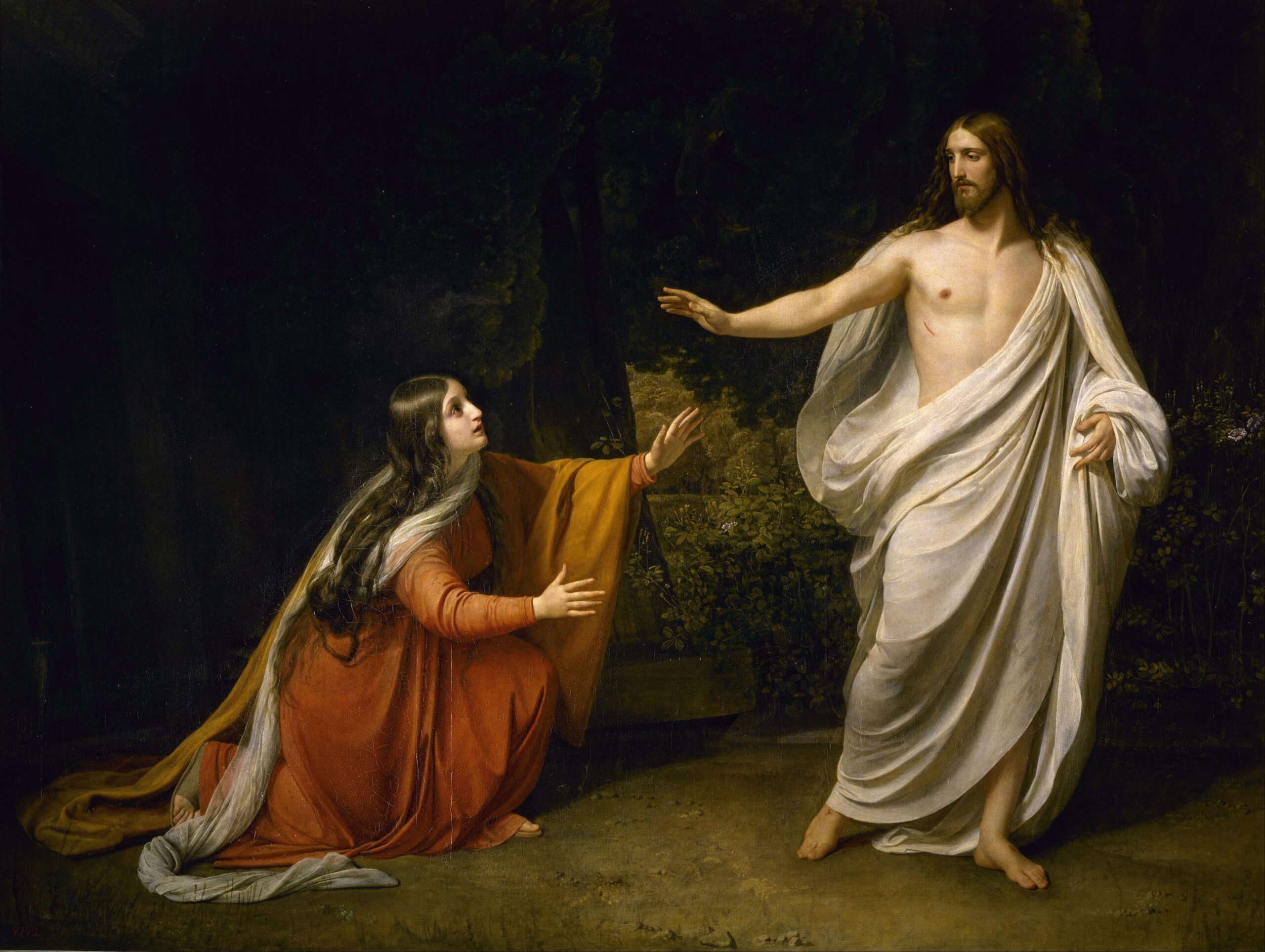
The first to encounter the risen Jesus was Mary Magdalene, one of the women who came to finish anointing his body, which had been buried hastily because the sabbath was beginning. Next was Peter, then the other apostles, and then more than 500 people at once: not everyone, but those God chose as witnesses.
The faith of the first Christians was based on the direct testimony of these witnesses: people known to them and, for the most part, still living among them—like Matthias, who was chosen to replace Judas as a “witness” to the resurrection.
The hypothesis that the apostles believed what they wanted to believe, with mystical exaltation and credulous faith, will not stand up. On the contrary, Jesus’ passion and death had drastically tested their faith, shocking, demoralizing, and frightening them.
At first, they regarded the women’s story as an “idle tale.” When they finally saw Jesus, on Sunday evening, he reproached them for their unbelief and hardness of heart. Still, they thought they were seeing a ghost; Jesus had to eat with them and let them touch him.
They could see that Jesus’ risen body was the same body that had been tortured and crucified. However, it possessed new characteristics: for example, it was not limited by space and time but able to be present how and when he willed.
Jesus did not return to earthly life like those he had raised from the dead. They would have to die again, but Jesus’ glorious body now shared divine life, belonging henceforth to the realm of heaven.
No one saw Christ’s resurrection; no evangelist describes it. No one can even say how it came about physically, much less how he became glorified. Therefore, while the resurrection was a physical, historically verifiable event, it nevertheless remains a mystery of faith, for it transcends history.
It was by the unity of the divine nature that Christ’s body and soul were reunited in the resurrection, for God the Son, the divine person of Christ, remained united to his soul and body even when they were separated from each other by death.
What does the resurrection mean for us?
First, it proves Jesus’ divinity, showing that he is truly “I Am,” Son of God and therefore God by nature. It proves his divine authority and confirms all his works and teachings, even those most inaccessible to human reason.
Second, it fulfills the promises made by God in the Old Testament and by Jesus during his earthly life, that everyone who believes in him receives forgiveness.
Third, it opens the possibility of new life: supernatural life, divine life, God’s life. As Christ’s brothers and sisters, we share his divine nature.
Finally, it guarantees our own resurrection. Our new life is hidden with Christ in God, but when he who is our life is revealed, then we also will be revealed with him in glory.
Christ is risen indeed! Alleluia! Alleluia!
Father Hawkswell is again teaching “The Catholic Faith in Plain English,” with new insights, in both print and YouTube form, at beholdvancouver.org/catholic-faith-course. He is also teaching the course in person on Sundays (2 – 4 p.m. at the John Paul II Pastoral Centre, 4885 Saint John Paul II Way, 33rd Avenue and Willow Street, Vancouver) and Mondays (10 a.m. – noon in St. Anthony’s Church Hall, 2347 Inglewood Avenue, West Vancouver). The title of next week’s talk is Virtue.
Your voice matters! Join the conversation by submitting a Letter to the Editor here.







