

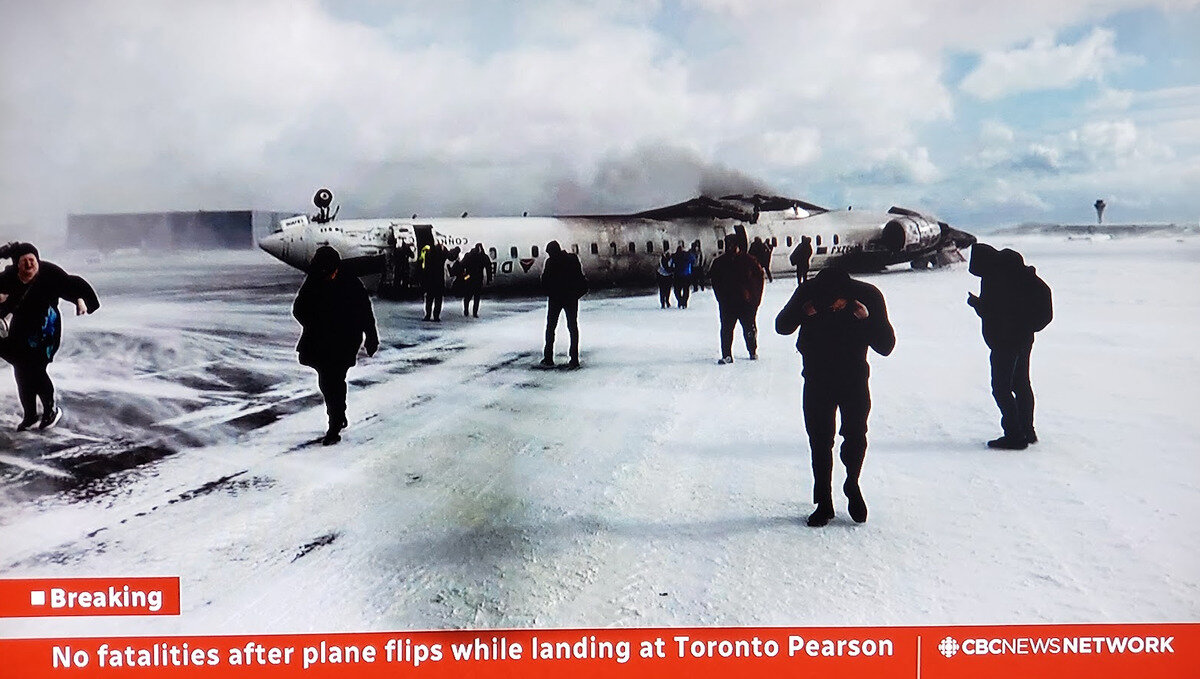

“We just landed. Our plane crashed. It’s upside down.”
If you were caught up in the Family Day news about a bizarre plane crash at Toronto’s Pearson Airport, you likely heard those words and saw the surreal video taken by passenger John Nelson.
A Delta Airlines feeder flight, DL4819, operated by Endeavour Air, had just touched down on Runway 23 at Pearson, in blowing snow conditions, when a series of events caused the aircraft to roll, and eventually come to rest upside down on runway 23.
Not only did the Bombardier CRJ900LR come to rest upside down, its fuselage was essentially intact. Yes, the tail had snapped off, so had one wing, but the all important fuselage was intact, helping preserve its precious cargo, 76 passengers and 4 crew. Remarkably, the fuselage was facing opposite to the direction of the landing.
This crew was able to get everyone off their aircraft thanks to safety improvements mandated for new aircraft following a somewhat similar crash in the 1980s. In that crash the weight of the wings crushed parts of the fuselage, ultimately leading to two dozen fatalities. Among the changes, wings that would break away in this type of crash, and seats that could withstand 16 g loading and not tear away in the aftermath of a crash landing.
Although the aircraft was upside down, the seats remained in place. Hopefully everyone was buckled in, and was subsequently able to free themselves, alone or with assistance. Yes, there were injuries, some severe and some even classified initially as critical, but the fact is that 75 per cent of the people on board walked out of the smouldering, upside down fuselage.
Canada’s Transportation Safety Board will take the lead in the investigation of this crash, happening as it did in Toronto, but the American National Transportation Safety Board, NTSB, will have representatives on hand as it was an American airline with a flight originating in Minneapolis. Adding to the confusion in the aftermath was the airport fire chief stating that the runway was dry and there were no crosswinds at time of the crash.
Within a couple of hours of the crash an initial news conference indicated that 18 people were transported to nearby hospitals. Greater Toronto Airports Authority president and CEO Deborah Flint described a textbook response by airport safety personnel.
Needless to say, social media sites were quickly inundated with news, and speculation, about the crash. Of course some fake imagery circulated, including a photo supposedly showing the aircraft upside down before touchdown. More gripping, and believable, were the short clips from passengers, such as the one where a woman passenger films herself strapped upside down in her chair, and then moments later, outside, somewhat in a state of shock with the words “I was just in a plane crash. Oh my God!”
In addition to social media clips, some standard linear TV channels interrupted programming and quickly lined up a number of experts. Notable was the coverage from three major players, CBC through its CBC NewsNetwork, CTV News Channel, and CNN. CBC ran almost wall-to-wall coverage well into the late evening.
CBC host Adrienne Arsenault even managed to snag an in-person, in-studio interview with a passenger on DL4819, Pete Carlson, who was in window seat 10D: “I cannot believe I’m sitting across from someone who has just survived a plane crash. Can you help me understand what happened?”
Carlson, a paramedic, described the touchdown as “forceful,” followed by a lateral rolling motion which was very disorienting. When asked if there was crying or yelling he said no: “What I saw was that everyone on that plane suddenly became very close in terms of how to help one another and console one another, and that was powerful.”
Almost immediately as the rescue effort got underway, the Pearson Airport Catholic Chaplaincy sprang into action. With 45 years of history, including with a previous crash twenty years ago, the Chaplaincy priests prepared to meet evacuated passengers as they boarded buses to bring them in from the tarmac, ready to provide calm and comfort through faith, while not knowing exactly what to expect.
It is always interesting to see representatives for the news channels attempting to get approval from video clip owners to run their content. Often such approval is sought quite openly, through public tweets for instance. Should you ever find yourself with an in-demand video clip, see if you can find some help to add a watermark, and don’t be embarrassed to ask for payment, even if only a small amount.
By the day after the DL4819 crash some revisions began to take shape. Delta clarified that the hospitalized passenger count had reached 21, and that within 24 h all but two of this count had been released. Weather experts contradicted the airport fire chief and said crosswinds were gusting to 65 km/h as the plane arrived at Pearson.
Perhaps most startling was a video clip, possibly taken from an aircraft awaiting takeoff approval, showing the DL4819 arrival from about a hundred feet above the surface, through to the fiery roll to the right, with a wing and the tail breaking off.
As this column went to press all hospitalized passengers had been released. The aircraft wreckage had been removed to a hangar for investigators to pore over. Following a runway inspection, all operations at Pearson, and at impacted airports across the country, were getting back to normal.
Despite a recent spate of aircraft crashes, air travel remains exceedingly safe, with one expert stating a number of one fatality for every 13.7 million passengers. The CRJ900 is itself a very safe aircraft. Some 1900 have been built by Canada’s Bombardier and there have been no fatalities arising from its use over more than twenty years.
Follow me on Twitter/X (@PeterVogel) or on Bluesky (@petervogel.bsky.social).
Your voice matters! Join the conversation by submitting a Letter to the Editor here.







