


8th Sunday of Ordinary Time, Year C
First Reading: Sir 27:4–7
Second Reading: 1 Cor 15:54–58
Gospel Reading: Lk 6:39–45
“A person’s speech discloses the cultivation of the mind,” we hear in the First Reading this Sunday. “It is out of the abundance of the heart that the mouth speaks,” Jesus says.
There is a profound relation between speech and thought.
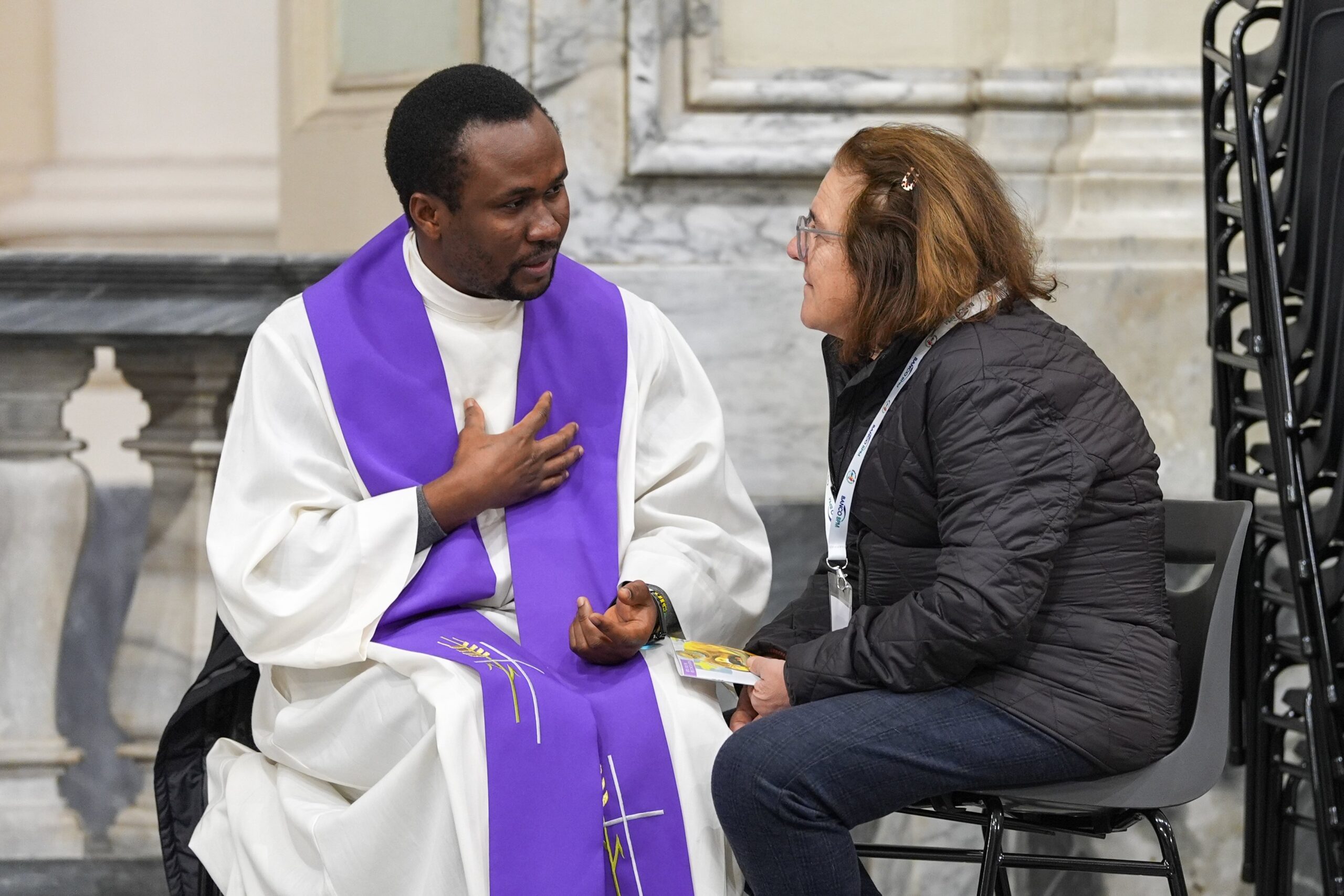
In my course The Catholic Faith in Plain English, a lady once argued against the need for confession in the Sacrament of Penance.
“Why can I not just confess my sin quietly to God?” she asked. “Why do I have to say it out loud to a priest?”
The answer is that “God, who has reconciled us to himself through Christ,” has given “the ministry of reconciliation” to his Church, St. Paul says.
“If you forgive men’s sins, they are forgiven them; if you hold them bound, they are held bound,” Jesus told his apostles. Clearly, then, the Church must know what those sins are and be convinced that we regret them and intend to change.
Accordingly, says the Catechism of the Catholic Church, “individual, integral confession and absolution remain the only ordinary way” for Catholics to reconcile ourselves with God and the Church. (“Integral” means confessing all our remembered mortal sins together, not reserving some of them for confession later.)
However, there are also human reasons for confession.
Like remembering or promising, forgiving is a mental act, which can be solitary or social. For example, remembering is a solitary act, for we can perform it alone, but promising is a social act, for we make the promise to another person.
A solitary mental act can exist without being expressed to anyone else. However, a social mental act must be verbalized; it cannot exist without being expressed by words or signs that make it known to the other party concerned.
Now forgiveness is a social act, for it is offered by one person and accepted by another, so it must be expressed verbally: “I’m sorry,” or “I forgive.” It is what linguists call a speech act: something we perform by saying something. It is not enough to say, “I’m sorry for anything I may have done to offend you”; the offence must be mentioned explicitly.
When we confess our sins, verbalizing our sorrow and our intention to change, we make our penitence known to the priest, but also to ourselves. “We can hardly be confident of the state of our own minds, but as it stands attested by some external action,” said Samuel Johnson.
Accordingly, one of the twelve steps to healing in Alcoholics Anonymous is to admit “to God, to ourselves, and to another human being the exact nature of our wrongs.” It is humbling, but humility is appropriate when we ask for forgiveness. Even psychologically, it “frees us and facilitates our reconciliation” with God and the Church, the Catechism notes.
Confession is difficult, primarily because by stating our sins aloud, without ambiguity or equivocation, we place them out there, where we can see them squarely as objectively evil and take responsibility for them. (It is just as difficult when we are alone, with no one to hear us—try it!)
In the Sacrament of Reconciliation, the priest acts in the person of Christ, the one whom we have offended. After the difficult words of confession, we hear the consoling and uplifting words of absolution, in which Christ personally addresses every sinner: “My son, your sins are forgiven.”
When my mother became a Catholic, she said, “I have always believed that God is merciful, but now I know he has forgiven me: I have heard it.”
We experience many temptations to avoid confession: pride, shame, discouragement, or reluctance to avoid the occasions of sin. Overcoming them can be part of our reparation for our sins.
Priests know how difficult confession can be, and Pope Francis has urged them to make it as easy as possible: an experience of “forgiveness and mercy,” not of “a prosecuting court.”
Father Hawkswell is again teaching The Catholic Faith in Plain English, with new insights. The whole course is available in written form and, one session per week, in YouTube form at beholdvancouver.org/catholic-faith-course. Father is also teaching the course in person: on Sundays at 2:00 p.m. in the John Paul II Pastoral Centre, 4885 St. John Paul II Way, Vancouver (33rd and Willow); and on Mondays at 10:00 a.m. in St. Anthony’s Church hall, 2347 Inglewood Avenue, West Vancouver. The title of next week’s talk is Divisions Among Christians.
Your voice matters! Join the conversation by submitting a Letter to the Editor here.







