

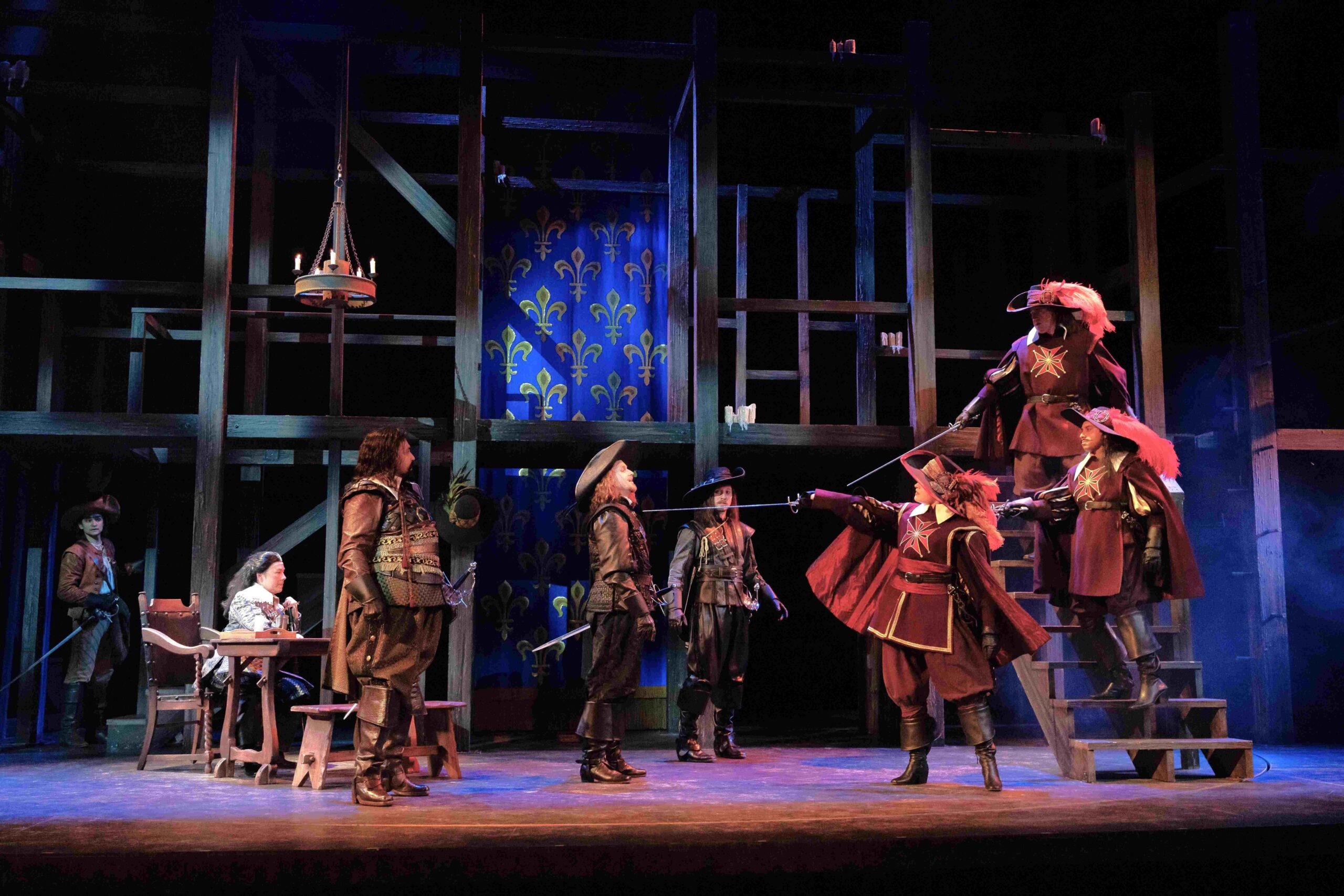

It is impossible not to admire the Arts Club’s artistic director and the company’s dramatic ambition, though sometimes their reach exceeds their grasp. Unfortunately, this is true of the Arts Club’s latest production, The Three Musketeers.
While few of us have actually read Dumas’ novel (I myself gave up on it many years ago after wading through about a third of it—in translation, let me hasten to add!), there have been so many movie and television versions of the book that many are already familiar with its sprawling plot.
Of course, it is easy to understand why the story has such dramatic appeal: its courtly backdrop of 18th-century France and England; its tale of intrigue, including the complications of the queen’s diamond necklace, political treachery, poison, murder, and romance; its swashbuckling, melodramatic scenes of plot and counterplot; and, above all, its stirring story of the musketeers (actually four of them) and their rousing oath, “All for one, and one for all.” These elements naturally lend themselves to theatrical adaptation.
However, the very sweep of the narrative poses a major challenge for a company like the Arts Club in staging a play based on it—even when produced jointly with Edmonton’s Citadel Theatre.
The production certainly does everything it can to tell the story, making use of a revolving stage, a versatile skeleton set, excellent and elaborate costuming, lengthy and well-managed sword-fighting scenes, and enthusiastic performances from a cast willing to give their all.
Sadly, that does not prove quite enough. There is a brave effort to solve the problem of mounting a play that demands visual excess; however, because of the sheer scope of the narrative, the characters inevitably remain two-dimensional, and the whole enterprise turns into a superficial “good guys versus bad guys” spectacle. Apart from the dashing musketeers, there is a mincing, prancing Louis XVI; his unfaithful wife, Marie Antoinette; a scheming, ambitious Cardinal Richelieu; tragic lovers; and a multitude of servants, townspeople, and incidental characters. The result is a production that becomes overly complicated and, at times, bewildering.
In short, the production brings to mind Dr. Johnson’s observation on the performing dog: the wonder is not that it is done well or badly, but that it is done at all.
That said, the production does offer a diverting opportunity to get a Coles Notes version of the novel for anyone unfamiliar with The Three Musketeers. Moreover, it provides an additional potential benefit. As someone who became a theatre lover because my parents took me to plays from the age of six, it seems to me that parents and grandparents could use the Arts Club production at the Stanley Theatre as a golden opportunity to introduce young people to the magic of live theatre. Many young people would doubtless respond enthusiastically to the physical action, the melodrama of the narrative (perhaps with some guidance from adults), and the liveliness of the performance. It would be a great way to introduce them to the much-loved Dumas tale—and to the wonderful magic of live theatre.
Your voice matters! Join the conversation by submitting a Letter to the Editor here.







