

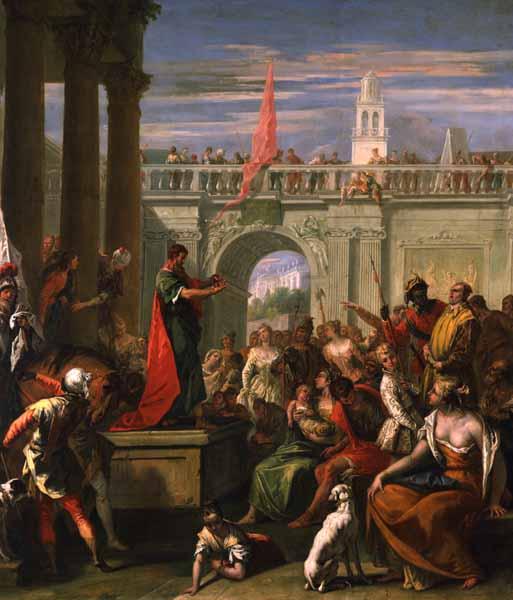

Standing in chains before a hostile crowd in Jerusalem, Paul does something unexpected. He does not defend himself with arguments. He tells a story — his own. Acts 22 records Paul’s testimony to the mob that had just tried to kill him, and in many ways it is a deliberate echo of chapter 9, where his conversion was first narrated. What Paul offers here is not abstract doctrine but personal witness, and in it we find one of the richest theological moments in the whole book of Acts.
The scene opens with a small but telling detail. When Paul addresses the crowd in Hebrew, their own language, the uproar quiets. He begins, “Brothers and fathers,” placing himself among his hearers rather than above or against them. This matters, because Paul was often accused of betraying his own people. The truth was more balanced: Paul remained a devoted Jew who loved his people and their traditions deeply. What he insisted on was simply that Gentile believers should not be bound to Jewish ceremonial law. He loved his own people, and he loved the Gentiles — including, in a sense, most of us reading this today, since we are not Jewish by birth. When that love became grounds for false accusation, we see a familiar temptation: the either/or mentality that says if you are not entirely with us, you must be against us. For Paul, it was never either/or. It was both.
He goes on to lay out his credentials: trained at the feet of Gamaliel, one of the great rabbis of the age. To sit “at someone’s feet” meant total submission as a disciple. Paul mentions this not merely to defend himself, but to make a deeper point — his radical embrace of the Gentiles could not have come from ordinary human reasoning. He had been a zealous Jew, a persecutor of the Church, trained by the finest teacher of his generation. For a man with that formation to be transformed so completely, something greater than himself had to be at work.
There is a lesson here for anyone who wants to share their faith. Doctrine matters — the Trinity, the person of Christ, the Eucharist — and explaining it well is often necessary. But sometimes nothing is as persuasive as simply telling our own story. “I used to be careless about my faith, and now I pray the rosary every day — what happened?” Paul’s testimony reminds us that our own history of grace can preach louder than argument.
Paul then recounts the road to Damascus: the blinding light, and the voice that called him by name — “Saul, Saul, why do you persecute me?” It is worth pausing on that wording. Jesus did not say, “why do you persecute my people” or “my Church.” He said, “why do you persecute me?” This is the seed of Paul’s entire theology of the Church as the Body of Christ. The Catechism, quoting St. Augustine, puts it starkly: “We have become not only Christians, but Christ himself… He and we together are the whole man” (CCC 795). Origen observed that every act of cruelty toward Christ’s disciples is done to Christ himself — and by the same logic, every good deed shown to our neighbour is done to him as well. How we treat the members, we treat the Head.
Ananias, described here as a devout observer of the Law, baptizes Paul with the words, “Why delay? Get up and have yourself baptized, and your sins washed away, calling on his name.” St. John Chrysostom noted that to call on the name of Christ, rather than merely be baptized in his name, is itself a confession of his divinity — for it is not lawful to call on anyone but God.
The scene then turns, as the crowd, which had listened patiently to Paul’s account of his Jewish credentials and even his conversion, cannot bear the thought that God’s people might now include uncircumcised Gentiles. Before Paul can even reveal that the crucified Jesus is alive, the crowd erupts:
“Away with such a one from the earth! It is not right that he should live!” — an echo of both the crowd in Nazareth and the crowd before Pilate.
Paul is bound for scourging when he quietly asserts his Roman citizenship, earned by birth rather than purchase like the tribune’s. Here we find something profound: Paul does not resist the injustice done to what he treasures most — his identity as a follower of Christ, even though this very persecution had been foretold. Yet he does speak up to protect a lesser good: his civil rights. He turns the other cheek where it matters most, willing to suffer for the name of Christ, while refusing to stay silent when injustice touches the natural order of law. Theodoret of Cyr adds, “Not because he was afraid of death, but because it was fair to do so in a fight.”
Taken as a whole, Acts 22 teaches that conversion does not erase identity — it fulfils it. Paul remained fully Jewish, fully trained in the Law, and fully a Roman citizen, even as he surrendered completely to the Lord who identifies himself with every one of his suffering members. His witness challenges us with a question: are we willing to listen to the Gospel only up to the point where it becomes uncomfortable, or will we, like Paul, keep listening until we too are sent out as witnesses to the world?







