

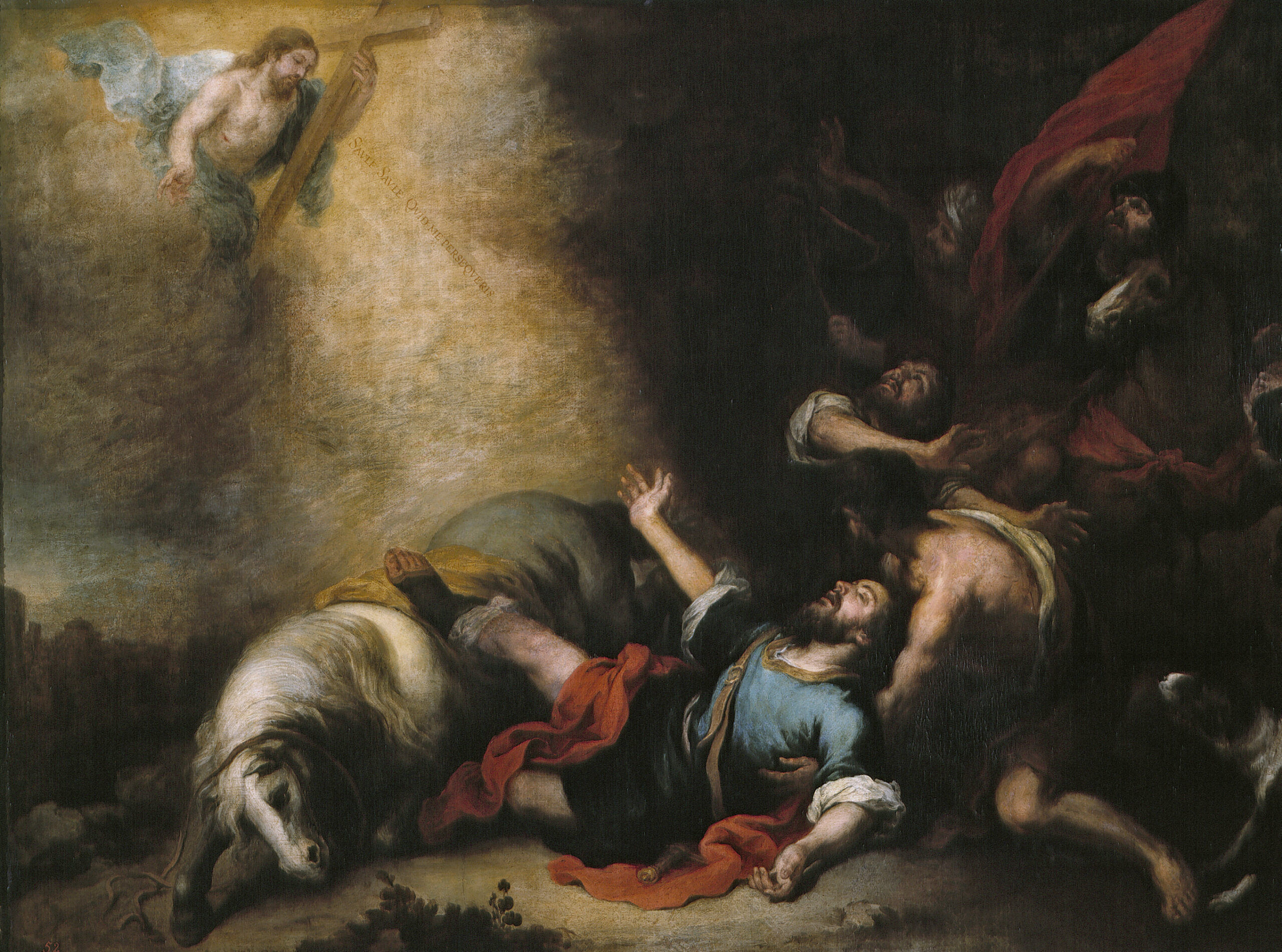

St. Luke opens Chapter 9 of the Acts of the Apostles, describing Saul as “still breathing murderous threats against the disciples of the Lord.” He has intensified his campaign against the followers of “the Way” even into Damascus.
What meets him on the road is not punishment but an extraordinary manifestation of the actual grace of God. A light from the sky suddenly flashes around him, and from that light comes a voice of gentle reproach: “Saul, Saul, why are you persecuting me?”
The identification of Christ with his members is so complete that injury to them is injury to him. St. Bede comments: “He did not say, ‘Why do you persecute my members?’ but ‘Why do you persecute me?’ Because he is still suffering from enemies in his body, which is the Church.”
Saul rises from the ground, led by the hands of his companions, unable to see. The man who came to bind others is himself bound by blindness. For three days, he neither eats nor drinks. St. Bede writes: “Since he had not believed that the Lord had conquered death by rising on the third day, he was now taught by his own experience of the replacement of three days of darkness by the return of the light.”
Father William Kurz, S. J., points out that fasting, “a traditional sign of penitence, is Saul’s instinctive response to his encounter with the Lord and a preparation for his baptism and further enlightenment.”
God appears to a disciple in Damascus named Ananias and entrusts to him the task of healing and baptizing Saul. St. John Cassian sees in God’s choice of the obscure Ananias a deliberate pedagogy of humility: God entrusted Saul to an elder so that he would be instructed by human teaching rather than by private revelation alone, lest each disciple conclude that he needed no guidance but his own spiritual experience.
When Ananias enters the house and calls him, “Brother Saul”. One who had come with threats is received with a fraternal embrace. Saul’s proclamation after receiving healing and baptism is immediate and total. He does not merely announce that Jesus rose; he preaches that this Jesus “is the Son of God.”
In Jerusalem, Barnabas brings Saul to the apostles and plays the same role here that Ananias played in Damascus: the human bridge across which grace passes. St. John Chrysostom says, “God does in many things leave them to manage for themselves by their own wisdom and in a human way, so to cut off the excuse of idle people.”
After Luke’s summary of the Church at peace, he turns to Peter’s apostolic journeys through Judea. St. John Chrysostom describes him as acting “like a general going around inspecting the ranks — which part was well-trained, which in good order and which needed his presence.”
In Lydda, Peter finds a man named Aeneas who had been bedridden for eight years. St. Bede sees in this a symbol of the whole human condition: “This Aeneas signifies the ailing human race, at first weakened by pleasure but healed by the work and words of the apostles.”
Peter says, “Aeneas, Jesus Christ heals you; rise and make your bed.” St. Bede comments: “Whoever has received into his heart the firm foundation of faith will not only shake off the torpor in which he has been lying idle but will also produce the good works in which he will be able to rest after his toil.”
This miracle awakens faith, and another greater miracle awaits in Joppa for the comfort of believers. A woman disciple named Tabitha — Dorcas in Greek, meaning “gazelle” — has died. Luke tells us she was full of good works and almsgiving. St. John Chrysostom comments: “It was not without purpose that the writer informed us of the woman’s name, but to show that her character matched her name — she was active and wakeful as a gazelle.”
When Tabitha dies, the widows gather in grief. They bring the tunics and cloaks she had made for them — a silent intercession more eloquent than words. Her works became her prayer. Peter arrives, sends everyone out, kneels, prays, commends, and raises her up.
Peter remains in Joppa with Simon, a tanner — a trade regarded by observant Jews as ritually unclean. The Navarre Bible notes that Peter’s stay with Simon signals that “the freedom of the Gospel takes over” from the old prohibitions. St. John Chrysostom draws the pastoral lesson: “Look at Peter’s unassuming conduct, look at his moderation, how he does not stay with someone of prominence but with a tanner. By all his actions he leads people to humility.”
Your voice matters! Join the conversation by submitting a Letter to the Editor here.
被摔倒卻被高舉
聖路加在宗徒大事錄第9章開端描述掃祿時說,他「還是向主的門徒口吐恐嚇和兇殺之氣」。他不但沒有停止,反而加劇迫害「這道門」的人,甚至追到大馬士革。
然而,在路上迎接他的不是懲罰,而是天主實際恩寵的非凡彰顯。從天上有一道光,環射到他身上,並從光中傳來一個帶著溫柔責備的聲音:「掃祿,掃祿,你為什麼迫害我?」
基督與祂肢體的結合是如此完全,以致於傷害祂的門徒,就是傷害祂本人。聖伯達評論說:「祂沒有說:『你為什麼迫害我的肢體?』而是說:『你為什麼迫害我?』因為祂仍在祂的身體—即教會—內,仍然因敵人的攻擊而受苦。」
掃祿從地上起來,因為他已看不見,由同伴牽著手前行。那位原本要捆綁別人的人,如今自己被失明所捆綁。他三天不吃不喝。聖伯達寫道:「因為他不相信主在第三天從死者中復活,如今他藉著自己三天的黑暗後重見光明的經驗,親身受教。」
威廉克爾茲神父(耶穌會)指出,禁食作為「傳統的補贖記號」,正是掃祿與主相遇後的本能回應,也是他準備領洗與進一步受啟蒙的方式。
天主向大馬士革的一位門徒阿納尼雅顯現,並託付他治癒與為掃祿施洗的使命。聖若望格西安看見天主在此所安排的謙遜教育:天主把掃祿交給一位無名的長者,使他藉著人的教導受訓,而不是只依靠私人啟示,免得每位門徒都以為只需依靠自己的神修經驗,不需他人指引。
當阿納尼雅進入屋內呼喚他:「掃祿弟兄。」那位帶著威脅而來的人,竟被以兄弟之情接納。掃祿在治癒與領洗後的宣講,是立即而徹底的。他不僅宣講耶穌復活,更宣講這位耶穌「是天主子」。
在耶路撒冷,巴爾納伯帶掃祿去見宗徒們,扮演了與阿納尼雅相同的角色:成為恩寵通行的人橋。金口聖若望說:「天主在許多事上讓他們按自己的智慧、以人的方式行事,好堵住懶惰者的藉口。」
路加在總結當地教會的平安後,轉向伯多祿在猶太地的宗徒旅程。金口聖若望描述他「如同一位將軍巡視軍隊—哪一部分訓練良好,哪一部分秩序井然,哪一部分需要他的臨在。」
在里達,伯多祿遇見一位名叫艾乃阿的人,已癱瘓臥床八年。聖伯達視此為整個人類處境的象徵:「這位艾乃阿代表病弱的人類,起初因享樂而衰弱,但藉著宗徒的工作與言語而獲得治癒。」
伯多祿說:「艾乃阿!耶穌基督治好你了;起來,整理你的床褥罷!」聖伯達評論:「凡在心中接受堅固信德基礎的人,不僅會甩掉長久的怠惰,也會結出善工,使他在勞苦後能在其中安息。」
這奇蹟喚醒了信德,而在約培還有更大的奇蹟等待著,為安慰信友。一位名叫塔彼達的女門徒—希臘文叫作多爾卡,意為「羚羊」—已經去世。路加告訴我們,她多行善事,廣施賙濟。金口聖若望評論:「作者提及她的名字並非無意,而是要顯示她的性格與名字相符—如羚羊般勤快、警醒。」
塔彼達死後,寡婦們聚集哀哭,拿出多爾卡同她們在一起的時候為她們所製的內外衣,指給伯多祿看。這些內外衣如無聲的代禱卻更有說服力。塔彼達的善工成了她的祈禱。伯多祿叫眾人都退到外面以後,遂屈膝祈禱,然後命令塔彼達起來,並扶她站起。
伯多祿留在約培,住在一位名叫西滿的皮匠家中—這行業在虔誠的猶太人眼中被視為不潔。納瓦爾聖經註解指出,伯多祿住在西滿家中象徵「福音的自由已取代舊有的禁令」。金口聖若望提出牧靈教訓:「看伯多祿的謙遜行為,看他的節度,他不住在顯赫的人家中,而住在皮匠家中。他以自己的行動引導人走向謙遜。
Your voice matters! Join the conversation by submitting a Letter to the Editor here.







