

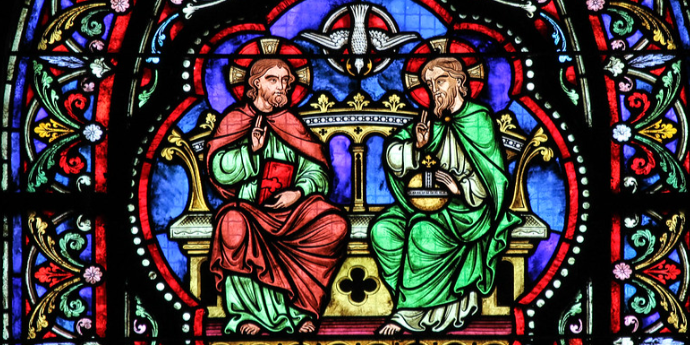

Trinity Sunday, Year A
First Reading: Ex 34:4b-6, 8-9
Second Reading: 2 Cor 13:11-13
Gospel Reading: Jn 3:16-18
By reason alone, we can know God with certainty as the author of the moral laws written in our hearts and the creator who controls the world.
However, God has revealed truths about himself that we could never discover on our own. We celebrate one of them this Sunday: the “mystery” of the Holy Trinity.
In Greek, the Bible calls such a truth a mysterion. It means “something closed” or “secret.” The mysteria are the sacred secrets revealed only to baptized believers. (At one time, only they were allowed to attend Mass.)
“Mysterion was translated into Latin by two terms,” says the Catechism of the Catholic Church: mysterium (in English, “mystery”) to emphasize a “hidden reality of salvation” and sacramentum (in English, “sacrament”) to emphasize its visible sacramental sign. In fact, Mass and the Sacraments are often called the “sacred mysteries.”
In its ordinary sense, “mystery” means either “something difficult or impossible to understand, explain, or identify,” or “something deliberately enigmatic,” having “an atmosphere of strangeness or secrecy” — like Gnosticism, a heretical “mystery cult.”
In its Christian sense, “mystery” transcends that ordinary meaning, for a Christian “mystery” is incomprehensible but not unintelligible. For example, St. Paul asked for prayers that he might “courageously make known the mysterion of the Gospel” — “hidden for many ages but now manifested.”
We cannot, then, excuse our ignorance or lack of understanding of the Holy Trinity on the grounds that “it’s a mystery!”
There is a legend — nothing more — that St. Augustine saw a child with a seashell trying to empty the sea into a hole in the sand. When he exclaimed, “That is impossible!” the child replied, “No more than for a finite mind to contain the infinite.”
First published in 1483 (over 1,000 years after Augustine’s death), this story has deterred many people from even thinking about the Trinity — which the Catechism calls “the central mystery of Christian faith and life,” the “most fundamental and essential” of all spiritual truths, “the source” of all the others and “the light that enlightens them.”
Quoting Augustine — “I believe, in order to understand, and I understand, the better to believe” — the Catechism explains that “a believer desires to know better the one in whom he has put his faith and to understand better what he has revealed; a more penetrating knowledge will in turn call forth a greater faith.”
Let us, then, as Augustine did in his De Trinitate (available online), meditate on the Trinity.
We may summarize what the Church teaches about this great truth as follows.
The Three are One. There is only one God, not three. “The Father is that which the Son is, the Son that which the Father is, the Father and the Son that which the Holy Spirit is: that is, by nature one God.” They do not share the divinity: “each of the Persons is that supreme reality,” knowing with the one mind and loving with the one will.
The Unity is Three. “Father,” “Son,” and “Holy Spirit” are not different modes of divinity: they are three distinct Persons. “He is not the Father who is the Son, nor is the Son he who is the Father, nor is the Holy Spirit he who is the Father or the Son.”
The divine Persons are distinct in their relations of origin: “It is the Father who generates,” or begets, the Son, “the Son who is begotten” by the Father, “and the Holy Spirit who proceeds” from the Father and the Son. In their names, then, “the Father is related to the Son, the Son to the Father, and the Holy Spirit to both.”
Does all this really matter?
Yes — more than anything in this world — for “at the heart” of God’s creation is his “desire to make room for created persons in the communion of the uncreated Persons” of the Trinity.
That is the happiness he made us for.
Father Hawkswell has now finished teaching The Catholic Faith in Plain English. The whole course is available on YouTube in both written and audio form at beholdvancouver.org/catholic-faith-course, and will remain available until the end of August. Father will teach the whole course again, with new insights, starting Aug. 24.
Your voice matters! Join the conversation by submitting a Letter to the Editor here.







