


Ascension Sunday, Year A
First Reading: Acts 1:1-11
Second Reading: Eph 1:17-23
Gospel Reading: Mt 28:16-20
In “the paschal mystery,” the Catechism of the Catholic Church includes Christ’s “passion, crucifixion, death, burial, descent into hell, resurrection, and ascension.”
In her four eucharistic prayers, the Church says that in the Mass, “we celebrate the memorial”—in Hebrew, zikaron, in Greek, anamnesis—of Christ’s “passion,” his “resurrection from the dead,” and his “glorious ascension into heaven”; his “saving passion,” his “wondrous resurrection,” and his “ascension into heaven”; his “death and his descent to the realm of the dead,” as well as “his resurrection and his ascension” to God the Father’s right hand.
(The Mass is not just the recollection, memorial, or commemoration of what Pope Francis called Christ’s “paschal deed,” but its zikaron or anamnesis—its re-presentation or re-actualisation—for the Church’s liturgy makes it “in a certain way present and real,” says the Catechism.)
In his Desiderio Desideravi—the words with which Christ began his last supper—Pope Francis said that baptism is neither “mental adhesion” to Christ’s thought nor agreement with his “code of conduct,” but rather a “being plunged into his passion, death, resurrection, and ascension”: his “paschal deed.”
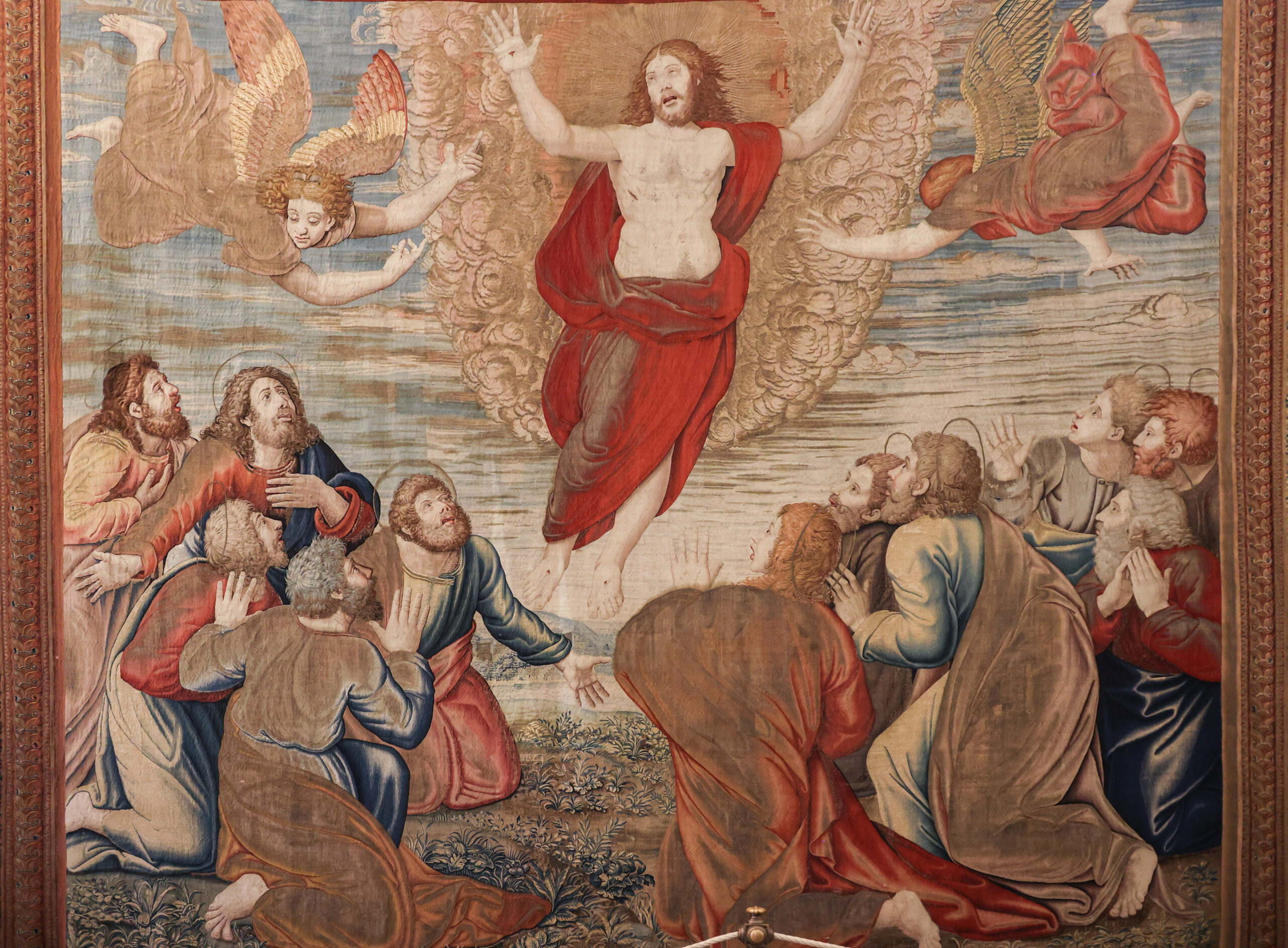
Christ’s ascension, then, is not merely his withdrawal from this world, but an essential part of the “paschal deed” by which he redeemed us.
We are familiar with the idea that in his new Passover—his last supper and crucifixion—Christ was both victim and priest, offering himself to his Father on earth as he does in heaven.
However, we may be less familiar with what Frank Sheed says in his book To Know Jesus Christ: that “with the resurrection, God showed that he had accepted the sacrifice by glorifying the victim,” but that “with the ascension,” he “showed that he had accepted the victim.”
In the symbolic sacrifices of the Old Testament, there had seldom been any question of God’s acceptance of the victims, Sheed notes. “What could God do with a roasted bull or a slaughtered goat?” They were slain only to renounce their use by humans: to show that they, like all created things, belonged to God.
Occasionally, it is true, God had showed his acceptance of the victim by sending down “fire from heaven” to consume it, like the bulls Solomon offered at the dedication of his temple, or those Elijah offered when he challenged the priests of Baal.
However, in his “paschal deed,” Christ offered a real, not a symbolic, sacrifice: that which the old sacrifices had foreshadowed. The one priest offered to God, as victim, the man whom he himself was. God accepted the victim, glorified him in the resurrection, and expressed his acceptance visibly in the ascension.
The Catechism quotes Christ’s “mysterious words” to Mary Magdalene on Easter Sunday morning: “I have not yet ascended to the Father; but go to my brethren and say to them, I am ascending to my Father and your Father, to my God and your God.”
These words, the Catechism says, indicate “a difference in manifestation between the glory of the risen Christ and that of the Christ exalted to the Father’s right hand, a transition marked by the historical and transcendent event of the ascension.”
In fact, Christ had indicated the importance of his ascension at the last supper. “It is much better for you that I go,” he had said. “If I fail to go, the Paraclete will never come to you, whereas if I go, I will send him to you.”
On Pentecost Sunday, when the Holy Spirit descended on the apostles, Peter told the crowds that Jesus, “exalted at God’s right hand,” had “first received the promised Holy Spirit from the Father, then poured this Spirit out on us.”
At his ascension, as perfect man, Jesus took humanity to the very heart of the Trinity. There, as a man—one of us—he received the Holy Spirit, whom he bestowed on his apostles just 10 days later.
Father Hawkswell is again teaching The Catholic Faith in Plain English with new insights, in print and YouTube form at beholdvancouver.org/catholic-faith-course. He is also teaching the course in person on Sundays (2–4 p.m. at the John Paul II Pastoral Centre, 4885 Saint John Paul II Way, 33rd Avenue and Willow Street, Vancouver) and Mondays (10 a.m.–noon in St. Anthony’s Church Hall, 2347 Inglewood Avenue, West Vancouver). The title of next week’s talk is The Beatitudes.
Your voice matters! Join the conversation by submitting a Letter to the Editor here.







