

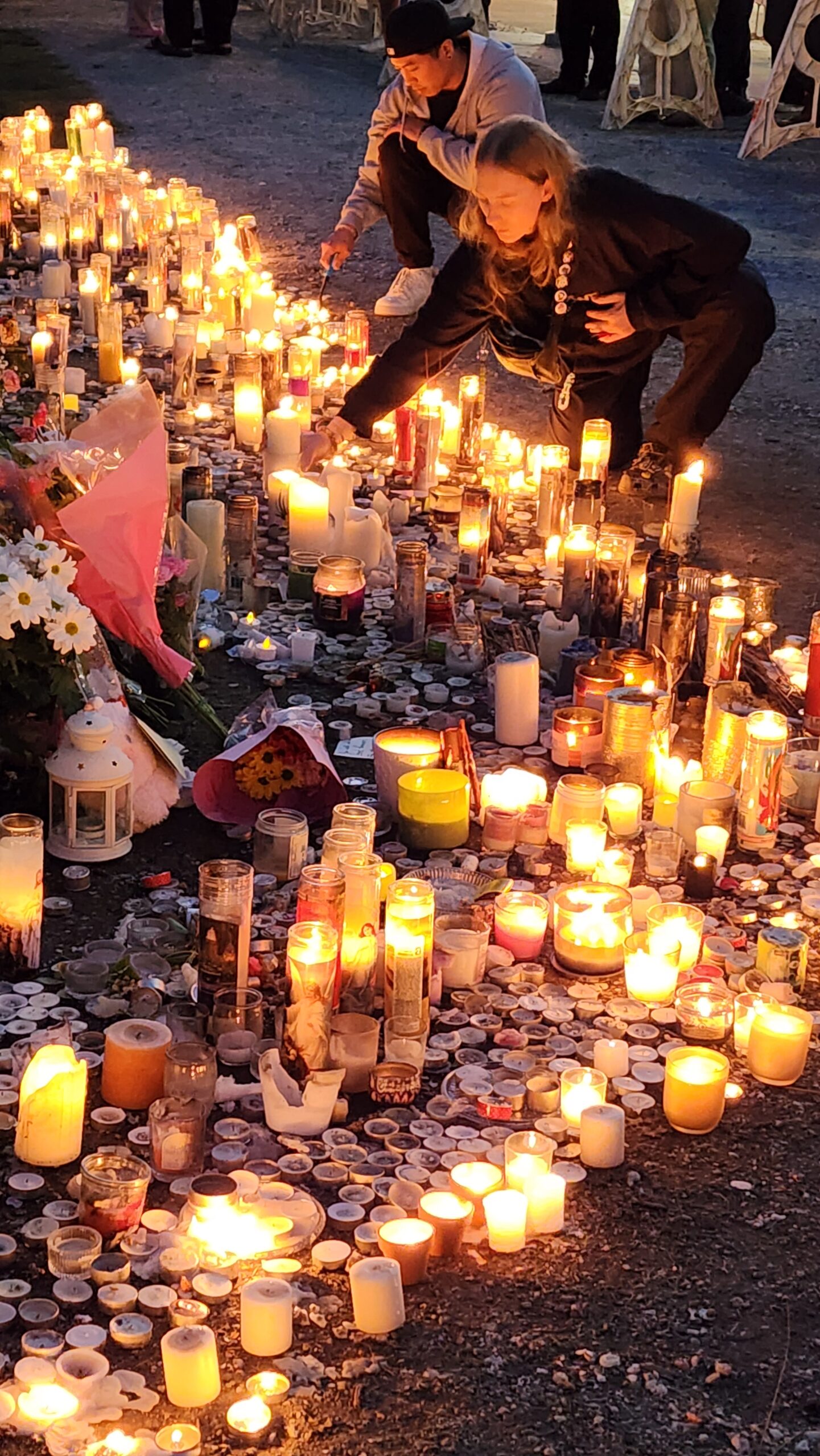

This is a homily to be delivered by Father Gabriel de Chadarevian, OP, at a Tagalog memorial Mass at St. Mary’s Church in Vancouver on April 26, the one-year anniversary of the Lapu-Lapu Festival tragedy.
My dear brothers and sisters, mga minamahal kong kapatid,
Today is Good Shepherd Sunday. Linggo ng Mabuting Pastol. And today we stand at a very sacred moment.
One year ago, our city was shaken by tragedy at the Lapu-Lapu Festival. Eleven lives lost. Many injured. A whole community wounded.
And today, in the Filipino tradition, we mark babang luksa, the end of mourning. We lay aside the dark clothes. We step again into the colours of life.
But let us begin here, clearly, lovingly, as a Church: This Holy Mass is offered for the repose of the souls of the 11 people who died, and for all those who were injured, and for all families and survivors still carrying pain.
(Pause)
Let us pray:
Assembly: Panginoon, kaawaan Mo po sila.
Lord, have mercy on them.
We entrust them to the Good Shepherd.
But let us be honest: the heart does not change colors so quickly. Some wounds are still there. Some memories still hurt. Some questions remain. May mga sugat pa… there are still wounds. And into this very moment, the Word of God speaks.
Jesus says in the Gospel: “I am the Good Shepherd… I came that they may have life, and have it abundantly.” (John 10:10)
Hindi lang buhay kundi buhay na ganap. Not just life but life to the full.
But how can we speak of abundant life after so much loss?
Listen to the voice of one of our own, a member of this parish, a social worker at Vancouver General Hospital.
She said: “That night, I stepped into trauma, fear, and uncertainty…
Families were searching for loved ones.
Sometimes all we could offer was our presence.
I stood with people in their grief.
At one point, I had to step away to cry and to pray.
My faith carried me.”
Brothers and sisters,
This is what the Good Shepherd looks like.
Hindi lang si Hesus kundi si Hesus na buhay sa Kanyang bayan — Not only Jesus but Jesus alive in His people.
When someone sits with you in your pain… When someone holds your hand… When someone stays… Kasama kita — “I am with you.” That is the Shepherd at work.
In the First Reading from Acts, Peter stands up and proclaims: “Repent… and you will receive the gift of the Holy Spirit.”
And the people were “cut to the heart.” Tinamaan ang puso. The heart was struck.
Mga kapatid, we too were cut to the heart. That night cut through everything.
But listen carefully: A heart that is cut is also a heart that can be opened. Bukas na puso — an open heart. Opened to God. Opened to one another. Opened to healing.
And then we prayed: “The Lord is my shepherd; I shall not want…” Ang Panginoon ang aking pastol, hindi ako magkukulang
Even though I walk through the valley… Dumaraan tayo sa dilim — We pass through darkness.
The Filipino community has walked through a valley this past year. But you did not walk alone. Hindi ka nag-iisa — You are not alone.
And in the Second Reading: “By his wounds you have been healed.” Sa kanyang sugat, tayo ay gumaling — Through wounds comes healing.
Today, at babang luksa, we do something very important.
We do not forget. Hindi natin nakakalimutan — We transform.
We take mourning and entrust it to the Good Shepherd.
We take pain and place it into His wounds.
My dear Filipino brothers and sisters, Minamahal kong mga kapatid, My beloved brothers and sisters… You have shown something beautiful.
Your faith. Your resilience. Your love for life. Matibay ang pananampalataya — Your faith is strong.
You cried… but you kept praying. You suffered… but you kept loving. This is the Holy Spirit.
But today, the Gospel challenges us.
There are thieves. The thief of fear — takot. The thief of anger — galit. The thief of despair — kawalan ng pag-asa.
But the Good Shepherd says: Huwag kang matakot — “Do not be afraid.” “I have come that you may have life.”
So today, on this babang luksa, we make a choice.
To live again. Muling mabuhay. To hope again. Magtiwala muli. To trust again.
And where does this happen most powerfully? Here. At the Eucharist.
Because here, Jesus gives Himself. Pagkain ng kaluluwa. Food for the soul.
And in receiving Him, our hearts begin to heal.
So today, I invite you: Bring everything. Ialay natin sa Diyos — Let us offer it to God.
And listen: The Good Shepherd is calling your name.
And maybe today you can take a small step. Isang maliit na hakbang — One small step…
Out of mourning into life.
Because the Shepherd is not finished.
He is still healing. Patuloy Siyang nagpapagaling — He continues to heal.
And one day He will wipe away every tear. Papahirin Niya ang bawat luha
Sa ngalan ng Ama at ng Anak at ng Espiritu Santo.
Amen.
Gina Saculsan is a St. Mary’s parishioner and a social worker at Vancouver General Hospital. She wrote the following account of what she experienced the night of the Lapu-Lapu tragedy.
As I sit down to write this email, I still feel a chill. Memories of the night of the Lapu-Lapu tragedy come rushing back—what I felt, what I witnessed firsthand, and what I was called to do. Even now, it is not easy to put into words.
I am a social worker in the emergency department at Vancouver General Hospital. At the time of the tragedy, I was off duty. My daughter, who is a nurse at VGH and working that night, called me to come in to support the two social workers on shift. She told me that a Code Orange had been declared. I remember realizing that stepping into the hospital that night meant stepping directly into the intersection of trauma, fear, and uncertainty.
As a Filipino, my heart is deeply rooted in helping my fellow Filipinos. That night, this calling felt even more personal. I was responding not only as a health-care professional, but also as part of a grieving community.
That night in the emergency department was unlike any other. There was urgency everywhere, but also a deep sense of humanity. Families were searching for loved ones, uncertainty filled the air, and sometimes all we could offer was our presence and compassion.
As social workers, we often work quietly in the background, but in those moments, we were doing some of the most deeply human work—grounding families, helping children feel safe, searching for missing loved ones, collaborating with the Vancouver Police, working alongside social workers from other hospitals, assisting in identifying unknown patients, and sitting with people in shock, holding space when nothing yet made sense.
I remember standing with people in their fear and grief, not always having answers, but doing my best simply to be there.
One moment that has stayed with me was identifying a patient through his wedding ring. I gently asked his wife if she recognized it. When she confirmed it, I accompanied her to the ICU so she would not be alone as she faced that heartbreaking reality. I remained with her and another family member at the bedside, offering support during one of the most difficult moments of her life.
At one point, the emotional weight became too much to carry. I stepped into my office and allowed myself to cry and to pray to God for strength. It was a deeply human moment amid overwhelming circumstances—an acknowledgement of the pain, grief, and magnitude of what we were witnessing. After that moment, I gathered myself and returned, continuing to be present for others.
There is something uniquely heavy about responding to a tragedy tied to a community celebration. It is not only about physical injuries; it is about collective grief. It shakes a sense of safety, belonging, and identity, especially in a city like Vancouver, where communities are closely connected. That made the experience even more profound.
Despite everything, I felt a quiet strength within me. My faith carried me through those moments, helping me remain grounded and continue showing up for others, even when the emotional weight felt overwhelming.
Writing this now reminds me not only of the pain of that night, but also of the grace of God that sustained me through it. For that, I am deeply grateful.
Your voice matters! Join the conversation by submitting a Letter to the Editor here.







