

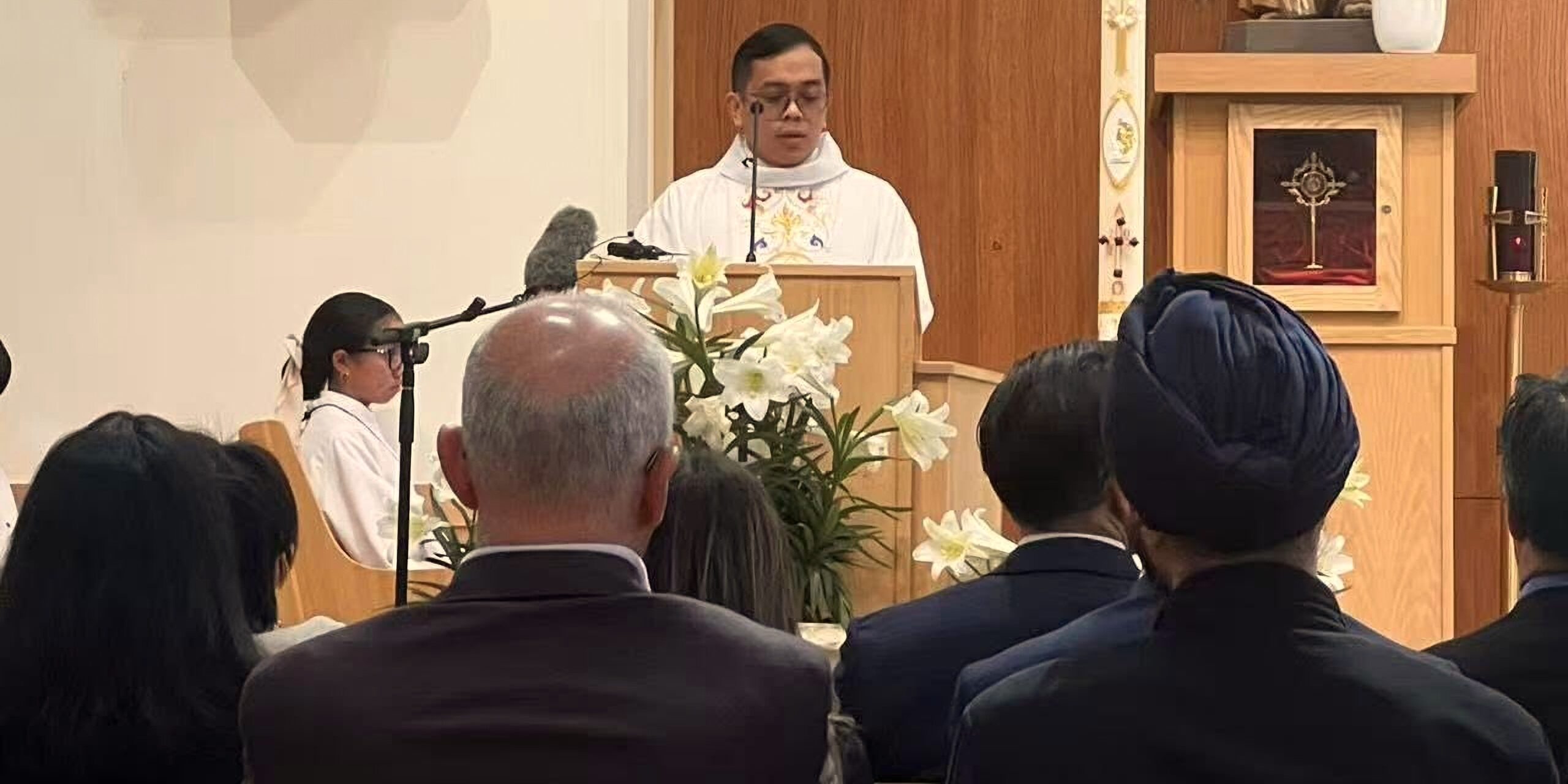

Father Vicente Miguel, Jr., delivered the homily at the Lapu-Lapu Memorial Mass at St. Andrew’s Church, Vancouver. He spoke to the community’s recent experience through themes of quiet hope, healing, and the Filipino concept of bayanihan—communal unity and mutual help—as both a cultural and Catholic Christian expression of unity.
“This is the day the Lord has made; let us rejoice and be glad.”
We proclaimed this as our Gospel Acclamation. But today, we hear it differently.
Because not every rejoicing is loud. Not every joy is expressed with smiles and laughter.
Sometimes, rejoicing is quiet.
Sometimes, rejoicing is simply this: to gather, to remember, to pray, and to trust God—even when our hearts are still healing.
So today, as a community, we come together.
Not because everything is already clear, nor because everything is already easy, but because we believe: this is still the day the Lord has made.
And in this day, we bring everything to him—our prayers, our memories, especially our loved ones, even our questions, even the parts of our hearts that are still heavy.
This morning, I went to the memorial site at Mountain View Cemetery. Before I reached it, I passed by the street where the incident happened.
As I walked through that place, some of the news I had read, some images, some stories—they came back to me. Not loudly, but quietly, like memories that remain.
But I continued my walk, step by step, toward the site, slowly and quietly, offering each step with a prayer.
And as I was walking, I told myself: I will be there as a Filipino and as a priest, as someone who wanted to pray and to be present.
When I finally reached the memorial, I saw the flowers, stuffed toys, and so many things. I saw handwritten notes—messages, many of them written with tears behind the words.
What struck me most was this: the messages came from different people—different nationalities, cultures, and languages.
Not everyone was Filipino, but many came. Many stood. Many remembered.
And as I stood there quietly, I felt something difficult to explain.
Yes, there was pain. There was sadness. There was a heaviness in the air.
But at the same time, there was also something else.
There was love. There was presence. There was a quiet kind of unity.
People came not because they had to, but because they chose to stand with others.
They did not come with answers. They came simply to be there.
And in that moment, one word came to my heart: bayanihan.
For us Filipinos, bayanihan is something very familiar. It is when neighbours help one another, when people come together to carry a burden, when no one is left alone.
Traditionally, we imagine it as people carrying a house made of bamboo. But in reality, bayanihan is deeper than that. It is not just carrying something physical—it is carrying one another, especially in moments of difficulty.
As I reflected on what had happened, I came across a line I read on the internet that said: “Let’s gather in the spirit of bayanihan… to lift each other up… to reflect on shared healing… and to honour culture and community with care.”
And I realized something: bayanihan is not only cultural. It is also deeply Catholic and Christian.
Because when we listen carefully to today’s Gospel, we see the same spirit.
The disciples are by the Sea of Tiberias, and they are fishing.
At first, it seems like a normal scene. But if we look deeper, this is not just fishing. This is something more.
These are disciples who have gone through so much. They followed Jesus. They believed in him. They hoped in him. And then they saw him suffer and die on the cross.
Yes, they have already heard that he is risen. Yes, Easter has already happened. Christ is alive.
But still, something inside them is not yet settled. There is confusion, uncertainty, and a kind of emptiness.
So what do they do? They return to something familiar. They go back to fishing—to their ordinary life, their routine, what they know.
And perhaps this is not a bad thing.
Because after difficult moments, just like us, we try to move forward. We continue life—not forgetting what has happened, but entrusting everything to God.
Because that is what Easter gives us.
Not instant answers, but a promise: that life continues, that hope is still possible, that God is still working, and that even in broken moments, God can begin again.
And yet, even as we move forward, something can still feel incomplete. That is normal. That is human.
As the Gospel says very simply: “They caught nothing.”
All night—working, trying, hoping for a catch—but nothing.
That line is simple, but it speaks deeply to the human heart.
Because there are moments in life when we continue, when we try our best, but inside there is still emptiness.
Then, early in the morning, something begins to change.
“Jesus stood on the shore.”
Not far. Not absent. Already there.
This is the quiet hope of Easter: even before we recognize him, Jesus is already near.
The disciples did not recognize him immediately, but that does not mean he was not present.
And in the same way, even in moments when we are still healing, even in moments when we do not fully understand, God is gently present.
Jesus asks them, “Children, have you caught anything to eat?”
They answer honestly: “No.”
And then he tells them, “Cast the net on the right side of the boat, and you will find something.”
It is a simple instruction, yet it requires trust.
They are experienced fishermen. They have been working all night. They are tired.
And yet they listen. They follow.
And when they do, everything changes. The net becomes full, overflowing.
And in that moment, something begins to open in their hearts.
Then they recognize him: “It is the Lord.”
Recognition did not come first. Trust came first. And then, slowly, recognition followed.
When they reach the shore, Jesus has already prepared something.
There is a charcoal fire. There is bread and fish.
He did not wait for them to complete everything. He was already preparing for them.
And he invites them: “Come and have breakfast.”
After a long night, after emptiness and confusion, Jesus does not begin with explanation.
He begins with presence. He begins with a meal.
He gathers them. He feeds them. He stays with them.
This is where the Gospel meets our life today.
In the Eucharist, we are gathered by the risen Lord, who offers himself to us as our true food. Here, Jesus does not only speak—he gives himself.
What we have seen in the past year, what we have experienced, is also a kind of gathering.
People coming together—not to fix everything, not to explain everything, but to be present, to remember, and to stand together.
That is bayanihan. And that is also how the risen Jesus heals us.
He does not always remove pain immediately. But he enters into it. He stays. And he gathers his people.
Mga kapatid, hindi tayo nag‑iisa. We are not alone.
At kahit sa gitna ng lungkot, may Diyos na buhay at kasama natin. God is alive, and he is with us.
As we remember our brothers and sisters, our kababayan, the victims and their families, we entrust them to the mercy of God and carry them in our hearts.
And God reminds us: healing does not happen alone. Healing happens together.
When we show up. When we listen. When we stay. When we care.
That is bayanihan. And that is also the Gospel.
Because the risen Jesus is still doing the same thing today.
He stands on the shore of our lives. He calls us. He guides us. He prepares a table.
And he invites us: “Come and eat.”
So let us come to him—even if we are tired, even if we are still trying to understand, even if our hearts are still carrying something.
Because in his presence, something begins to change within us.
A little more peace. A little more strength. A little more hope.
And that is already the gift of Easter: a quiet renewal of the heart, a gentle beginning of healing, a living hope that God is still at work within us.
As we move forward as a community, may we continue to pray for one another, to be present to one another, and to choose love together, just as Christ has loved us.
Because when we do that, we become part of God’s healing. We become part of his Resurrection.
May Mary, our Mother who gathers her children in times of sorrow, teach us to stay close to Jesus, to care for one another with love, and to walk together in hope and healing.
Amen.
Your voice matters! Join the conversation by submitting a Letter to the Editor here.







