


Easter Sunday, Year A
First Reading: Acts 10:34a, 36-43
Second Reading: Col 3:1-4
Gospel Reading: Jn 20:1-18
This Sunday we celebrate Christ’s Resurrection—which makes Christianity different from any other religion.
The Resurrection “is the crowning truth of our faith in Christ,” says the Catechism of the Catholic Church: a truth “believed and lived as the central truth by the first Christian community, handed on as fundamental by Tradition, established by the documents of the New Testament, and preached as an essential part of the Paschal mystery along with the cross.”
In his crucifixion, on Friday, God the Son allowed death to separate his human soul from his human body and put an end to his earthly human existence. His body lay in the tomb all day Saturday. However, early on Sunday morning, three women went there. They found the stone which had sealed the tomb rolled back and the tomb itself empty.
Even when Jesus’ body and soul had been separated, his body, like his soul, had remained united to the Person of God the Son, says the Catechism, and so his corpse did not decay.
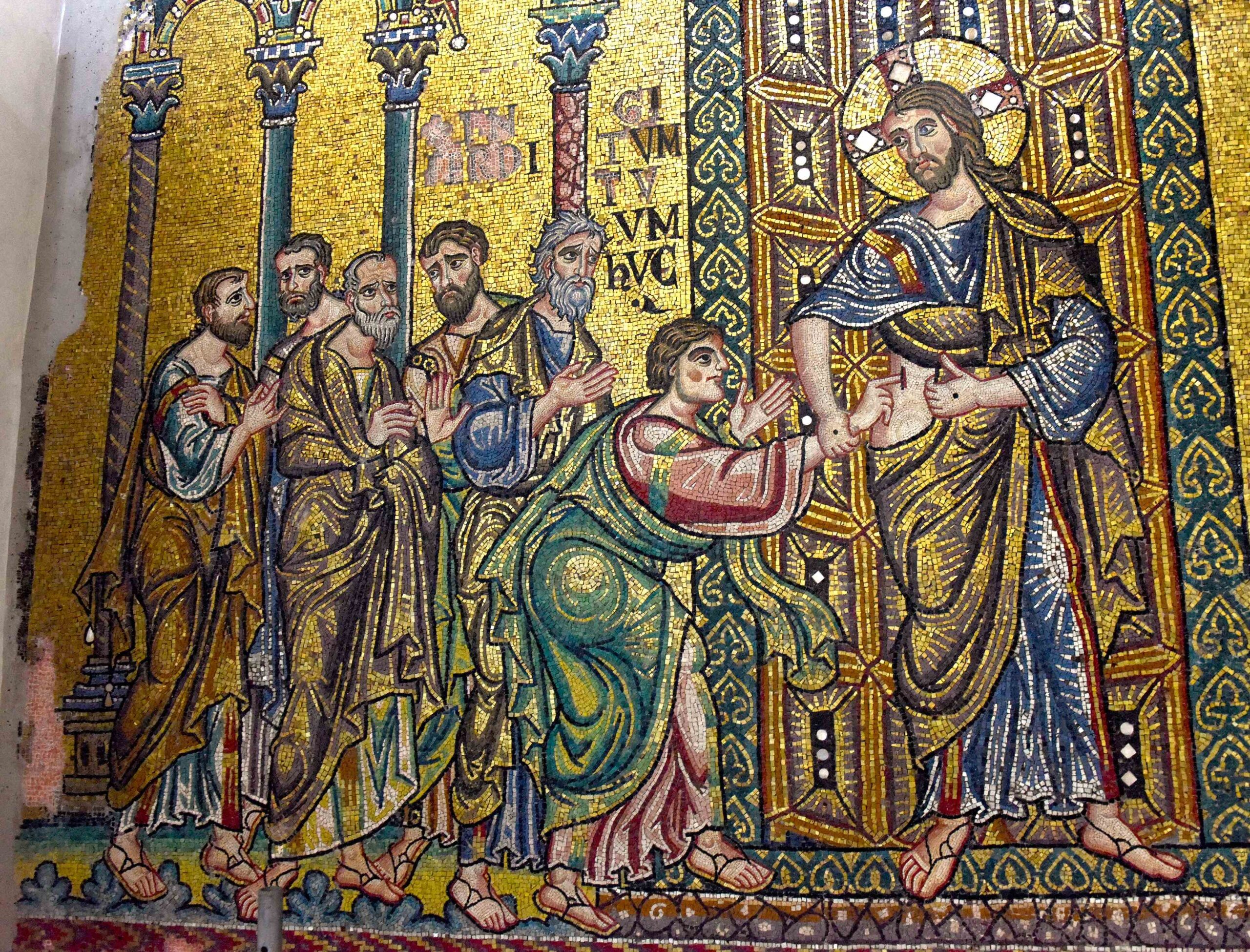
By eating with his disciples and letting them touch him, the risen Jesus convinced them that he was not a ghost and that his risen body was the very body that had been tortured and crucified.
However, his body possessed the new characteristics of a glorious body: not limited by space and time but able to be present how and when he willed. His humanity could no longer be confined to earth, but belonged henceforth to the realm of heaven.
In his resurrection, Jesus did not return to earthly life, like the people he himself had raised from the dead. His risen body is essentially different, filled with the power of the Holy Spirit and sharing God’s life in all its glory, so that St. Paul calls him “the Man of Heaven.”
Now, by becoming a member of Christ’s Mystical Body through baptism and the Eucharist, we can unite ourselves to him and, like him, rise from the dead, to live forever with God in heaven in utter happiness.
That is what differentiates Christianity from all the other religions of the world.
However, like Christ, we must first submit to death. “Was it not necessary that the Messiah should suffer these things and then enter into his glory?” Jesus said to the disciples on the road to Emmaus.
Death entered human history as a consequence of Adam and Eve’s rebellion against God. In his crucifixion, Christ accepted that consequence in complete and free submission to his Father’s will. By his obedience, he undid Adam’s rebellion and made death, the punishment for that rebellion, an instance of that free submission to God which Adam had refused, thus transforming the curse of death into a blessing.
Now, through the sacraments, Christ’s Church offers us the possibility of being made partners in his death and resurrection.
“His death is life for all,” said St. Ambrose. That is why “we are sealed with the sign of his death; when we pray we preach his death; when we offer sacrifice we proclaim his death. His death is victory; [the instrument of] his death is a sacred sign; each year his death is celebrated with solemnity by the whole world.”
By sharing in Christ’s death, we transform our own death into an act of obedience and love toward God the Father. Christian death, therefore, has a positive meaning. It is not just a punishment for our fallen condition, but also the medicine or the remedy. Welcomed with humility and self-renunciation, it undoes the original rebellion, which brought death as a consequence and merited death as a punishment.
“God did not decree death from the beginning,” St. Ambrose said; “He prescribed it as a remedy.” Accordingly, it is appropriate for a Christian to desire death. As St. Paul said, “To me, ‘life’ means Christ; hence dying is so much gain.”
What other religion can claim that?
Father Hawkswell is again teaching The Catholic Faith in Plain English with new insights, in print and YouTube form at beholdvancouver.org/catholic-faith-course. He is also teaching the course in person on Sundays (2–4 p.m. at the John Paul II Pastoral Centre, 4885 Saint John Paul II Way, 33rd Avenue and Willow Street, Vancouver) and Mondays (10 a.m.–noon in St. Anthony’s Church Hall, 2347 Inglewood Avenue, West Vancouver). The title of next week’s talk, on Easter Sunday, is Virtue.
Your voice matters! Join the conversation by submitting a Letter to the Editor here.







