


The liturgy of Holy Week is often described as a single, continuous prayer—one that begins with the “Hosannas” of Palm Sunday and does not truly conclude until the “Alleluia” of the Easter Vigil. To enter into these days is to step outside of ordinary time and into the “today” of our salvation.
In this special double-page feature, Father Vincent Hawkswell provides an exhaustive, close-up look at the history and liturgy of Christ’s Passion. Far more than a weekly homily, this is a deep dive into the “Paschal deed”—tracing the profound and often overlooked connections between the ancient Jewish Passover and the new, definitive Passover of the Mass.
From the “radical loneliness” of Gethsemane to the tearing of the Temple curtain, Father Hawkswell walks us through the scriptural roots of our sacramental signs. He reminds us that the Mass is not merely a remembrance of a past tragedy, but a “re-presentation” of a living victory. We invite you to keep this guide as a companion through the coming days, as we move from the Upper Room to the Cross, and finally, to the empty tomb.
Pasch (Exodus 12:1-14)
Holy Week is closely connected to the Jewish Pasch, which God ordained about 1300 BC, when the Israelites were slaves in Egypt.
Each household had to choose a flawless male lamb (or kid) on the 10th day of the month of Nisan; slaughter it “during the evening twilight” on the 14th; drain the body of blood, as in all sacrifices; roast it whole, without breaking any bones; eat it; and sprinkle its blood with a hyssop branch on the doorposts and lintel of the house where it was eaten.
That night, God killed the first-born in every Egyptian family, but “passed over” the homes marked by the blood, where lambs had been sacrificed instead. As a result, the Egyptians let the Israelites go.
“This day shall be a zikaron for you, which all your generations shall celebrate with pilgrimage to the Lord, as a perpetual institution,” God said.
Accordingly, the Jews celebrated Passover annually as a zikaron—a re-actualization—of the Pasch.
Freely (John 10:17-18, 11:1-54)
Shortly before His last Passover, Jesus raised Lazarus from the dead. The Jewish authorities had tried to suppress Jesus for some time—unsuccessfully, for “his hour had not yet come”—but after this, so many “put their faith in Him” that the authorities formed a plan “to kill Him.”
“In consequence,” Jesus “no longer moved about freely,” but withdrew to Ephraim, 20 kilometres northeast of Jerusalem, “where he stayed with His disciples.”
However, “six days” before Passover, he came back to Bethany, Lazarus’ village, less than three kilometres from Jerusalem. Lazarus’ sister Martha gave a banquet for him, at which their sister Mary anointed his feet with perfume—“against the day they prepare me for burial,” Jesus explained.
His “hour” was approaching. “I lay down my life to take it up again,” he said. “No one takes it from me; I lay it down freely.”
Hosanna! (Matthew 21:1-11)
Aware that the authorities were planning to arrest Jesus, the pilgrims in Jerusalem for the Passover watched for him, asking one another, “What do you think? Is he likely to come for the feast?” The day after Martha’s banquet, they heard that he was about to enter the city and went out to meet him.
Hitherto, Jesus had avoided attempts to make him king, but now, as he neared Jerusalem, he sent two disciples to bring him an ass and her colt. They “laid their cloaks on them, and he mounted,” and so entered Jerusalem, Judea’s capital.
Jesus was fulfilling a well known prophecy: “Shout for joy, O daughter Jerusalem! See, your king shall come to you; a just Saviour is he, meek, and riding on an ass, on a colt, the foal of an ass. He shall banish the chariot from Ephraim and the horse” (used by the Romans, symbol of conquerors) “from Jerusalem.”
Jesus also seemed to be fulfilling another prophecy. About 600 BC, Daniel had foretold that Judea would be subject in turn to Babylon, Persia, Greece, Rome, and then “the God of Heaven.” The first four had become history; now the Jews were expecting the Messiah—the hereditary King of Israel, descended from King David—to free them from Rome.
Accordingly, a “huge crowd” welcomed Jesus into Jerusalem, spreading cloaks and palm branches along his path, declaring that he was indeed the one coming “in the name of the Lord,” and shouting, “Son of David!” “King of Israel!” “Hosanna!” (“Save” us!) The whole city “was stirred to its depths.”
On Palm Sunday, the priest wears red instead of purple. Before Mass, he reminds us that Lent is nearing its end: Jesus’ “hour has come.” Then he blesses palm branches, which we hold while we listen to an account of Jesus’ entry into Jerusalem.
We, too, welcome Jesus as Lord, King, and Saviour, but we know that he comes to save us not from the Romans, but from Satan.
New temple (John 2:13-22)
After this, Jesus returned to Bethany, “where he spent the night.” During the next three days he came back to Jerusalem, openly teaching in the temple area and forcibly ejecting the merchants. When the authorities demanded a sign to authorize his violence, he replied, “Destroy this temple, and in three days I will raise it up.”
He meant “the temple of his body,” St. John explained. Fundamentally, said Pope Benedict, Jesus was attacking the temple worship itself. Accordingly, at his trial, he was accused of plotting to replace the temple with one “not made by human hands.”
From Monday to Wednesday in Holy Week, the Church celebrates Mass as usual, but on Holy Thursday, the only morning Mass is the Chrism Mass, at which diocesan priests renew their ordination promises and the bishop blesses the sacred oils.
Last Supper (1 Corinthians 11:23-26; John 13:1-15)
“Two days” before Passover, Jesus sent Peter and John to “go and prepare” their “Passover supper.”
“When the hour arrived”—“when it grew dark” on Thursday evening—Jesus took his place at table with his apostles, saying, “I have greatly desired to eat this Passover with you before I suffer.”
However, this Passover—Jesus’ Last Supper—was somewhat different from usual.
First: The year Jesus died, the lambs were slaughtered in the temple at twilight on Friday and eaten in the people’s homes on Saturday—but Jesus started his Last Supper after twilight on Thursday.
Second: No account of this Last Supper mentions a lamb. Instead, Jesus pronounced the bread and wine to be his body and blood given and shed for us, thus identifying himself as the sacrificial lamb.
Third: The last prescribed cup of wine and water was omitted. Jesus did not drink wine again until just before he died, shouting, “It is finished!”
Agony (Matthew 26:36-46; Luke 22:39-46; Hebrews 5:7-9)
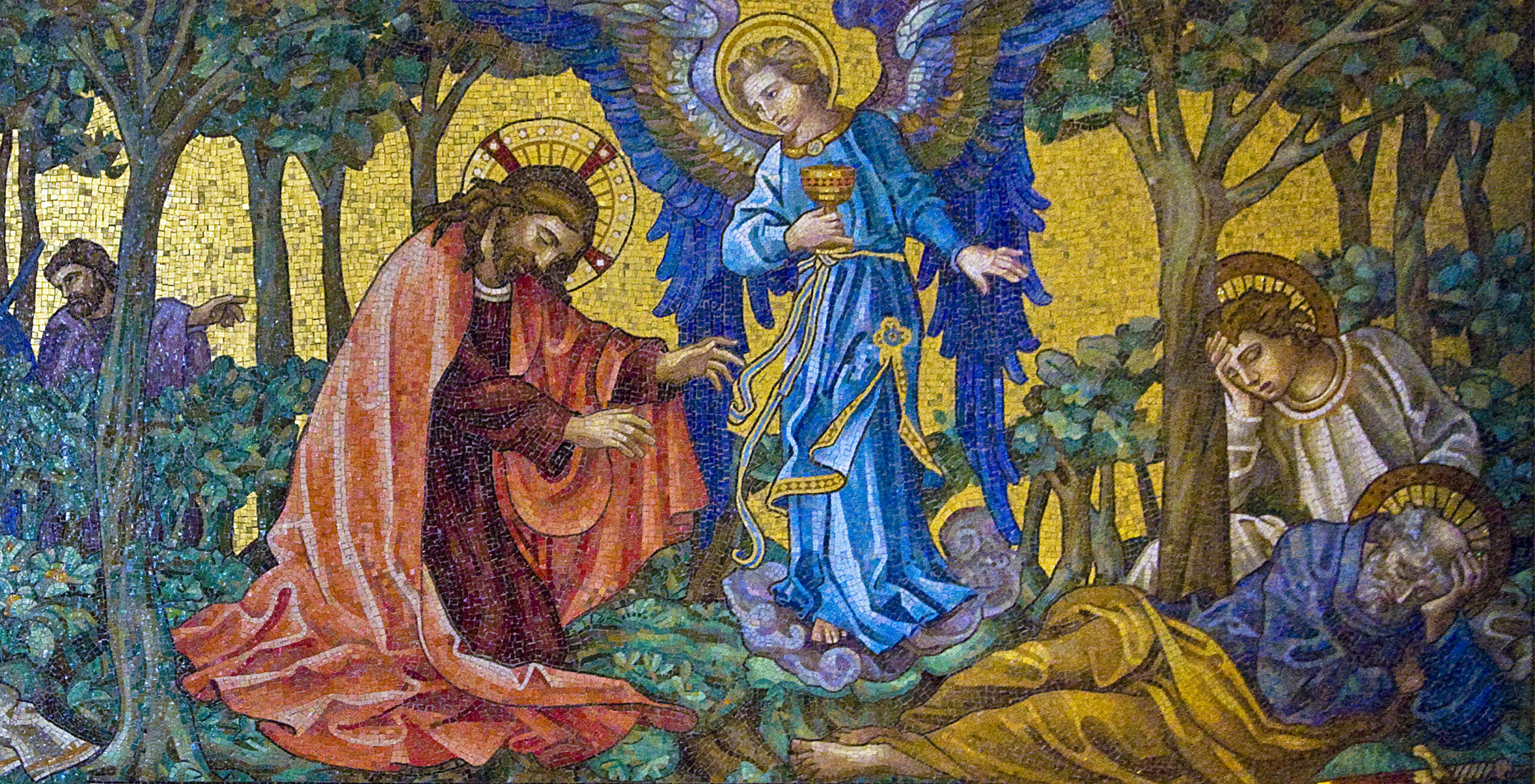
After supper, Jesus “walked out to the Mount of Olives” with his apostles and waited in the Garden of Gethsemane to be arrested.
“My heart is nearly broken with sorrow,” he said. “Stay awake with me.” When the apostles fell asleep, he reproached them: “You could not stay awake with me for even an hour?”
Jesus’ agony was not just fear of torture and death, said Pope Benedict. “The innermost heart of his passion” was “radical loneliness,” culminating in his cry from the cross: “My God, why have you forsaken me?”
At his Incarnation, Jesus had taken on “the sin of the world.” At his baptism, he had let himself be counted among sinners and begun his work as God’s suffering servant.
However, at his Last Supper, when he gave his apostles his body to eat and his blood to drink, he united himself to sinners so closely that he himself became infected: “God made him who did not know sin to be sin.”
Always, Jesus had exercised his human will in perfect accord with God’s will, but now, having entered into full “solidarity” with sinners, he began to suffer sin’s consequence—separation from his Father—in a new way.
We can see the difference in his prayer. Just days before, he had stood at Lazarus’ tomb and said loudly, with “filial boldness,” “Father, I know that you always hear me.”
Now, in anguish so great that his sweat thudded on the ground like heavy drops of blood, he “went down on his knees” and “fell prostrate,” begging to be spared. He submitted, but the very words of his submission reveal his separation from his Father: “As you would have it, not as I”; “not my will, but yours.”
Arrest (John 18:1-12)
Shortly before Passover, Judas had offered to help the Jewish leaders arrest Jesus and, from then on, had watched “for an opportunity to hand him over.” It must not be “during the festival,” the leaders had warned, “for fear of a riot among the people.”
However, at the Last Supper, Jesus forced the pace of events by revealing that he knew all about the plot. “Be quick about what you are to do,” he told Judas, and Judas “went out.”
Jesus knew that matters were urgent. His “paschal deed” would not be complete until his crucifixion, for he was the sacrificial Lamb eaten by his apostles, and it must be “finished” before the next sundown, with his body in the tomb during “three days,” as He had prophesied.
The Jewish authorities, afraid that Jesus might escape them again, acted swiftly on Judas’ information and went to Gethsemane that evening. There they asked for “Jesus the Nazorean”—but when Jesus answered, “I am he,” they “retreated slightly and fell to the ground.”
Jesus was using the words God had used for his own name: I am. The Jews must have recognized them and perhaps feared that Jesus would invoke divine power. Only after he had ordered Peter to sheathe his sword did they venture to arrest and bind him.
Condemnation (Matthew 26:57 – 27:31; John 18:12 – 19:16)
Like all Roman subjects, the Jews could administer their own laws, but they had to refer crimes incurring the death penalty to the Roman governor, Pontius Pilate.
Taken by surprise, the Jewish authorities did not have a plausible charge prepared against Jesus, let alone credible accusers. (They required “the testimony of two or three witnesses” to condemn someone to death.)
Moreover, they needed time to convene the Sanhedrin, the Jewish council, for an unexpected nighttime meeting. Accordingly, they had Annas question Jesus informally before taking him to the house of Caiaphas, the high priest.
There “the whole Sanhedrin” tried to frame a charge against him “so that they might put him to death,” and “many spoke against Him falsely,” but “their testimony did not agree.”
Finally, Caiaphas said, “I order you to tell us under oath before the living God whether you are the Messiah, the Son of God.” In his reply, Jesus called himself “the Son of Man,” whom Daniel had seen receiving “dominion, glory, and kingship” from “the ancient one.”
“He has blasphemed!” Caiaphas exclaimed, recognizing the reference. “What further need have we of witnesses? Remember, you heard the blasphemy. What is your verdict?” The others replied, “He deserves death”—the penalty decreed by Moses. Blasphemy, then, was their charge against Jesus. However, at “daybreak,” when they visited Pilate, they changed it: “We found this man subverting our nation, opposing the payment of taxes to Caesar, and calling himself the Messiah, a king.”
Accordingly, Pilate asked Jesus, “Are you the King of the Jews?” Jesus’ reply—“My kingdom does not belong to this world”—reassured Pilate, but to pacify the Jews, and perhaps excite their pity, he had Jesus flogged and taken out to them.
When Pilate hesitated, the Jews revealed their real charge: “We have our law, and according to that law He must die because He made Himself God’s Son.” However, they repeated their official charge: that in calling Himself a King, Jesus was challenging Caesar.
Finally, after appealing to Herod, Pilate yielded.
Guilty (Matthew 27:32-56; John 19:17-37)
How could the people demand so vehemently that Jesus be crucified when, only days before, they had welcomed him as “Saviour” and “King of Israel”?
On Palm Sunday, they had seen him as the Messiah who would save them from Rome. Now they saw him beaten, in the custody of Roman soldiers, mocked by a crown of thorns and a purple robe—just another pseudo-Messiah.
Jesus, they felt, had deceived them. Barabbas had had the right idea; kill the Romans! As for Jesus—“crucify him!”
“So you are the one who was going to destroy the temple and rebuild it in three days!” they jeered. “Come down off that cross if you are God’s Son!”
When Jesus was nailed to the cross, “around midday,” darkness “came over the whole land.” When he died, three hours later, “the earth quaked, boulders split,” dead people rose, and the temple’s curtain—three storeys long—was torn in two “from top to bottom.” Even the Roman soldiers were “terror-stricken.”
Seeing “what had happened,” the crowd went home “beating their breasts,” in token of grief or repentance.
Moreover, seven weeks later—when Peter reminded them of Jesus’ miracles, quoted the prophecies about him, declared that he had died according to God’s “purpose and plan,” and claimed that the apostles were “witnesses” to his resurrection—the people were “deeply shaken” and asked, “What are we to do?”
“You must reform and be baptized,” Peter said, “that your sins may be forgiven”; and “some 3,000” were baptized that day.
We cannot, then, lay the guilt of Jesus’ death “on the Jews in Jerusalem as a whole,” nor extend it “to other Jews of different times and places.”
Nor can we argue, said Pope Benedict, that the crowd’s cry—“His blood be on us and on our children!”—was anything more than “a formula for ratifying a judicial sentence.” Jesus’ blood, unlike Abel’s, “does not cry out for vengeance and punishment, but brings reconciliation. It is not poured out against anyone; it is poured out for many, for all.”
In fact, we sinners were “the authors and the ministers” of Jesus’ suffering, especially if we “continue to relapse” into our sins. Christians bear “the gravest responsibility,” for we “profess to know him.”
New Passover (Isaiah 53; John 19:28-37)
Together, the Last Supper and the crucifixion comprise what Christians soon started regarding as the new Passover—Christ’s Passover. Accomplished in the context of the old Passover, it gave the old “its definitive meaning.”
The evangelists, especially St. John, stress the connections. Years before, John the Baptist had called Jesus the Lamb of God. Caiaphas, speaking “as high priest,” had “prophesied that Jesus would die for the nation,” as though choosing the paschal lamb for slaughter four days later. On the cross, Jesus took wine from a hyssop branch. He died at 3 pm, when the slaughter of the lambs began in the temple. None of his bones was broken. Finally, from his pierced side, “blood and water flowed out,” like the blood of the paschal lambs flowing from the temple into the Kidron Brook; “the temple of his body” had replaced the old temple with its torn veil.
Jesus began the new Passover sacramentally at his Last Supper on Thursday, under the appearances of bread and wine, but he could not finish it until his “bloody” death on the cross, for he himself was the sacrificial Passover Lamb.
Jesus’ new Passover, then—the Last Supper/crucifixion—like the old, consisted of a sacrifice and a meal. The meal revealed His death to be a sacrifice, not an execution; His death revealed the meal to be a sacrament—an efficacious sign, accomplishing what it signified.
“Only a few hours after the supper, the apostles could have seen in the cross of Jesus, if they could have borne the weight of it, what it [had] meant for Jesus to say, ‘Body offered,’ ‘Blood poured out,’” Pope Francis said.
In fact, since Jesus began the Last Supper “after dark” on Thursday and died before “the sabbath” began at sunset on Friday, the Last Supper and the crucifixion, by Jewish reckoning, occurred on the same day: between successive sunsets.
Mass (John 6:51-58)
“Do this as a zikaron of Me,” Jesus commanded his apostles at the Last Supper.
That is what the Mass is: a zikaron—a re-actualization—of the Last Supper/crucifixion.
“The sacrifice of Christ and the sacrifice of the Eucharist are one single sacrifice.” In the Mass, “the same Christ who offered himself once in a bloody manner,” on the cross, “is contained and is offered in an unbloody manner,” just as at the Last Supper.
Again, the connections are clear—provided we have learned the “language of the liturgy,” as Pope Francis urged.
In the Offertory, the priest thanks God for the bread and the wine (mixed with water) in words strikingly similar to those of the Jewish Passover.
At the Consecration, under the appearances of bread and wine, Jesus comes to the altar as the Lamb of God sacrificed—body and blood separated.
After the Consecration, we ask God the Father to “bless, acknowledge, and approve” our Offering, just as he glorified the risen Christ, and to accept it, borne by an angel to his “altar on high,” just as he welcomed the ascended Christ, seating him “at his right hand.”
Then, while the priest raises the Victim as sacrificed—body and blood separated—we acknowledge that “through him, with him, and in him” we worship God.
However, Christ’s body, “precisely as sacrificed, is living,” said Pope Benedict. At his resurrection, “his blood was reunited to his body, flowing again in his veins as before.” Accordingly, while we call on the “Lamb of God,” the priest “mingles” them in the chalice.
Finally, we eat the Lamb’s body, and the priest (at least) drinks his blood.
Indeed, Mass “makes present” to us today Christ’s Last Supper/crucifixion, so that we ourselves participate in his “paschal deed.”
Holy Thursday (John 13)
At his Last Supper, Jesus instituted two sacraments: the Eucharist (“This is my body”) and Holy Orders (“Do this as a zikaron of Me”).
Accordingly, the Mass of the Lord’s Supper on Holy Thursday evening is especially joyful: the priest wears white or gold, there are flowers in the sanctuary, and we sing the Gloria for almost the first time since Ash Wednesday, ringing bells for the first part.
What is happening on the altar is paramount, so the tabernacle is empty and the sanctuary light out. Usually, we receive Christ’s body and blood “under both species:” drinking his blood from the chalice and eating his body under the appearance of bread.
There is no blessing or dismissal, for the Last Supper/crucifixion—Jesus’ new Passover—is not completed until later. The Mass of the Lord’s Supper may be called the “first act” in the liturgy of the Sacred Triduum (“three days”). The second takes place on Good Friday and the third begins on Holy Saturday evening and ends early on Easter Sunday morning.
After the final prayer, the priest carries a ciborium containing the Host (from the Latin hostia, “sacrificial victim”) around the church to the “altar of repose,” outside the sanctuary, where it remains in the tabernacle until midnight so that we can “stay awake” with Jesus as he begged.
Then the Church’s mood changes. Since the Gloria, the organ has been silent, except to support the singing. Now the flowers are removed, the altar stripped, the tabernacle opened, and the holy water removed from the fonts.
Good Friday (Isaiah 52:13 – 53:12; John 18:1 – 19:42)
For Catholics (from our 18th birthday to our 59th), Good Friday is a day of fast and (from our 14th birthday on) abstinence from meat and poultry. There is no Mass, and no other service until 3 pm, when Jesus died.
In the church, the tabernacle is wide open and the sanctuary light out. We do not genuflect or take holy water; the fonts remain empty until “the blessing of the water at the Easter Vigil.”
The priest, who wears red, begins by prostrating himself before the empty sanctuary.
The service has four parts: the Liturgy of the Word, special general intercessions, the veneration of the cross, and Holy Communion, with Hosts consecrated the night before.
Finally, the Blessed Sacrament is removed and the altar stripped again. There is still no blessing or dismissal, for this is only the “second act” of the Sacred Triduum liturgy. The people exit silently and the church is left empty.
Holy Saturday: The Marathon of Grace
There is no Mass on Holy Saturday morning, but after nightfall, the Church begins her most solemn Easter Vigil.
It starts in darkness, outside the church, symbolizing the darkness of sin. Then the priest lights the new fire, symbolizing the light of the risen Christ.
On the large paschal candle, he inscribes a cross, A (“alpha”) and Ω (“omega”), and the digits of the current year, 2026. Then he inserts five grains of incense, one for each of Christ’s wounds in hands, feet, and side.
Next the priest or deacon carries the candle into the church, stopping three times to proclaim, “The light of Christ,” and we light our own small candles from the paschal candle, symbolizing the spread of Christ’s light.
Then, by candlelight, the very ancient Exsultet is sung, in which the Church exclaims, “O happy fault, that earned so great, so glorious a Redeemer!”
There follow seven Readings, “all of which should be read whenever possible,” the Church stipulates, for a vigil, by its nature, “demands an extended period of time.” In the Old Testament readings from Genesis, Baruch, Isaiah, and Ezekiel, we trace a history that “demands an extended period of time.”
Then the Gloria is sung triumphantly, accompanied by the organ and continuous bell-ringing; the purple cloth that has covered the images for the last two weeks is removed; and flowers appear.
Now the usual Mass Readings begin. Before the Gospel, the priest intones the solemn Easter Alleluia! (“Praise God!).
After the homily, the choir sings the Litany of the Saints and the priest blesses the baptismal water. The elect are baptized and confirmed, baptized non-Catholics are received into the Catholic Church, and uncatechized Catholics are confirmed. As at all the Easter Sunday Masses, we renew our baptismal promises and the priest sprinkles us with baptismal water.
Tonight, Mass finishes with the usual blessing and dismissal, for it concludes the Easter Triduum liturgy.
New creation (Genesis 1:1 – 2:2; Romans 6:3-11)
God “wonderfully created the dignity of human nature” in His first creation, but He has “still more wonderfully restored it” in His new creation.
Not surprisingly, the two parallel each other.
On the sixth day, God “finished” creating the world; on the sixth day of Holy Week, Jesus shouted from the cross, “Now it is finished!”
On the seventh day, the sabbath, God “rested” from all His work; on the seventh day of Holy Week, Jesus rested in the tomb.
On “the first day of the week,” Jesus rose from the dead. As the first day, it recalls the first creation; as the eighth day, it symbolizes the new creation.
Easter (Matthew 28:1-10)
Easter is “the solemnity of solemnities,” for “the Resurrection fills the whole liturgical year with its brilliance.”
At first, Easter’s date was tied to Passover’s date (determined by the moon), but in 325 AD, the Church changed it slightly to make Easter always fall on a Sunday—the first Sunday after the first full moon after the spring equinox.
This year (2026), that full moon falls on April 2 and Easter Sunday on April 5.
Your voice matters! Join the conversation by submitting a Letter to the Editor here.







