

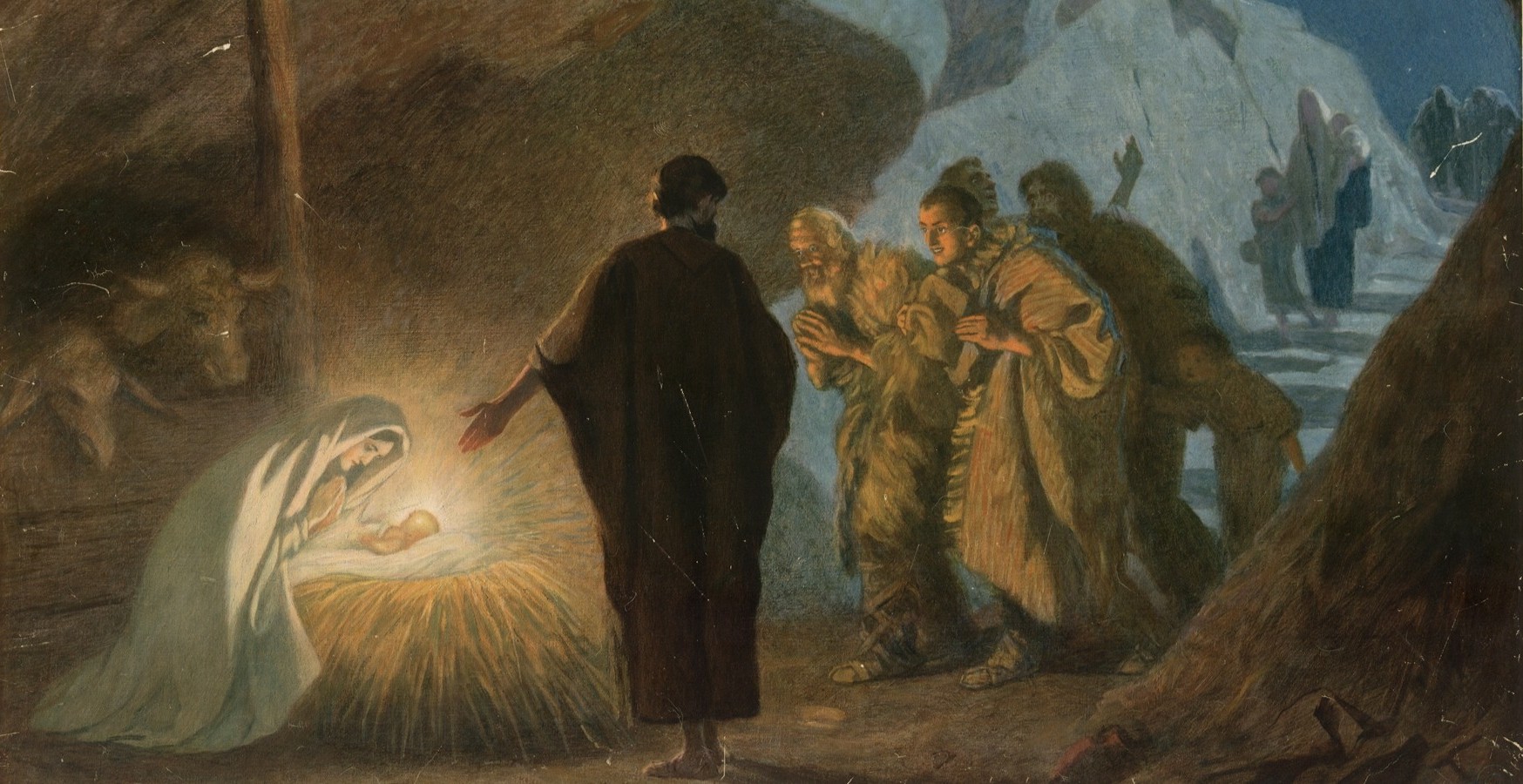

Christmas, Year A
First Reading: midnight Is 9:2–4, 6–7; dawn Is 62:11–12; day Is 52:7–10
Second Reading: midnight Ti 2:11–14; dawn Ti 3:4–7; day Heb 1:1–6
Gospel Reading: midnight Lk 2:1–16; dawn Lk 2:15–20; day Jn 1:1–18
Rejoice in the Lord always; again I say, rejoice! Today our Saviour, Christ the Lord, is born! The Word becomes flesh and lives among us – “the exact imprint of God’s very being”!
Thus the Church makes a claim that no non-Christian has ever dared to make.
The pagan “gods” who visited the earth in human form were not “God” in our sense, for they were limited by external circumstances – including other “gods.” They were never thought to be self-existent creators of the universe; they were elements in, and products of, mere Nature.
The true God revealed himself as “I Am Who Am.” His name contains the truth that he alone is. Only he is the fullness of being and of every perfection, without origin or end. His creation receives everything it is and has from him, but he is everything that he is of himself. He alone is his very being.
Like Christians, Jews and Muslims worship God as the one uncreated being, but Jews deny that he has become man, and Muslims deny that such condescension is even possible. They protest that God “must remain absolutely transcendent,” Pope St. John Paul II said; “He must remain pure majesty.” Christians alone assert that, without ceasing to be God, he became man, part of his own creation.
We see the difficulty of believing this truth in the heresies that arose after Christ’s death. For example, Paul of Samosata, Bishop of Antioch, held that Jesus was human by nature and God’s Son only by adoption. Arius, a priest of Alexandria, said that Jesus was God’s Son, but of a different “substance” from the Father. Nestor, Bishop of Constantinople, taught that Jesus was two persons: one human, the other God the Son. The Monophysites held that he was not truly human, but possessed only the divine nature.
Against all such heresies, the Church maintains that Jesus is one person with two natures. He is God’s son and therefore fully God; he is Mary’s son and therefore fully human.
In the man Jesus, God became visible, Pope Benedict XVI said. Indeed, Jesus’ communion with God the Father was “the true centre” of his personality; it is from this centre “that he makes himself present to us still today”; and if we do not understand that, “we cannot understand him at all.”
In Jesus we see “God in our own nature, experiencing the things we have experienced, coping with situations we have to cope with,” Frank Sheed said. “Thereby we know God as the most devout pagan cannot know him.” As St. John said, “No one has ever seen God. It is God the only Son, who is close to the Father’s heart, who has made him known.”
God made us to know him, love him, and serve him in this world and to be happy with him forever in the next. To know God, we must become intimate with Jesus by assiduously reading the Gospels.
“If we do not know him as he lived among us, acted and reacted and suffered among us, we risk not knowing him at all,” Sheed said. “For we cannot see him at the right hand of the Father as we can see him in Palestine. And we shall end either constructing our own Christ, image of our own needs and dreams, or in having no Christ but a shadow and a name.”
We can see how far that has become true in our own time from the degradation of Christmas. For many people it is now nothing more than a nostalgic “winter holiday,” with nothing to celebrate and no purpose except to enrich merchants.
As Catholic Christians, let us celebrate Christmas openly and unashamedly as God’s Incarnation, and let us pray with the Church that “by our communion with God made man,” we may become “more like him,” who is Lord and God for ever.
Father Hawkswell is again teaching The Catholic Faith in Plain English with new insights, in print and YouTube form at beholdvancouver.org/catholic-faith-course. He is also teaching the course in person on Sundays (2–4 p.m. at the John Paul II Pastoral Centre, 4885 Saint John Paul II Way, 33rd Avenue and Willow Street, Vancouver) and Mondays (10 a.m.–noon in St. Anthony’s Church Hall, 2347 Inglewood Avenue, West Vancouver). The title of next week’s talk is Mary and Joseph.
Your voice matters! Join the conversation by submitting a Letter to the Editor here.







