


This is an excerpt from a recent talk by Father Larry Lynn, pro-life chaplain for the Archdiocese of Vancouver, at Pregnancy Concerns’ annual gala at All Saints Church in Coquitlam.
About 3,200 years ago, Moses said to the Jewish people, “I have set before you life and death, the blessing and the curse. Choose life, then, that you and your descendants may live.” If your children live, they will have their own descendants. It is what makes the world go round.
The culture of death has been with us since ancient times. Scripture tells us Cain killed his brother Abel. Killing never leads us anywhere good, yet we kill constantly: war, crime, neglect, hatred, greed, misunderstandings, vengeance.
Today, killing is often chosen because the alternative is inconvenient. The World Health Organization reports about 73 million abortions per year worldwide and more than 101,500 in Canada in 2023. Euthanasia is another chapter. Less than a decade into legal euthanasia, Canada is at the forefront of expanding who may be permitted to end their lives through the medical system. We are approaching a point where about five per cent of all Canadian deaths are by euthanasia.
The culture of death is alive and well. As the southern rock band Lynyrd Skynyrd sang, “Ooh, what is that smell? The smell of death is all around you.” Much of our entertainment revolves around death, murder or mayhem. The internet contains anything imaginable, both good and horrible. Even the name “dark net” tells you enough.
What has gone wrong with humanity? What was it in Cain that allowed him to kill his own brother? What was missing in him that let him plan murder in cold blood?
He failed to see his brother as made in the image of God, the imago Dei. He failed to see the inherent dignity God gives to every human being.
The Catechism of the Catholic Church teaches that human dignity is rooted in creation in the image and likeness of God, giving each person an incomparable and inalienable dignity. A human being is not something but someone: capable of self-knowledge, self-possession and freely giving himself in relationship with others.
Human dignity is not measured by external factors, attributes or abilities. It is the one thing in which we are all equal. It is not earned or dependent on ability. It is not surrendered or lost through physical, psychological or cognitive decline. The impaired hospice patient lying in a coma has no less dignity than the athlete at the top of her game. Human dignity does not depend on what we can do, fail to do or lose the ability to do.
The human person is uniquely able to imagine, to create, to wonder, to think about tomorrow. We search for truth. We seek right order. We find our order when we seek the purpose for which we were made. Creation is properly ordered when oriented toward God. Everything is ordered to God, though many do not know it.
This is why we see widespread dismissal of human dignity. People with limited imagination believe the child in the womb is not fully human or, if human, not worthy of life. They tie dignity to size, viability, communication or usefulness. Euthanasia debates in Canada often revolve around usefulness versus cost. This disordered thinking has enormous consequences for individuals, families, nations and humanity. Ignoring human dignity at this level is catastrophic.
Aleksandr Solzhenitsyn saw this in the Soviet totalitarian catastrophe. Speaking of the millions murdered, the gulags and the vast number of abortions, he lamented that men had forgotten God. Dostoevsky echoed this insight through Ivan Karamazov, who says that without God, everything is permitted.
Theologian Francis Schaeffer wrote that if humanity is not made in God’s image, nothing stands in the way of inhumanity. Human life becomes cheapened, visible in debates on abortion, infanticide, euthanasia, child abuse, violence, pornography, torture, crime and random violence. The smell of death is all around us.
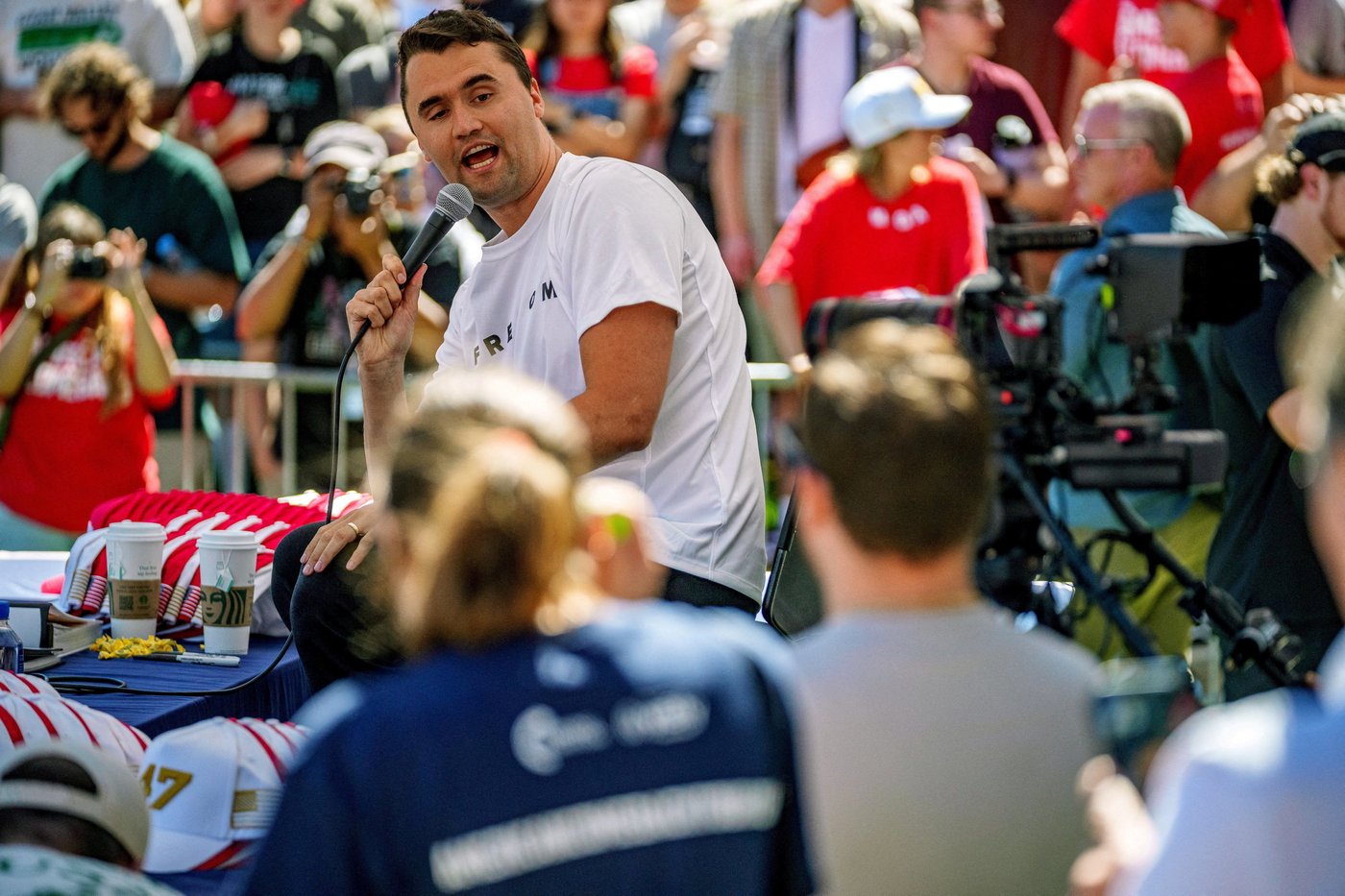
Commentator Charlie Kirk at a Utah Valley University speaking event in Orem, Utah, Sept. 10, 2025, moments before his assassination. The jubilation some people showed “shows where we have come,” writes Father Lynn. “The pretence of common ground is disappearing.” (OSV News photo/Trent Nelson, The Salt Lake Tribune via Reuters)
Our political and academic elites often filter everything through economics. When Harvard invited Mother Teresa to speak, she challenged their introduction of her as someone from “the world’s poorest nation” addressing “the world’s richest.” Her response was that India was rich in spiritual treasure, while America was desperately poor because she “slaughters her own unborn children.”
I began preparing this talk around the time Charlie Kirk was assassinated. What disturbed me was not only the killing but the jubilation from politicians, journalists, professors and students. Kristen Hawkins of Students for Life was speaking on a campus when she was told Charlie had been shot. She announced it, and the students laughed and high-fived each other. Kristen shouted, “Charlie Kirk is my friend!” The students then acted like children caught misbehaving.
It shows where we have come. The pretence of common ground is disappearing.
When belief in human dignity collapses, violence replaces real conversation. Bishop Robert Barron, reflecting on the tragedy, recalled the US Supreme Court’s 1992 decision in Casey v. Planned Parenthood, where the court said liberty includes defining one’s own concept of existence and the mystery of human life. If that were true, there would be no shared reality. Each person would be their own universe.
Conversation requires a shared context of meaning, something outside ourselves that we recognize as true and good. If each person defines their own universe, we share nothing. Without common ground, disagreement leads to violence.
Abortion becomes framed simply as choice.
I am not setting up an “us” versus “them.” The human condition is that we are all vulnerable to our own brokenness. We are sinners and can be led by disordered desires. Even saints knew this. St. Therese of Lisieux, exhausted and suffering, said that without faith she might have taken her own life. If the great Doctor of the Church could say that, imagine someone with no faith, no support and devastating pain. What happens when euthanasia is offered?
We are here because the world says human life is expendable and suffering can be eliminated like swatting a bug. We know this is not true.
After the dignity of the human person, the second pillar of Catholic social teaching is solidarity, which shows another way to confront suffering. Suffering is part of life. Everyone here suffers in some way. Buddhism teaches that life includes suffering; Christianity teaches that redemption comes through it. Salvation happens on the cross and leads to resurrection.
We must let go of the things that weigh us down: sorrow, anxiety, vengeance, unforgiveness. We are called to suffer with one another, to care for one another, to live in solidarity with the poor, weak and vulnerable. Solidarity also means recognizing that those who oppose us—the promoters of abortion, euthanasia and other anti-life ideologies—are suffering too. They need healing. We stand with them, though not with their ideologies. Solidarity means we are made for relationship with each other and with God.
St. John Paul II wrote that solidarity is not vague compassion but a firm and persevering determination to commit to the common good, because we are all truly responsible for all.
‘Responsible for all’: priest authors guide to Catholic social justice teaching
A new eight-page booklet by Father Larry Lynn offers parishioners a concise introduction to the four foundational pillars of Catholic social doctrine: dignity, solidarity, subsidiarity and the common good.
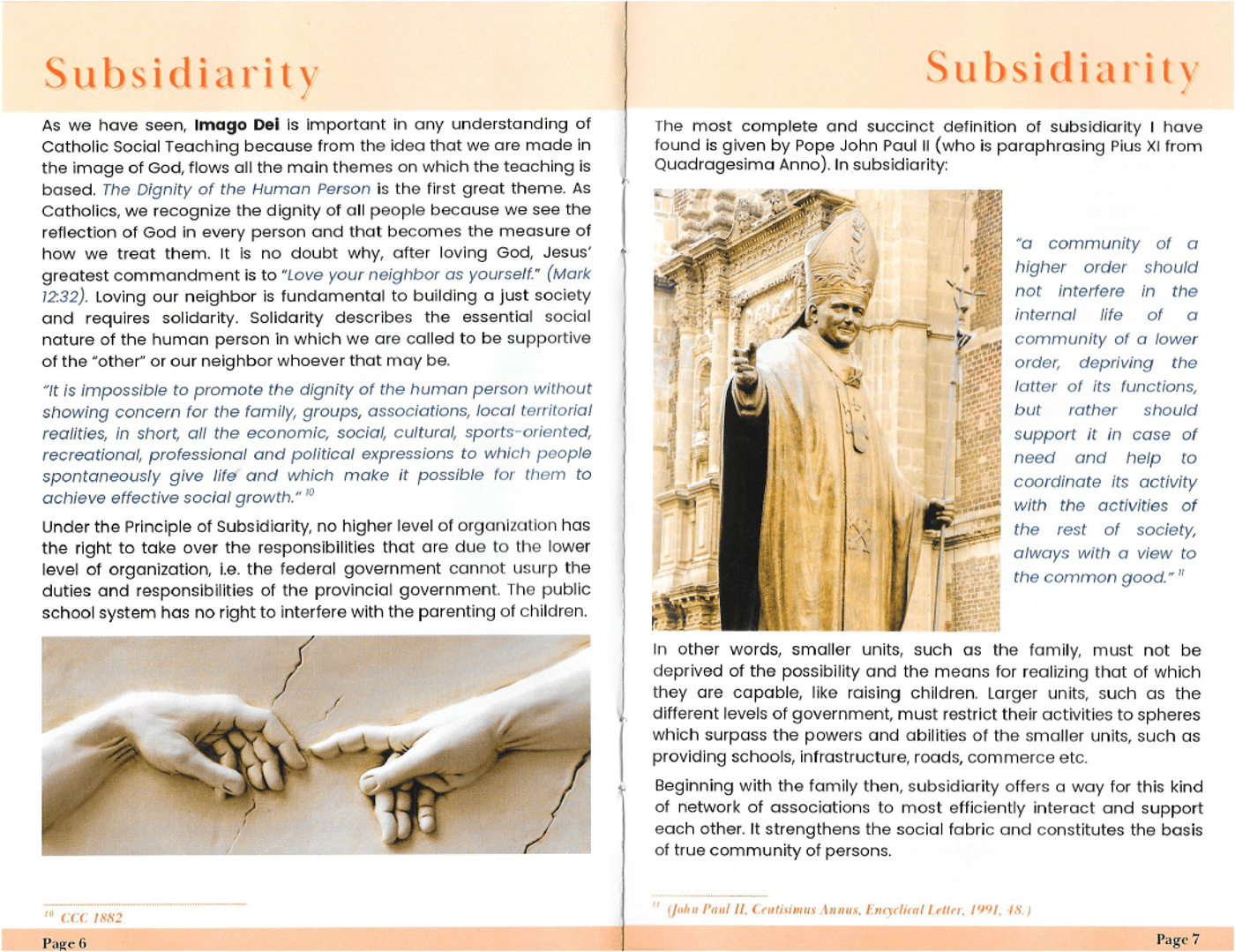
Titled Catholic Social Justice Teachings: A Primer, the booklet was written to help Catholics understand how these principles shape the Church’s moral vision and guide its engagement with the world. Father Lynn writes that when Catholics are confronted with the “secular spirit of the times,” they need confidence that the Church’s approach is “based on a long-established understanding of human anthropology, of what a human being is and what one’s worth is.”
The booklet begins with human dignity, explaining the Church’s teaching that every person possesses an “incomparable and inalienable” worth rooted in the imago Dei, not in ability, status or utility. The section on solidarity emphasizes that because all people share that dignity, Christians are called to stand with one another, especially the vulnerable, and that solidarity is “an intrinsic quality of the Triune God” reflected in human relationships.
Father Lynn presents subsidiarity as the principle that decisions should be made at the most local and human level possible, with larger institutions supporting rather than replacing families, communities and individuals. He concludes with the common good, describing a society ordered toward human flourishing as one that protects dignity, encourages solidarity and respects the proper role of families and communities.
Throughout the booklet, Father Lynn frames these principles within a clear pro-life ethic, arguing that respect for human life — from conception to natural death — follows directly from Catholic teaching on the human person. He writes that each person, regardless of age or condition, “is loved by God, no matter their circumstances.”
The booklet is intended as an accessible resource for parishioners and pro-life supporters seeking a straightforward presentation of the Church’s social doctrine grounded in Scripture, tradition and the consistent teaching of the Magisterium.
Your voice matters! Join the conversation by submitting a Letter to the Editor here.







