

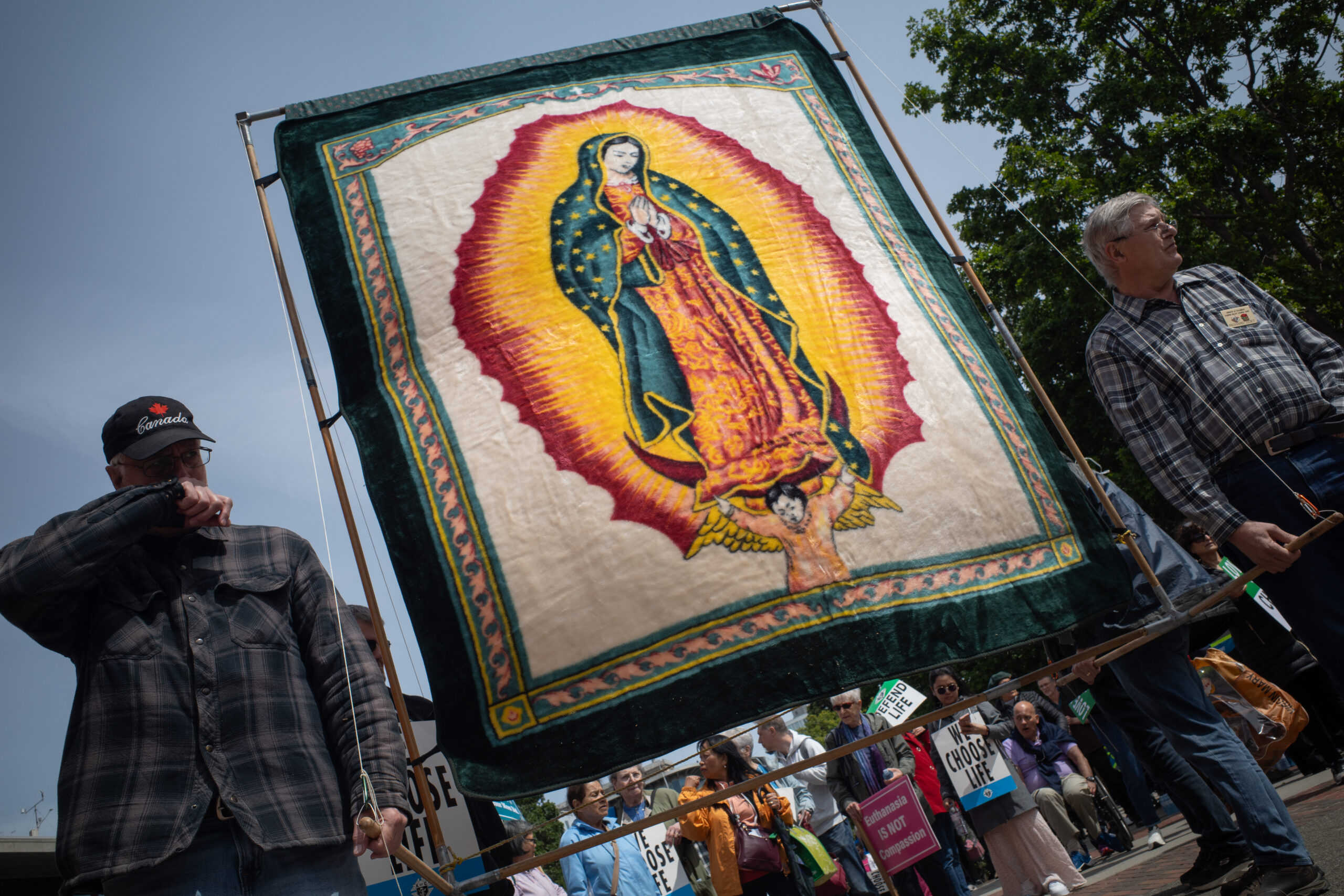

On Dec. 12, we celebrate Mary with the title Our Lady of Guadalupe, commemorating Our Lady’s appearance to an Indigenous man in December 1531.
Her soft voice called his name, Juan Diego, and asked him to build a church on Tepeyac Hill, where she appeared in the northernmost area of present-day Mexico City.
Juan Diego requested proof so his bishop would believe that the Blessed Virgin had appeared to him. Mary instructed Juan Diego to pick roses at the top of the hill, as they would not have been in season in December. It was the proof that Diego needed. He found Castilian roses, which are not native to Mexico, and when he gave the roses to his bishop, they fell out of his cloak, leaving an image of Mary imprinted on his tilma, which was made of cactus fibre.
The image is of a mestiza — a woman of mixed Indigenous and European ancestry — showing unity between cultures. It means that Mary is a mother to all peoples and does not discriminate. God wants to show us how he loves us all.
Timothy Matovina writes in Guadalupe and Her Faithful: Latino Catholics in San Antonio (2005) that there is a lot of meaning in the image, not only the colours, posture, and clothing, but the moon and the stars as well.
Jeanette Favrot Peterson notes in Visualizing Guadalupe: From Black Madonna to Queen of the Americas (2014) that the rose-pink dress has floral patterns unique to Indigenous culture. The jasmine flower called “the flower of the sun,” with four petals, rests on Mary’s womb, a subtle sign of her pregnancy and that she is carrying the Son of God. Her eyes look down, and she has her hands clasped, showing she is not a goddess and prays to God, who is the only true God.
She also wears a turquoise cloak that signifies nobility and deity in Aztec culture, and the many gold stars on her cloak form constellations. Contemporary researchers Father Mario Rojas Sanchez and Dr. Juan Hernandez Illescas noted that the constellations are depicted as they would have been in December 1531.
The crescent moon on which Mary stands indicates she can conquer darkness, not through her own power, but God’s.
I have been drawn to this image of Our Lady of Guadalupe since I was small. She has a comforting appearance and looks peaceful, while her garments are beautiful and meaningful.
Millions of people visit the Basilica of Our Lady of Guadalupe every year, and although I have never been there, my handwritten prayer intentions have made the trip thanks to a kind parishioner. She had attended a Magnificat prayer luncheon in Vancouver where the women wrote out their prayers so she could take them to Mexico City.
After reflecting on the meaning and symbolism of the image of Our Lady, I’d like to offer some ways we can celebrate her feast day: pray the Rosary, attend Mass, enjoy some Mexican food, or sing a Marian song.
The Rosary is a common and perfect prayer for contemplating Jesus’ life through Mary, and attending Mass is the highest form of prayer.
There is a variety of Mexican food you might try, from tamales and tacos to refried beans and Mexican red rice. Sharing this cuisine while celebrating the joy of the Marian apparition is a simple way to open conversations about faith with your family. This year I’ll be making a meal with the traditional dishes many families in Mexico enjoy for Our Lady of Guadalupe. I hope you and your family feel the hope this feast brings.
As a line in the song Roses in December says, “On a mountain we find roses in winter, all the world has been touched by your love.”
Your voice matters! Join the conversation by submitting a Letter to the Editor here.







