
Since the dawn of credit cards and mortgages, the “poor” is a term for those in the global south or in the developing world. Poverty is something that North American high school kids pay thousands of dollars to “go and experience.”
If we know that Jesus loves the poor, why do we carefully disassociate and disentangle ourselves from them? And why do we work diligently to make sure that we ourselves are perceived as anything but poor?
In her Magnificat, Our Lady extols the goodness of God. She takes the time to extol his generosity and his mysterious will. “He has filled the hungry with good things, and the rich he has sent away empty … he has cast down the mighty from their thrones, and has lifted up the lowly.”
Who, precisely, are the lowly? Can we choose to be lowly? With God’s help, being lowly should be our goal. Because after all, lowliness is our reality. We have nothing that hasn’t been given to us. If we don’t see things clearly here, our eyes will be wide open when our earthly possessions are long gone and all we have is lamentation over our choices during our lives.
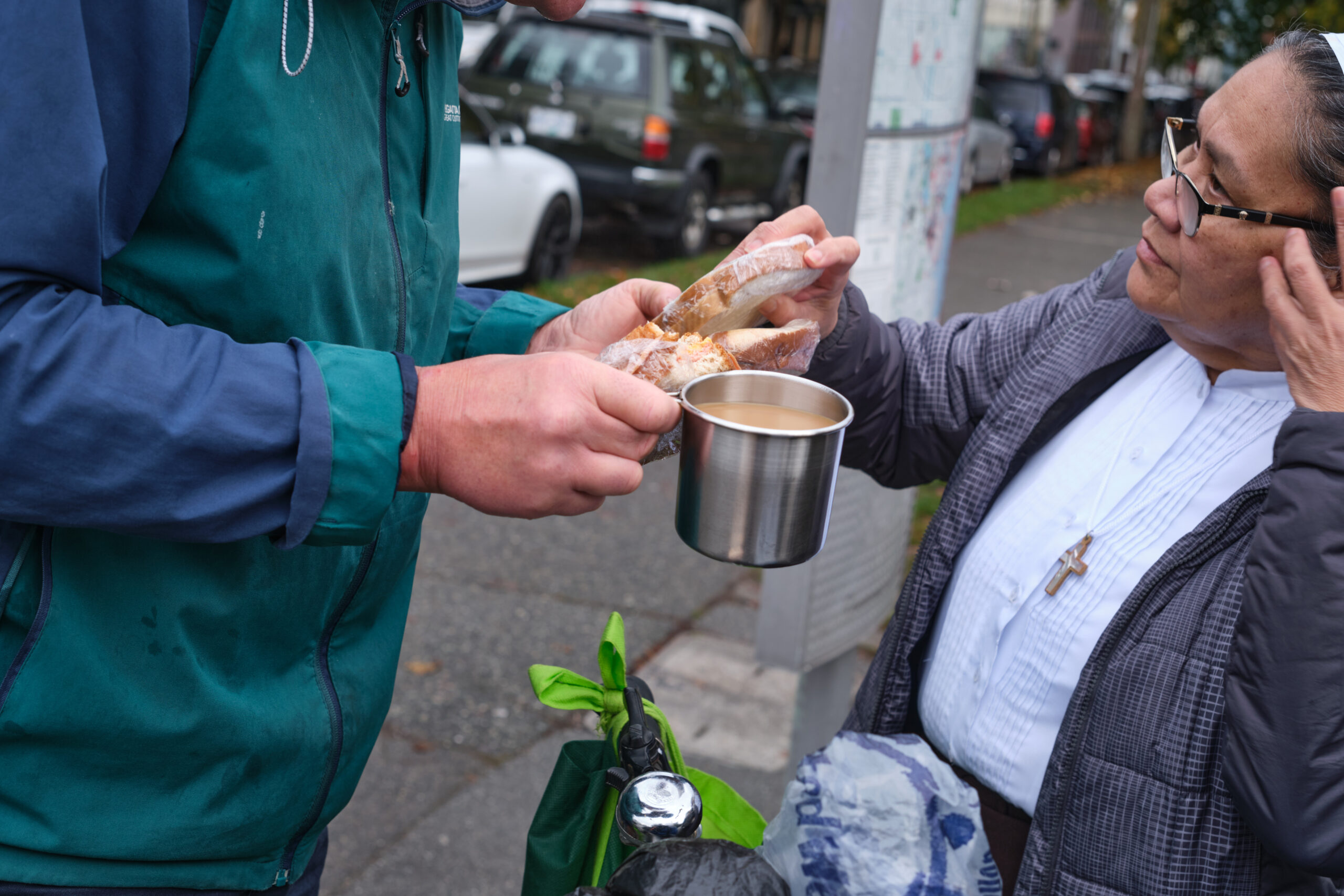
Dorothy Day once said, “If I have two coats, one of them belongs to the poor.” If we give that second coat to the poor, there is no longer a material disparity between “us and them.” Likewise in Luke’s gospel, John the Baptist says: “Anyone who has two shirts should share with the one who has none, and anyone who has food should do the same.” When we give in this way, we have willingly put ourselves beside our brother or sister instead of looking down at them from our abundance.
These meditations may well separate the serious Christians among us from the freelancers. These deeper insinuations of Jesus throughout the gospel can be terrifying for us. In his chosen company and in his miracles, we witness preferential treatment across the board. This much is clear: the poor are his favourites and the lowly make up his inner circle.
Say you are exceedingly blessed and you can afford a new car. Do you buy the ultra-comfortable package or do you get the base model and give the extra money you saved to the poor? Do you eat simply a few times a week so that you can give more generously? How about your travel budget? Will we be cast down from our thrones or lifted up?
Attachment to comfort and status is what stopped the rich young man in his tracks: Jesus told him, “Go and sell everything you have and give the money to the poor.” What did that rich young man do? We don’t know for certain. But what we do know is that he went away sad because he had many possessions. We also know that this particular encounter had an effect on Jesus’ followers because it is featured in three of the four gospels.
It doesn’t take a lot of research or deep diving in the Scriptures to see God’s heart. He chose David, an outcast shepherd, to be the king of his chosen people. He chose John the Baptist, a small-town hippy loner, to be his forerunner. He chose the shepherds watching their flocks by night to be the first to hear the news of the Messiah’s birth. He chose a “disreputable” woman to announce his Resurrection. He chose a little boy to give the loaves and fish that would feed the multitude. He chose uneducated fishermen to start his Church. He chose a carpenter and his young betrothed to be the Son of God’s guardians on earth.
God doesn’t “fall into” poverty. It isn’t an accident or happenstance. He chooses poverty and lowliness over and over again. Do we choose lowliness like God when we can? Sometimes in life, we can’t help having the lowest place. But sometimes it is within our power to be more intimate with God in our poverty. Do we want to be his beloved? Lowliness is godliness.
Your voice matters! Join the conversation by submitting a Letter to the Editor here.