Life after death surpasses earthly social constructs
This is an excerpt from a homily given in Our Lady of the Assumption Church Nov. 19 as part of the archdiocese’s liturgy conference.
The Liturgy is the supreme opus Dei, the work of God in which He Himself acts first, and we become the redeemed precisely because He is at work. Liturgy is our sharing on earth in the Trinitarian dialogue between Father, Son, and Holy Spirit.
That’s why the Liturgy is ultimately not of our own “making,” but of God. It is His action upon us and with us. Our Liturgy is always a response to an initiative from above, to a call and an act of love. In the liturgical assembly, Christ actualizes the Paschal Mystery of His death and resurrection, and the baptized draw abundantly from salvation.
In the words of Pope Emeritus Benedict XVI, “The active presence of Christ subsists in the liturgical action of the Church: what He did as He went about among human beings, He continues to make active through His personal sacramental action whose centre is the Eucharist.”
Second, we have to remind ourselves that, as St. John Paul II once said, “a very close and organic bond exists between the renewal of the Liturgy and the renewal of the whole life of the Church.”
The Church draws from the Liturgy the strength for her life, and only from the grace of her worship is she able to carry out the evangelizing mission entrusted to her by the Lord.
The theme of the afterlife is appropriate for the month of November, as the Church’s year draws to a close. Whether there is a life after death, and what kind of life it could be, has been asked by people from time immemorial.
Christians have a firm hope that not only will the immortal souls of the faithful departed live forever, but the body, too, will one day rise again.
I suspect that a good many of our contemporaries have just as much trouble with this belief as did the Sadducees in Jesus’s time. They rejected the belief that God would raise up the righteous who had died. For them it was an innovation that had no basis in tradition.
We see them do this in today’s Gospel. They invoke an ancient marriage practice, a man’s obligation to marry his brother’s widow, to try to trap Jesus and expose Him as a foolish fraud. So they propose seven brothers for one bride, and crassly ask whose wife she will be at the resurrection.
As so often happens, Jesus challenges the questioners’ assumptions and escapes the trap they have laid for him. They were talking at different levels, as is so often the case in our discussions.
The Sadducees assume that the relationships that hold on earth will be the same in the resurrection, but Jesus offers something new and infinitely better to the crowd. He insists that the resurrection does not restore the social arrangements we know on earth, where men and women marry.
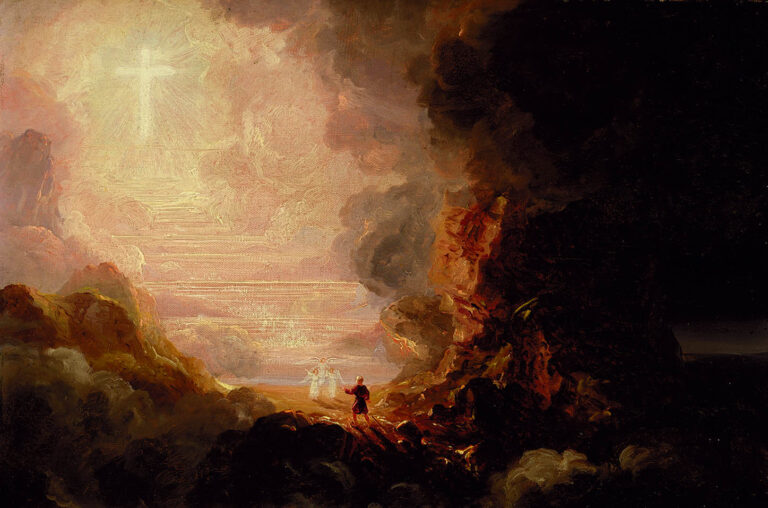
The life which the resurrected lead in God’s presence is like that of angels, not like that of the world we know here. Indeed, all too often we portray heaven simply as a kind of eternal projection of life on earth. This is natural enough, but not adequate to the mystery of eternity.
Jesus reveals to us something new about the “resurrection of the body” which we profess in our Creed. It is among the fundamental tenets of our faith. Those who have died and been raised from the dead are “alive” in a new way.
The Christian proclamation of the resurrection is the announcement of a sure hope, because it is based, as the Gospel reminds us, on the very fidelity of God. He in fact is the “God of the living” and communicates to all those who trust in Him that divine life which He possesses in full. He, the “Living One,” is the source of life: all life and every life.
Belief in the resurrection is a belief about God and His power, not a belief about ourselves.
Our hope for eternal life rests not primarily on arguments about the immortality of the soul, though they substantiate Christian teaching, but on something even more certain: on God’s promises and on what He has done in Christ.
Those whom God has made in His image and likeness are destined to share in His life, that life which is both eternal and abundant, life to the full.
And this new life into which we have already been introduced by the waters of baptism is now nourished by the Eucharist. The God of the Living gives us a share in His very life so that we may become fully alive in Him.