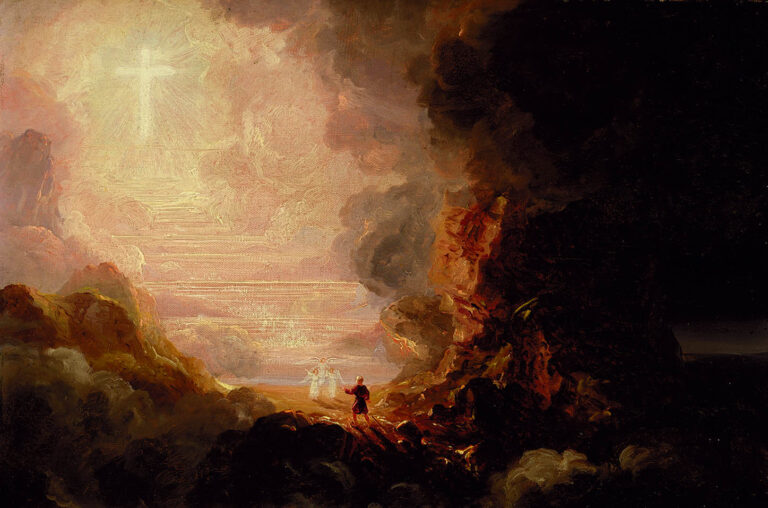
At the turn of the 20th century, Jacques Maritain said, “God does not ask for ‘religious’ art or ‘Catholic’ art. The art he wants for himself is Art, with all its teeth.” (He would certainly roll over in his grave to know Wikipedia refers to him as a “Catholic philosopher,” but that’s beside the point).
Art was at the heart of religious experience long before the Gospels. Today, however, some consider art superfluous to the spiritual life, or worse, luxurious. Art has pulled many souls in many directions and indeed it has saved some.
A young engineer was travelling through Europe several years back with the Canadian military. His parents had fled Chinese communism years before and had passed along their atheistic worldview to their son.
While overseas, the young man, despite his atheism, found himself seeking out the cathedrals in each of the ancient cities he visited. Once inside, he would drink in the stained glass windows. His eyes would feast upon the rich murals and the holy golden vessels. He told anyone who would listen how the art of these cathedrals preached to him about the existence of God.
He wondered how artisans and labourers created beauty that could only properly be attributed to the order of the divine? The devotion and detail displayed in these places of worship and the art that adorned their domed ceilings and walls spoke to him. He began to wonder at the idea of a faith so inconceivably confident and immense.
Upon his return to Canada, the young man was baptized.
In his 1999 Letter to Artists, St. John Paul II wrote that “every genuine art form in its own way is a path to the inmost reality of man and of the world. It is therefore a wholly valid approach to the realm of faith, which gives human experience its ultimate meaning.”
The purpose of art in the Church has certainly shifted throughout the millennia. In the infancy of the Church, art was employed as a point of access for believers who relied principally on oral tradition. Today, art has many competing mediums. We have Bibles, for one, but reading them alone in one’s room is not what early Christianity had in mind for the Church. Art offers new vistas for communal contemplation.
In every age, art has drawn our eyes simultaneously within ourselves but also upward. Inspired art never runs out of things to say to us and through us, if we have ears to hear.
Though not all of us are called to be artists in the strict sense of the word, St. John Paul doesn’t let us off the hook that easily. “All men and women are entrusted with the task of crafting their own life: in a certain sense, they are to make of it a work of art, a masterpiece.”
We are to live beautifully. It is right and just. If this life is a supreme gift, bought at an exorbitant price, what other way can we respond?
St. Teresa of Calcutta urges us on: “Let no one ever come to you without leaving better and happier. Be the living expression of God’s kindness: kindness in your face, kindness in your eyes, kindness in your smile.” In a word: be a living and breathing masterpiece of God’s love and kindness.
Art is able to penetrate into the inner chambers of hearts gently yet powerfully. A stained glass window cannot be loud and abrasive in its opinions. It simply offers the truth of its whole being. Inspired art soars high above the lands of offence and politics and usually lands exactly where it should: quietly before the eyes of the heart and then respectfully before the eyes of the intellect.
The world is in need of artists who are unafraid to act as channels of God’s love in the world today. Artists who do not hide behind qualifiers like “Catholic” or “spiritual” but who fearlessly create in the midst of their secular contemporaries. The Holy Spirit, as always, will do the distinguishing work.