

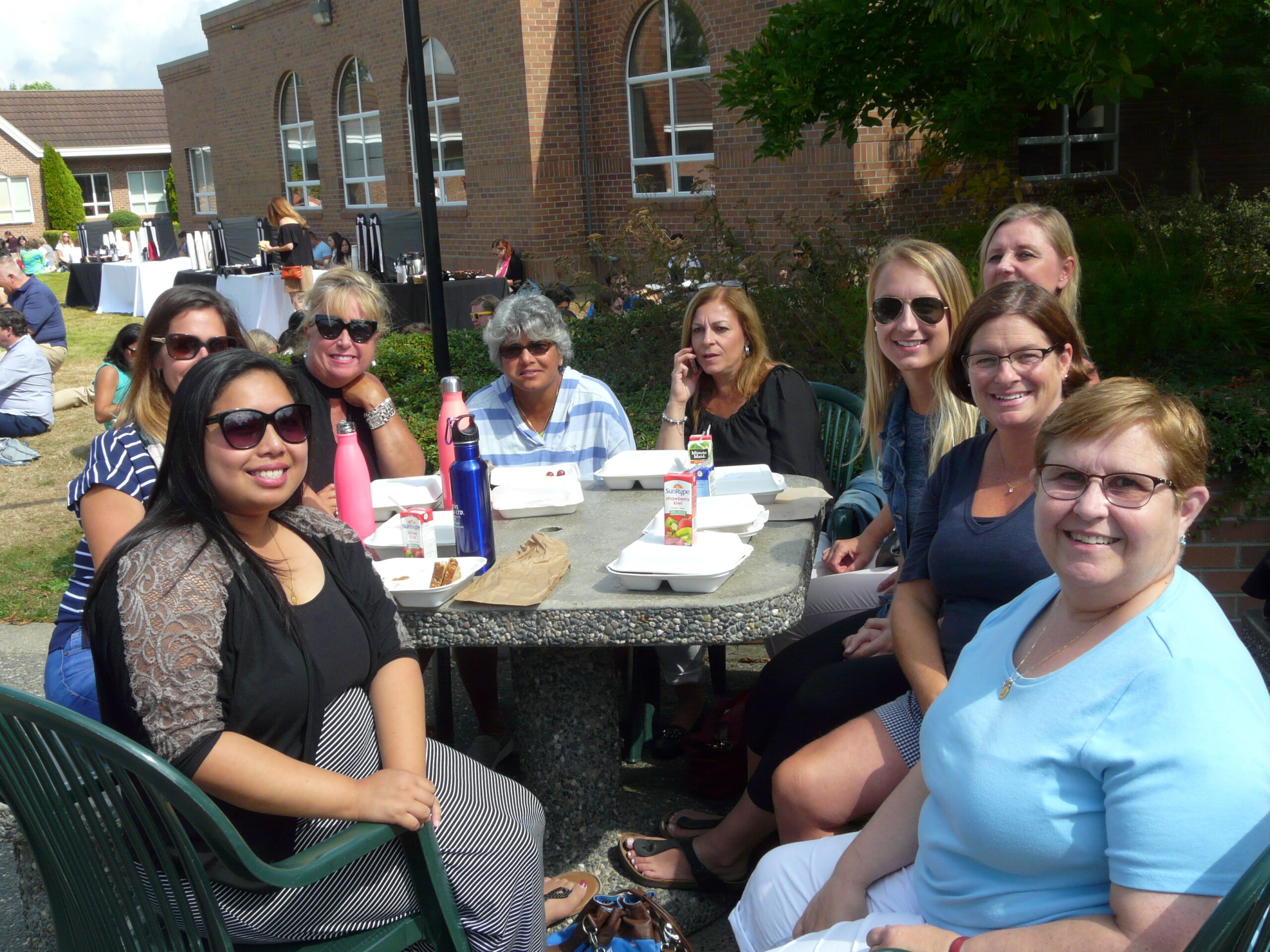

SURREY—Dear educators in the Catholic Schools of the Archdiocese. It really is a great joy for me to join with you – more than 1100 strong, a powerful force for proclaiming the Gospel to our youth and families – as we gather to celebrate the Eucharist this morning at what is now our annual gathering for the opening of the school year: Faith Development Day.
It is good
for us to be here: to express our gratitude to the Lord for calling us to be
educators in our wonderful Catholic schools; to exchange ideas with our
colleagues and friends; to be inspired and lifted up by turning our minds and
hearts to the greatness of the Gospel; and to learn more about why and how beauty,
truth and goodness shape a robust faith-filled understanding of our world.
I want to tell you how thankful I am that are you educators committed to our Lord Jesus Christ and to your friendship and personal relationship with him which gives enthusiasm and energy to your calling as Catholic educators. And, if you will allow me a personal confession, I would like you to know how proud I am of our Catholic schools and the great consolation they are to me as I look out on our local Church. No system and no school is perfect – nor can we expect them to be – but the many positive steps that you are taking to be increasingl intentional in fulfilling your mission of being evangelizing communities in the family of the Church is both inspiring and a great consolation.
What I wish for you at the outset of yet another academic year is put so well by the Apostle Paul, as it always is: “And may the Lord make you increase and abound in love for one another and for all” (1 Thes 3:12): to care for everyone in our common home of this Earth.
Gospel
This morning’s Readings exhort us to be ready and prepared when the Son of man comes in judgment at an hour we do not know and casts into outer darkness those who have mistreated others. It’s a bit scary, even intimidating. However, like a good doctor, Jesus’ parable warns us when our life-style is damaging our health and could lead to a premature death. Sometimes, she or he will “scare the daylights” of the patient, just to wake them up. That’s being a good physician. And that seems to be the main lesson the Lord wants to get across.[1]
But there is something curious in the parable. While the industrious servant is blessed for being prepared and ready for the Master when he arrives (cf. Mt 24:46), his reward is not an early pension or even a day off. Rather, he receives total responsibility for everything; in charge of “all his possessions” (Mt 24:47).
Let’s face it, it doesn’t seem like much of a reward. More work? But, for disciples, the truth of the matter is that the more they work for the Lord, the more they are immersed in his affairs – and he wants to draw all people to himself – the deeper the satisfaction. This is another of the paradoxes that mark the Christian life: to the one who has, more will be given besides. Keep this in mind when you are asked to do more than you thought you would have to do!
Hope
Now just one other thought focussed on the four words: “your Lord is coming” (Mt 24:42). In the parable, Jesus does not use the past tense here, as he might have in reference to himself: “God has come” among you. Nor is he referring to the future, “God will come,” but to the present: “your Lord is coming” (Mt 24:42). He is referring to a continuous action. In other words, in every moment of your life, “your Lord is coming.” He is there! Today, now!”
This tells us that our God, as we heard Peter confess in last Sunday’s Gospel, is the “living God.” He is not a God who is remote, just up there in a far-off Heaven somewhere, unconcerned with us an indifferent to our personal and collective history. Ours is not an absent God, but a God who is passionate in seeking us out for himself, knowing that is what gives us the “fullness of life” (Jn 10:10). We humans are experts at severing bonds and destroying bridges with others. He, however, is not. “If our heart cools, his remains ever incandescent. Our God accompanies us always, even if by mishap we should forget him.”[2]
He is a Father who never stops thinking of us and, while fully respecting our freedom, he desires our friendship: “I no longer call you servants but friends” (Jn 15:15), Jesus said at the Last Supper. God comes to save us. We cannot lose sight that the Lord is always coming to us, inviting us to conversion, to friendship and abundance of life with him (cf. Jn 15:15, 10:10):[3]
As believers, we have hope, hope that even now in the present moment we are on a pilgrimage, moving towards the fullness of reality, to God himself. In essence, we have hope because, by his grace, we know the heart of the good and merciful Father. Jesus, with his death on the Cross and his Resurrection, has revealed his Face to us, the face of a God so great in love as to communicate to us an uncrushable hope that not even death can break.”[4]


The ultimate reason, then, for our hope is that our Lord comes to us, right now. He enters our life with his love. We know and believe that, even in life’s hardest and most disturbing moments, the Lord’s mercy and goodness are greater than any trial, and that nothing will tear us from his hands and from friendship with him: “I am with you always, even to the end of the age” (Mt 28:20).
Our hope is steadfast and does not disappoint us; it never lets us down. Why? Not because we trust in what we can do or be, but because of the love that God himself has for each of us. It is easy to say: God loves us. We all say it. But do we mean it? On this point, Pope Francis makes an acute observation:
But think a bit: each one of us is able to ask: am I sure that God loves me? It is not so easy to say it. But it is true. This is a good exercise, to say to oneself: God loves me. This is the root of our certainty, the root of hope. . . . God loves me. ‘But in this difficult moment?’ – [yes,] God loves me. ‘I, who have done this bad and cruel thing?’– [yes,] God loves me. No one can take this certainty away. We must repeat it as a prayer: God loves me. I am sure that God loves me. I am sure that God loves me.[5]
To have such hope, such conviction, is, of course, a gift that we have received. “It is an extraordinary gift of which we are called to make ourselves ‘channels’, with humility and simplicity, for everyone.”[6] We proclaim this hope to others because we have as Father a God who opens his house to all human beings, beginning with the least and the most distant, with the marginalized and the suffering.
First as disciples and, coupled with that, as educators, you are heralds of hope, bearers of this trust and hope in God in your school communities: to your students, to your colleagues, and to the families you serve. This is the foundation of your evangelizing, the message you bring, “your Lord is coming” (Mt 24:42).
It is shown by the witness of your life – you live with meaning – and, as St. Peter says, you must also be ready to give an account for the hope within you: that you can, with gentleness and reverence, explain from the head and from the heart, why you are convinced of God’s love and why you live in hope.
[1] Cf. Aidan Nichols, Year of the Lord’s Favour, vol. 4 (Leominster: Gracewing, 2012), 152.
[2] Francis, General Audience (26 April 2017).
[3] Cf. Benedict XVI, Homily at First Vespers for the First Sunday of Advent (2 December 2006).
[4] Benedict XVI, Angelus (2 December 2007).
[5] Francis, General Audience (15 February 2017).
[6] Cf. Francis, General Audience (15 February 2017).







