

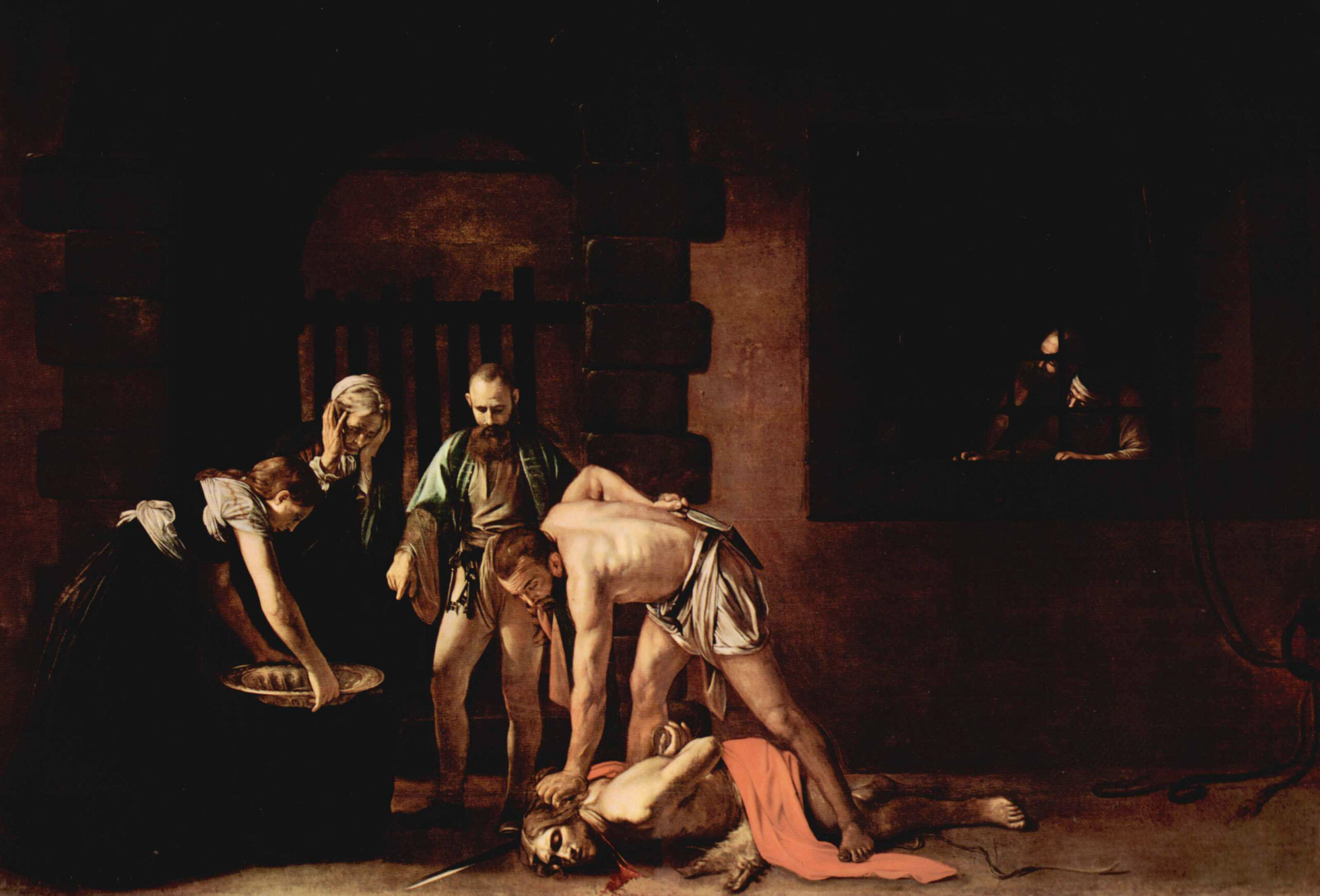

This is an excerpt from remarks on the feast of the Martyrdom of St. John the Baptist.
VANCOUVER—Allow me to say a few words about today’s feast, the Beheading or Martyrdom of St. John Baptist, and draw out from the Word of God something for your reflection.
It is a chilling, if vivid, episode. The conversation, the dancing, the head of John on a platter like a course at Herod’s birthday banquet makes for good reading.
John’ Silence
In looking at the Gospel, where John is the principal figure, is it not curious that the text has no words of John in it? He says nothing, but appears only in the gruesome form of the decapitated one. In some ways at least, here he is reduced to a “background” figure – just as he always understood himself to be: the one who pointed not to himself, but to Jesus; the one who said that he must decrease so that Jesus must increase.
Moreover, John’s unjust death at the hands of those who wanted to kill him, his docility – like a lamb led to the slaughter – and the tenderness with which the disciples “took John’s body and laid it in a tomb” (Mk 6:29) – all of those point out that the Baptist’s death foreshadowed Christ’s, just as every martyr’s death is a vivid memorial of the Lord’s Death on the Cross.
Is this not the way of the Religious? In a variety of different and creative ways – by your prayer, your joy, your compassion – you point beyond yourselves, ultimately to the Lord, so that they will not praise you but our Father in heaven. You are loved by the good Lord and by us, not because you make yourselves the centre of attention but because you are concerned with what is the most relationship in the world: that with God himself.
Martyr and Witness to Truth
Perhaps even more important than John’s silence in this last act o his life – though he had spoken clearly previously – is how he always points to Christ. Today we honour that fact of his martyrdom, what the Church is commemorating today. As you know, the English word “martyr” comes from the Greek word meaning “witness.” Martyrs are those who, without counting the cost, even when it led to hideous torture and an excruciating death, remained faithful.
“As an authentic prophet, John bore witness to the truth without compromise. He denounced transgressions of God’s commandments, even when it was the powerful who were responsible for them. Thus, when he accused Herod and Herodias of adultery, he paid with his life, sealing with martyrdom his service to Christ who is Truth in person.”[1]
It is not easy to bear witness to the saving truth of the Gospel in a culture which relativizes and trivializes the very notion of “truth,” which speaks of “my” truth and “your” truth – as if it were merely a matter of taste. To insist that God exists and that our human dignity demands that we be responsible for our actions: to be firm in our respect for life from conception to its natural end, to be adamant about the sacred value and of the family, to insist on the fact that there is a human “nature.”
For us, “there is also daily martyrdom, which may not entail death but is still a loss of life’ for Christ, by doing one’s duty with love, according to the logic of Jesus, the logic of gift, of sacrifice.”[2]
Herod: Seed Which Did Not Take Root
John the Baptist held Herod accountable; he was living in an immoral marriage with Herodias, who was both his sister-in-law and, scholars tell us, also his niece. And he knew it. Even so, Mark tells us that Herod liked to listen to John, and was unsettled by him. Perhaps he was even a little afraid of the austere desert prophet.
He had the Baptist arrested, but even so was fascinated by himThe Word reached his ears but not his heart; it did not take root in him. He is really a sad little man.
The manifestation of Herod’s immorality is shown not only in his licentiousness but also his impetuosity – by making an absurd promise to the dancing daughter of Herodias, usually called Salome – “half his kingdom” (Mk 6:23). He might well have made this oath simply to impress his guests.
And this is compounded by his willingness to go through with this, even though he “was deeply grieved.” Self-regard – what will others think? And not, what is the right thing to do? – guided his response. He was a coward. Valuing the high opinion and admiration of his guests was more important to him than an innocent man’s life.
“Herod’s actions show the snowball effect of unchecked sin, a common biblical theme . . . From adultery Herod progressed to debauchery and ultimately, via his rash oaths, to murder. Like Pilate later in the Gospel, Herod holds no malice toward his victim, yet cowardice and excessive concern for his own reputation lead him to bloodshed.”[3]
Herodias
Unlike Herod, Herodias is not at all hesitant. She is determined, but perversely so. She hated John the Baptist; she “had a grudge against John, and wanted to kill him” (Mk 6:18). She was just waiting for the opportunity to act.
While we do not act on our grudges and petty resentments in such a dramatic way, the idea of “getting back” by word or insinuation or even a deed, no matter how small, tells me that there is a bit of Herodias in all of us.
Salome
She is a willing accomplice in evil. Salome is both lascivious and willing to take part in her mother’s wickedness. This attitude, too, is not uncommon today. Perhaps we don’t initiate evil actions, but we do nothing to stop them and even take part in them. Watching movies of the Holocaust always brings this to mind.
Executioner
The silence of the Baptist is countered by that of the executioner. He is just obeying orders, as the saying goes. Nor did the guests. Just as in the Passion of Christ everyone was complicit, so too here. Jesus, like John, will meet his death because he confronts people with the truth of God’s merciful love revealed through him, his Gospel and, ultimately, his Paschal Mystery.
[1] Benedict XVI, Angelus (24 June 2007).
[2] Francis, Angelus (23 June 2013).
[3] Mary Healy, The Gospel of Mark (Grand Rapids: Baker Academic, 2008), 121.







