
At the time of writing this, the Academy Awards have not been awarded, but judging from other film awards already announced, Three Billboards Outside Ebbing, Missouri is likely to garner several Oscars. In some areas it may well be deserving of recognition, but certainly not in the Best Picture or Best Screenplay categories.
The basic elements of any work of fiction – film or other genre – are plot and character. Three Billboards … suffers from major flaws in these areas.
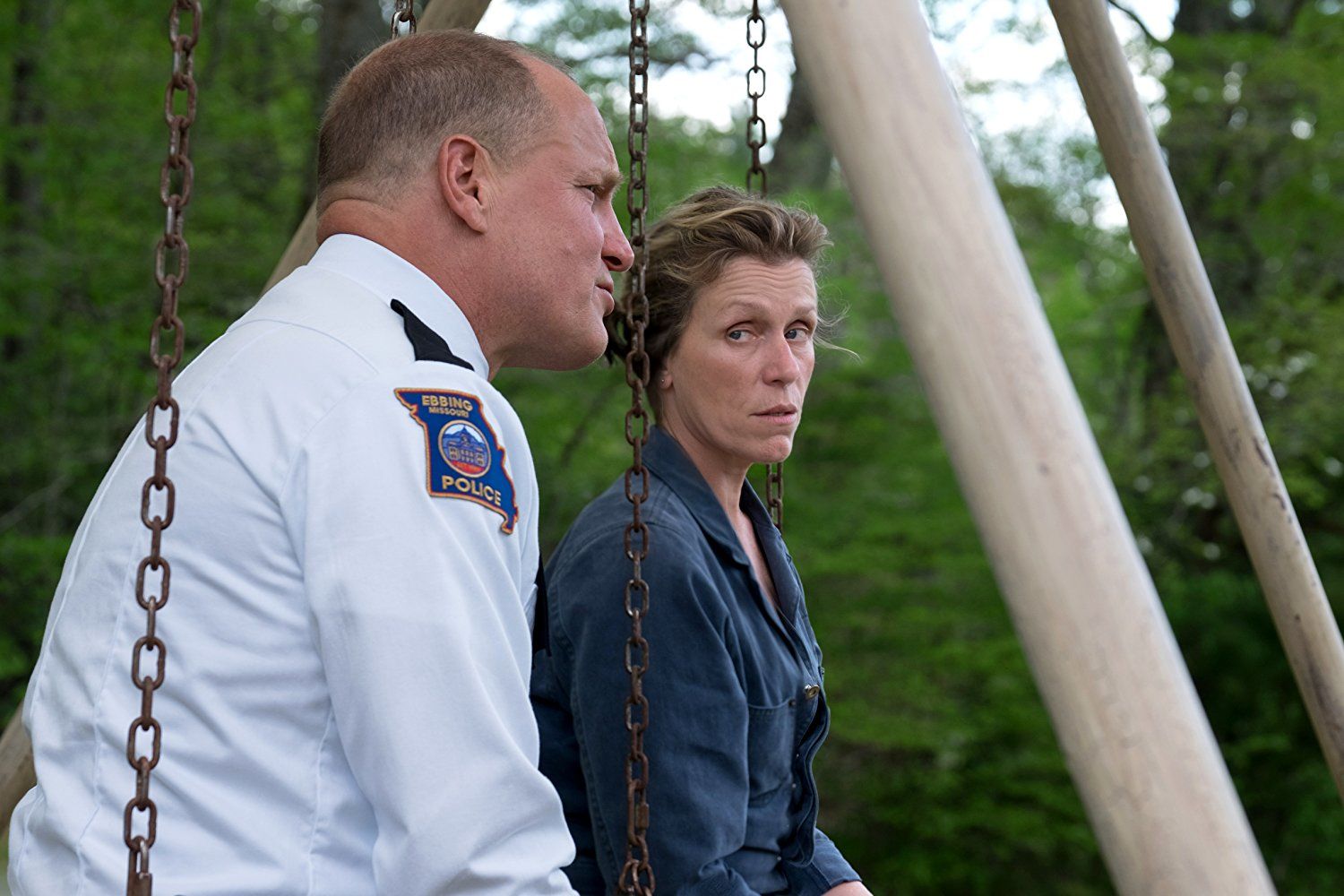
The film tells the story of an angry mother whose daughter was raped and murdered. After many months, the police have not been able to track down the killer. As a protest at what she sees as police indifference, she rents three billboards outside her small, Southern town, asking why the sheriff has not brought the investigation to a satisfactory conclusion.
Since she herself is not a particularly popular person, while the sheriff is, the result is that the townspeople make clear their disapproval of her action. The town in general and the police force in particular are filled with prejudice and racism, so what ensues often becomes nasty, especially as the mother decides to take vengeful action herself.
All of this might well be satisfactory in that the scenes are played out with conviction and skill. However, later in the film, the plot undergoes a complete change of trajectory, and the main characters undergo a 180-degree turn – acceptable if a more convincing plot device to effect this change were introduced. As it is, one might as well assume that a simple message, such as might be found in Chicken Soup for the Soul, is all that is necessary to transform the most hardened criminal. As if this unlikely and clumsy development were not weakness enough, the fact that it is effected by the even clumsier device of voice-over dialogue makes the film even weaker.
Of course, it is pleasant to know that the makers believe that the audience is looking for a nice positive message, one which will give hope in these times of anger, but good intentions do not necessarily make for good results. While the acting is excellent and the direction sharp, in the end the film leaves one thinking that the climax could not possibly happen.
At the same time, I for one am getting fed up with films in which no character seems to be able to utter a line without having recourse to the grossest language. I recognize that such language is realistic, and I certainly do not want to return to the days when The Moon is Blue was banned in Boston for using the word “virgin.”
However, as one is forced to crawl through a sewer of obscenities in films such as Three Billboards…, I, Tonya, and Molly’s Game, I cry, “Enough is enough!”
I think back to films such as On the Waterfront and African Queen – films which depicted ordinary working class characters in convincing fashion without needing to resort to an uninterrupted stream of crude vulgarities.
Despite what many might regard as a lack of realistic dialogue, they have proved to be enduring and popular classics. Isn’t it about time that modern screen writers exhibited their skill at portraying, in convincing fashion, ordinary people without resorting to such a barrage of offensive language? A little self-censorship might make movie-going a more satisfactory experience for the viewers.