

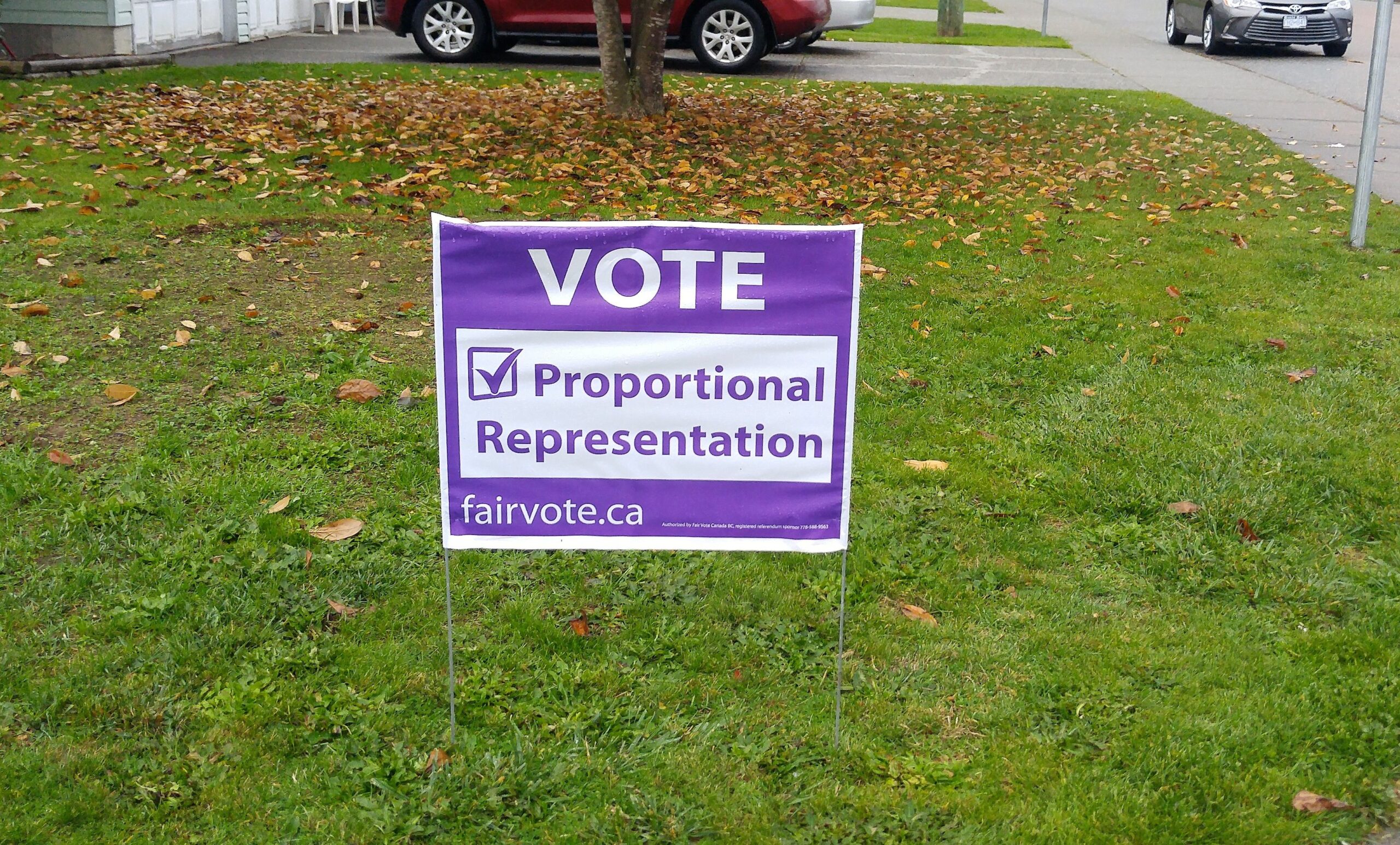

I just received the Voter’s Guide to the referendum question on electoral reform. I was hoping for a clear choice between our current system and a clearly articulated alternative proportional system.
Instead the Guide describes three complicated alternative systems, two of which are not used anywhere else in the world, and none of which provide the clarity I was seeking.
Instead, I am being asked to rank in order the three alternative systems without knowing the boundaries of my electoral district; the number of MLAs to be elected; whether both the first and second candidate in my district will be elected, or who will actually represent me – someone I voted for or someone chosen by a political party who may not even live in my district.
These questions will only be answered after the referendum, and will be determined by committees, commissions, and politicians.
None of this is surprising. The Yes side knows that the clarity of the referendum question dictates the outcome. Research has shown that when citizens are provided with a clear informed referendum question, proportional representation has almost always failed. That is why the government has made the current question so confusing and ambiguous. Their message is that “voters can’t be trusted to make the right choice if they are fully informed, so let’s keep them in the dark.” This is both undemocratic and anything but “Reform.”
I will vote in favour of keeping our current First Past the Post system which is easily understood: One Person; One Vote. The person who gets the most votes earns the right to represent me. This simple voting system has served our democracy well by providing stable, predictable and good governance for over a hundred years. And I will do so with a clear understanding about what I am voting for!
John Amon
Victoria
(We welcome letters on all sides of B.C.’s Electoral Reform Referendum, which ends Nov. 30. Send letters to letters@rcav.org – Editor)
Re Graham Osborne’s Oct. 15 article “Should confirmation be later – or earlier?
If we were living in a holy and perfect world we could go back to the early days as described by Graham Osborne. But in our part of the world our children grew up in a permissive, faithless, anti-God society, and their learning at our Catholic schools, PREP programs, together with the good examples of parents and grandparents is insufficient for many to withstand the influence of society.
We need to prepare our children and teens better so they stand strong in their faith and live their lives like mom, dad, and grandparents. We are failing our youth and the status quo is not an option. We have to do more and do it better.
Why not delay the age of confirmation and have a program in place for two or three years covering the basics of our faith, drugs, teen suicide, drinking and driving, etc. – topics they can relate to.
It is not easy to get our teens together, as they are busy with school and sports. Perhaps a few Saturday or Sunday afternoons in the fall and spring. This could be an inter-parish plan, requiring fewer resources. It would be great for our students in public high schools to hang out with others sharing their faith.
End the sessions with Mass and a short, meaningful homily, perhaps offered by our deacons under the guidance of our Archbishop.
There will be better suggestions. Let us listen, move forward, and make a change.
Steve De Jong
Surrey
I must disagree with Paul Schratz’s Oct. 15 column “Wanted: pro-family housing solutions.”
First, subdividing properties would lead to an enormous strain on infrastructure – bridges, sewage systems, water supply, garbage removal, and policing. (More populated areas statistically have higher crime rates.
Second, “adjusting” (read lowering) the market to accommodate the millennials will teach them that it’s not hard work, being smart, and making independent decisions that lead to success; to succeed in their minds would involve taking away from other people.
Gregoz Gawronski
North Vancouver
Re Sheila Giouto’s Oct. 22 letter “The art of preaching is lacking.”
I am grateful for her honest and frank criticism of our homilies. I do think we need to listen to the faithful and their needs, especially in this area of the Word of God and our homilies.
She mentioned her hopes that seminarians will take seriously the art of preaching. So I have posted her letter (enlarged) in our seminary classroom to help communicate this reminder from the laity. Pray for our homiletics course that it bears fruit in our future priests, and that the “Jesus message” be more effectively communicated. God bless.
Father Joseph Park, OSB
Seminary of Christ the King
Mission







