


31st
Sunday in Ordinary Time, Year B
First
Reading: Dt
6:2-6
Second
Reading: Heb
7:23-28
Gospel
Reading: Mk
12:28-34
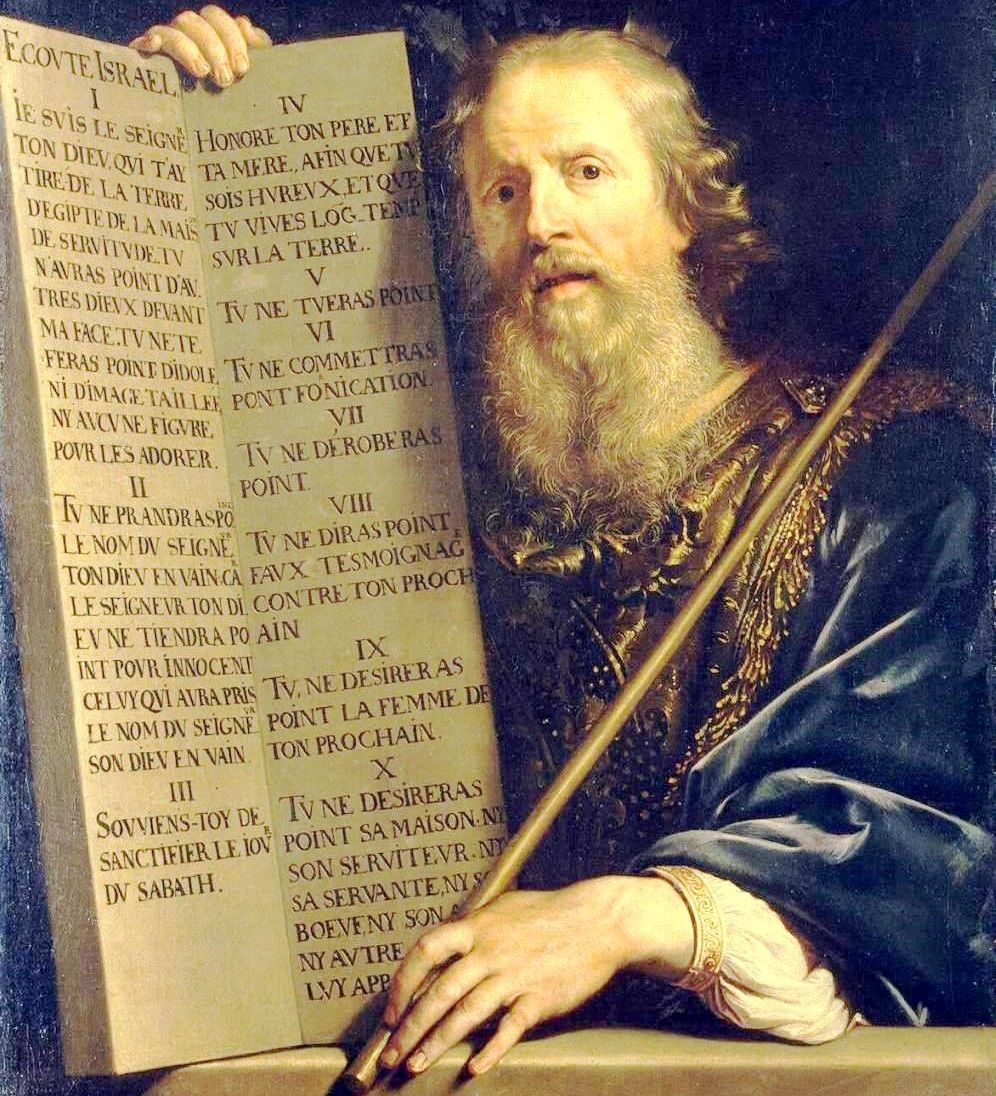
This Sunday’s Readings speak about the Ten Commandments, which God gave Moses. They represent the “insurmountable limits” which humans “must freely recognize and respect with trust,” says the Catechism of the Catholic Church.
Very early, we learn that there are patterns in the physical universe; for example, water refreshes, washes, or drowns us; fire warms or burns us; and objects move when we push them. Our certainty about these patterns makes us call them “laws,” which represent limits on our bodies.
Similarly, the moral laws, or the laws of right and wrong, represent limits on our souls. However, they differ from the physical “laws” in three important ways.
First, the physical “laws,” or patterns, are not necessary in the logical sense; that is, it is not impossible or unthinkable that God can, and sometimes does, do things differently. (We call such events “miracles.”) However, the moral laws could not possibly be different, for they reflect God’s nature and its image in human nature.
Second, the physical “laws” are the patterns according to which physical objects do in fact normally behave, while the moral laws describe the way in which humans, to conform to God’s image, ought to behave.
Third, we cannot refuse to conform to the physical “laws,” or patterns, but we can refuse to conform to the moral laws.
In other ways, moral law is similar to physical “law.” Both must be learned; we cannot invent, abolish, change, or escape either. If we know them, we can act freely within them, but if we do not know them, or if we ignore them, we can be damaged or destroyed, soul or body.
From the beginning, God implanted the moral law in our hearts, but when Adam and Eve fell, our wills became perverted and our reason obscured. In our fallen state, we needed to be reminded of the moral law and have it fully explained to us. Accordingly, God gave us the Ten Commandments.
The Ten Commandments were a gift from God. They were part of a covenant in which he swore to be our God and to make us his people. Through them, he taught us how to escape the slavery of sin and to become his children. (Significantly, he gave us this gift while he was freeing the Israelites from slavery in Egypt.)
However, fallen human beings found it impossible to keep the commandments perfectly. The Israelites broke every one of the first five covenants that God made with them.
The Jewish scribes tried to help the people keep the Law by prescribing exactly how it should be understood in all possible circumstances. By Jesus’ time, it had expanded to thousands upon thousands of rules and regulations occupying more than 50 volumes. In order even to try to keep them all, the Pharisees separated themselves from ordinary life. (“Pharisee” means “separated one.”)
In contrast, the scribe in the Gospel Reading realized that to love God with all one’s being and to love one’s neighbour as oneself “is much more important.” Accordingly, Jesus said that he was “not far from the Kingdom of God.”
Jesus said he had come not to abolish the Law, but to fulfill it. He did so by keeping it himself “in its all-embracing detail,” down to “the least of the commandments.” Moreover, he gave the Law its “definitive” interpretation. Then, on the cross, he took upon himself “the curse of the Law”: the punishments, judgments, or consequences incurred by those who do not “abide by the things written in the book of the Law.”
The Jewish high priests had offered sacrifices “day after day” in atonement for sin without success. Now, by sacrificing himself to his Father, Jesus became our great High Priest, “holy, blameless, undefiled, separated from sinners, and exalted above the heavens.”
It is that sacrifice, offered “once for us all,” that is re-presented to us in the Mass.
Father Hawkswell teaches a free course on the Catholic faith on Mondays until Pentecost: from 11 a.m. to 1 p.m. at St. Anthony’s Parish, 2347 Inglewood Avenue, West Vancouver, and again from 7 to 9 p.m. at the John Paul II Pastoral Centre, 4885 Saint John Paul II Way (just off 33rd Avenue between Oak and Cambie). Everyone is welcome, Catholic or non-Catholic.







