


30th
Sunday in Ordinary Time, Year B
First
Reading: Jer
31:7-9
Second
Reading: Heb
5:1-6
Gospel
Reading: Mk
10:46-52
This Sunday’s Readings show how God loves us. “See, I am going to bring them from the land of the north,” he says in the First Reading. “With consolations I will lead them back … for I have become a Father to Israel.”
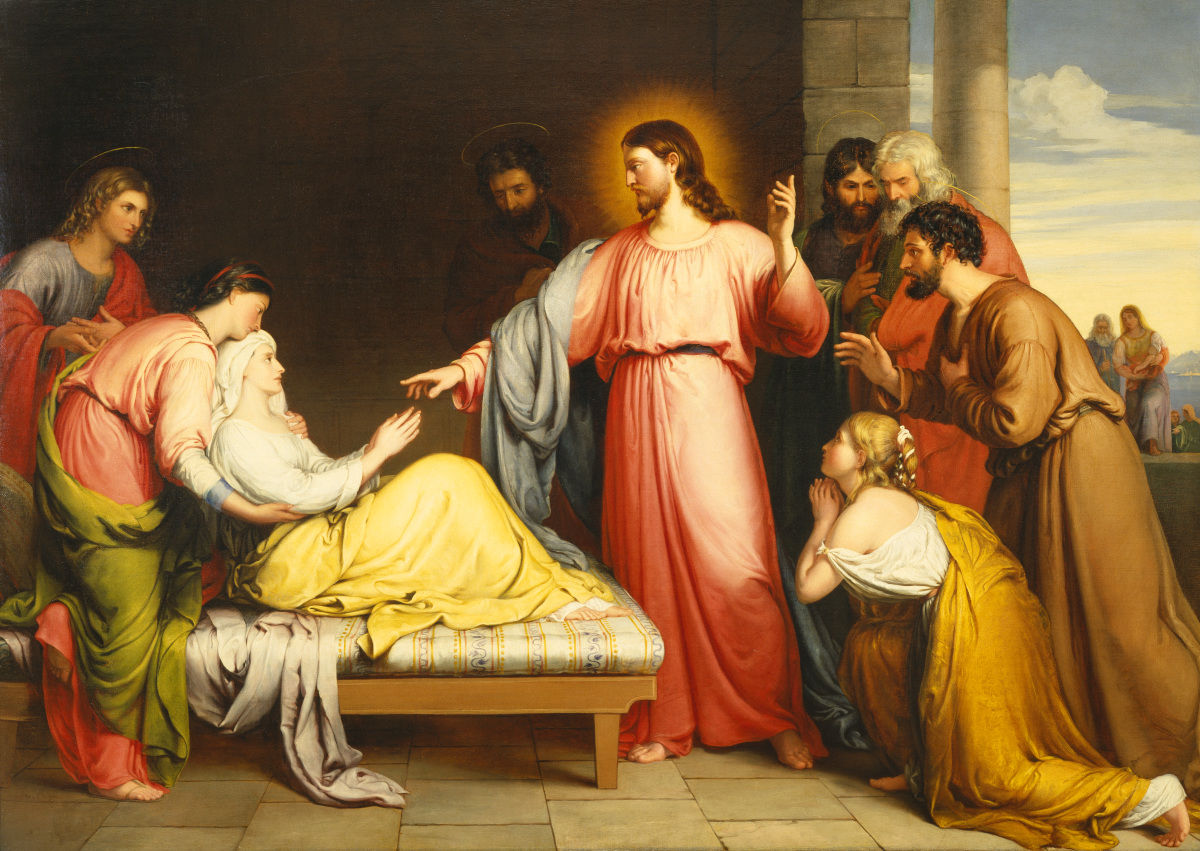
In the Second Reading, he appoints his own Son High Priest, to sacrifice himself to make amends for our rebellion. In the Third Reading, Christ shows his love for us: a love which led him not only to suffer torture and death, but also to cure blindness and deafness, relieve suffering, and enlighten ignorance.
“God is love,” St. John said. God is love in his triune being; he did not have to create in order to have someone to love. Nevertheless, lacking nothing in himself, he loves us and wants to share his divine life with us.
“The Son of God became Man so that we might become God,” St. Athanasius said. God the Son, “wanting to make us sharers in his divinity, assumed our nature, so that he, made Man, might make men gods,” St. Thomas Aquinas said.
In order to respond adequately to this love, we must constantly correct the self-ward leaning of our fallen human nature. Consequently, we tend to think of God’s will for us as unpleasant by nature: something we must endure, accept, put up with.
However, there is a misconception here. God’s plan for us is to adopt us into the Holy Trinity. The life of the Holy Trinity is a life of love. In the accomplishment of his plan, therefore, God wants not just our meek resignation, but rather our deliberate, willing, and free co-operation.
God is a Lover. He loves us. What lover is satisfied when the beloved, initiating nothing, responds resignedly “Whatever you like, dear” to all his proposals? Besides, is it not rather insulting to our divine Lover to assume that his plan for us will always be unpleasant?
God loves us. “Would one of you hand his son a stone when he asks for a loaf, or a poisonous snake when he asks for a fish?” Jesus queried. “If you, with all your sins, know how to give your children what is good, how much more will your heavenly Father give good things to anyone who asks him!”
C.S. Lewis points out that God has “filled his world full of pleasures”: things for humans to do all day long “without his minding in the least – sleeping, washing, eating, drinking, making love, playing, praying, working.”
In accepting the pleasures, as well as the duties, of life, we have to say “Thy will be done,” Lewis notes, for we often, “almost sulkily, reject the good that God offers us because, at that moment, we expected some other good.” On every level of life, whether religious, gastronomic, erotic, aesthetic, or social, “we are always harking back to some occasion which seemed to us to reach perfection, setting that up as a norm, and depreciating all other occasions by comparison.”
These other occasions “are often full of their own new blessings if only we would lay ourselves open to them,” he says. “God shows us a new facet of the glory, and we refuse to look at it because we’re still looking for the old one.”
Even more insulting to our divine Lover would be the attitude that we should never accept joy from his hands, but always “deny ourselves” and “take up our cross.” True, we must do penance for our sins, particularly by prayer, fasting, and almsgiving, and doubtless none of us does enough, but what lover wants all his gifts returned, however high-mindedly? Surely a lover enjoys seeing his gifts enjoyed!
God is a Lover. He loves us. “All who love me will keep my words,” he says in the Gospel Acclamation, “and my Father will love them, and we will come to them.”
Father Hawkswell teaches a free course on the Catholic faith on Mondays from 11 a.m. to 1 p.m. at St. Anthony’s Parish, 2347 Inglewood Avenue, West Vancouver, and again from 7 to 9 p.m. at the John Paul II Pastoral Centre, 4885 Saint John Paul II Way (just off 33rd Avenue between Oak and Cambie). Everyone is welcome, Catholic or non-Catholic.







