
27th
Sunday in Ordinary Time, Year B
First
Reading: Gn
2:7ab, 15, 18-24
Second
Reading: Heb
2:9-11
Gospel
Reading: Mk
10:2-16
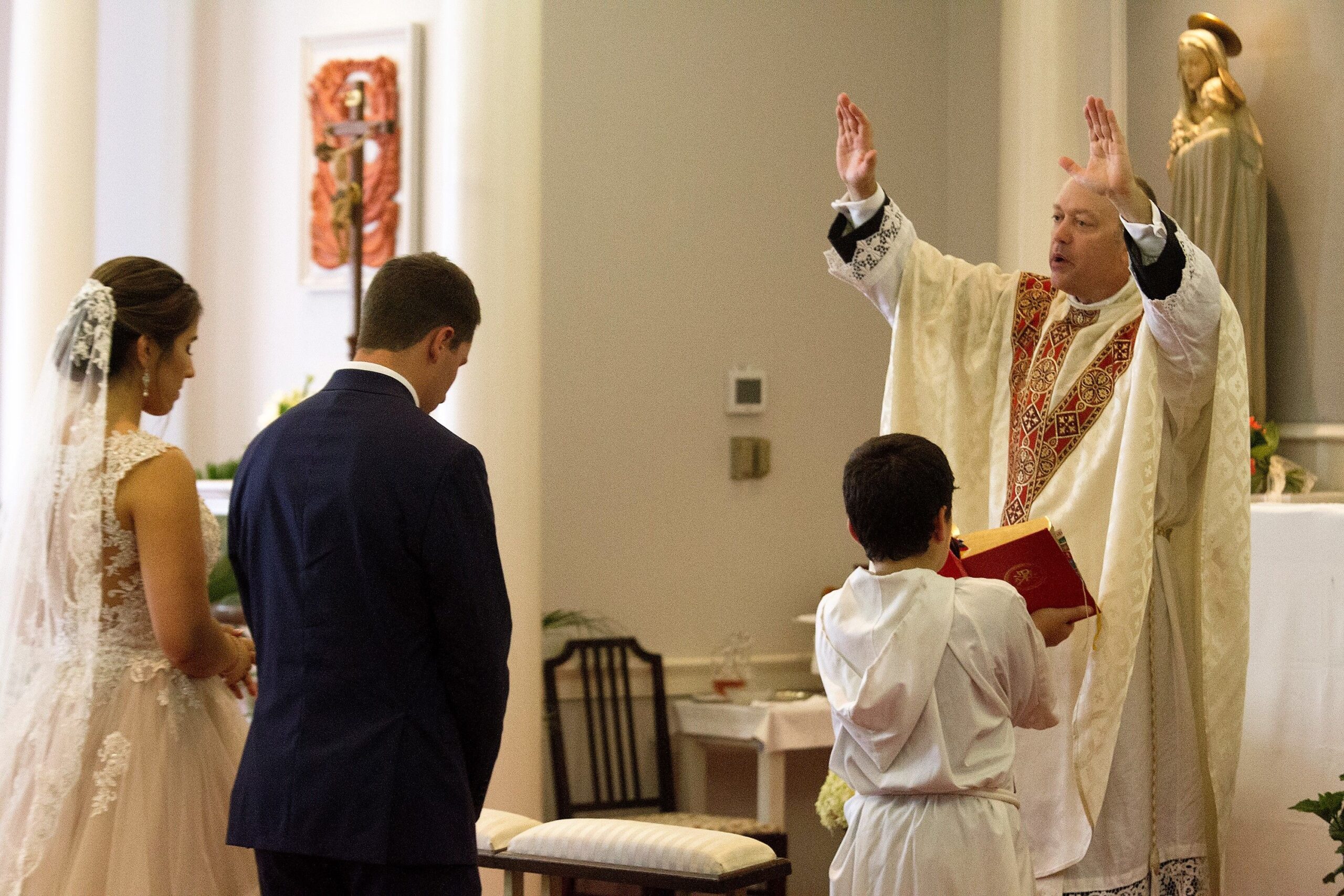
This Sunday’s First Reading, from Genesis 2, tells how God instituted marriage. “It is not good that the man should be alone,” he said; “I will make him a helper as his partner.” Therefore “a man leaves his father and his mother and clings to his wife, and they become one flesh.”
Genesis 1 is different. There, “God created man in his image; in the divine image he created him; male and female He created them.” And God blessed them, saying, “Be fertile and multiply; fill the earth and subdue it.”
Both of these accounts precede the story of the original sin committed by Adam and Eve when they preferred themselves to God, denying the fact of their “creaturely status,” as the Catechism of the Catholic Church says.
Both accounts, therefore, show us what marriage was in the very beginning, as Pope St. John Paul II stressed in his theology of the body. Jesus refers to them when he says, in the Gospel Reading, “From the beginning of creation, ‘God made them male and female. For this reason a man shall leave his father and mother and be joined to his wife, and the two shall become one flesh.’”
Accordingly, the Catechism affirms that “the intimate community of life and love which constitutes the married state has been established by the Creator and endowed by him with its own proper laws … God himself is the author of marriage.”
“Marriage is not a purely human institution, despite the many variations it may have undergone through the centuries,” it says. “The vocation to marriage is written in the very nature of man and woman as they came from the hand of the Creator.”
In Himself, God, who is three Persons, “lives a mystery of personal loving communion,” St. John Paul said in his 1981 document Familiaris Consortio. Intending to create humans in his own image, he gave them, too, the vocation, the capacity, and the responsibility of love and communion. Whether we realize that vocation through marriage, or through celibacy and virginity, we are called to love in our “unified totality” of body and soul.
“Love includes the human body, and the body is made a sharer in spiritual love,” the Pope said. Consequently, our sexuality “is not purely biological, but concerns the innermost being of the human person.”
In marriage, husband and wife “realize” their sexuality by giving themselves to each other in “the acts which are proper and exclusive to spouses,” he said. This realization is “truly human” only if it is “an integral part of the love by which a man and a woman commit themselves totally to one another until death.” In fact, it “would be a lie if it were not the sign and fruit of a total personal self-giving.” To “withhold something,” or to “reserve the possibility of deciding otherwise in the future,” is to refuse to give totally.
The totality of conjugal love includes “responsible fertility,” the Pope added. “This fertility is directed to the generation of a human being, and so by its nature it surpasses the purely biological order.”
In marriage – “the covenant of conjugal love freely and consciously chosen” – spouses accept “the intimate community of life and love willed by God himself,” the Pope said. Marriage is not an artificially imposed ceremony or “an undue interference by society or authority.” Rather, “it is an interior requirement of the covenant of conjugal love.” In fidelity to God’s plan, it publicly affirms that love as “unique and exclusive.”
God ordained marriage to bring “many sons and daughters to glory,” as St. Paul puts it in this Sunday’s Second Reading. In God’s plan, therefore, spouses become “sharers in creative Wisdom,” St. John Paul said.
Marriage is the free, full, faithful, and fruitful union of a man and a woman, ordained by God from the beginning. Nothing less deserves to be called marriage.
Father Hawkswell teaches a free course on the Catholic faith on Mondays until Pentecost: from 11 a.m. to 1 p.m. at St. Anthony’s Parish, 2347 Inglewood Avenue, West Vancouver, and again from 7 to 9 p.m. at the John Paul II Pastoral Centre, 4885 Saint John Paul II Way (just off 33rd Avenue between Oak and Cambie). Everyone is welcome, Catholic or non-Catholic.