


26th
Sunday in Ordinary Time, Year B
First
Reading: Nm
11:25-29
Second
Reading: Jas
5:1-6
Gospel
Reading: Mk
9:38-43, 45, 47-48
When Eldad and Medad began to prophesy without having gone through the same ritual as the other 68 elders, Joshua wanted to stop them. Similarly, when the disciples saw someone casting out demons in Jesus’ name, they tried to stop him. However, Jesus said, “Whoever is not against us is for us.”
In the past, Catholics have tended to assume that anyone outside the Church could not be inspired by God or have right on his side. However, Vatican II said, “The Catholic Church rejects nothing of what is true and holy” in other religions.
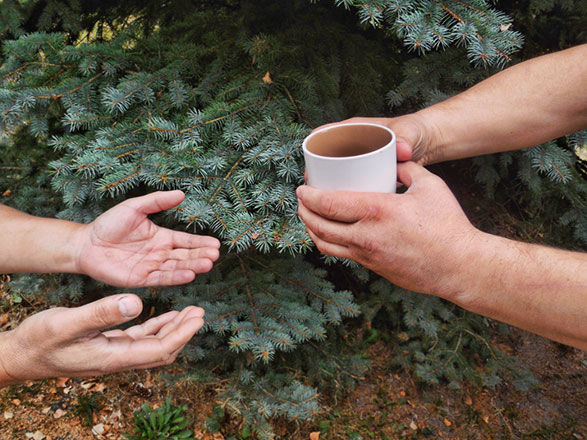
Moreover, Christ said that he will welcome people from “all the nations” even if they do not know him, provided they have shown love to his “brothers.” In this Sunday’s Gospel Reading, he says “whoever gives you a cup of water to drink because you bear the name of Christ will by no means lose the reward.”
“Those who, through no fault of their own, do not know the Gospel of Christ or his Church, but who nevertheless seek God with a sincere heart, and, moved by grace, try in their actions to do his will as they know it through the dictates of their conscience – those too may achieve eternal salvation,” says the Catechism of the Catholic Church.
Nowadays, this is so well understood that we tend to fall into the opposite error, supposing all religions, or no religion, to be equally good ways to God.
No, says the Catechism. “All salvation comes from Christ the head through the Church, which is his Body.” The Church “is necessary for salvation” because Christ, “the Mediator and the Way of salvation,” is present to us “in his Body, which is the Church.” Accordingly, no one could be saved “who, knowing that the Catholic Church was founded as necessary by God through Christ, would refuse either to enter it or to remain in it.”
It is true that “in ways known to himself, God can lead those who, through no fault of their own, are ignorant of the Gospel, to that faith without which it is impossible to please him,” the Catechism asserts. Nevertheless, “the Church still has the obligation and also the sacred right to evangelize all men.”
In the Declaration Dominus Iesus, published Aug. 6, 2000, the Vatican warned that the Church’s missionary work “is endangered today by relativistic theories which seek to justify religious pluralism.”
On the contrary, “Jesus Christ has a significance and a value for the human race and its history which are unique and singular, proper to him alone, exclusive, universal, and absolute,” it says. “The key, the centre, and the purpose of the whole of man’s history” is to be found in him. Moreover, “the fullness of Christ’s salvific mystery belongs also to the Church, inseparably united to her Lord,” for Jesus “continues his presence and his work of salvation in the Church and by means of the Church.”
The “one true religion” founded by Christ “continues to exist fully only in the Catholic Church,” the document says. In fact, the elements of “sanctification and truth” found elsewhere “derive their efficacy” from the “fullness of grace and truth entrusted to the Catholic Church.”
The Church, therefore, is the “universal sacrament of salvation,” for she has “an indispensable relationship with the salvation of every human being.”
We Catholics should rejoice that God has chosen us to help dispense his truth in its fullness. At the same time, we must remember what Jesus said: “When much has been given a man, much will be required of him; more will be asked of a man to whom more has been entrusted.”
In the language of the Second Reading, we must not let our gold and silver rust. We must not hoard them, but share them generously, following Christ’s command to “go into the whole world and proclaim the Gospel to every creature.”
Father Hawkswell will be teaching a free course on the Catholic faith starting September 24. It will run on Mondays from then until Pentecost: from 11:00 am to 1:00 pm at St. Anthony’s Parish, 2347 Inglewood Avenue, West Vancouver, and again from 7:00-9:00 pm at the archdiocesan centre, 4885 Saint John Paul II Way (just off 33rd Avenue between Oak Street and Cambie Street). Everyone is welcome, Catholic or non-Catholic.
(An editing error in the print edition of Father Hawkswell’s Sept. 17 column resulted in a photo caption that implied clerical abusers should be hated. Father Hawkswell’s column clearly stated we should “direct toward our own sins the hatred we feel for child abuse and its concealment.” We regret the error. – Editor)







