


“Look Mommy! I’m more Catholicker than you!”
Tommy was pulling a collection of lovingly gathered sacramentals over his head, and he said it with joy, not pride. He had a two-inch plastic gold Miraculous Medal, with a crucifix big enough for a monk, and a variety of saints. He had put them on a piece of string and happily wanted to display his Catholicity.
“Look Mommy! I’m using my money to light a candle to Saint Joseph!”
It is always a terrifying sight to watch a five-year-old struggle with the lighting sticks and votive candles in a church full of flammables. But I let him: it is a rite of devotional passage, after all, and I internally translate his statement, “Look Mommy, I’m more Catholicker than you.”
“You certainly are, Tom,” I think to myself.
It has been my experience that a certain age comes when pre-catechized children become a little preoccupied with what it means to be Catholic … and with what it means to not be a Catholic.
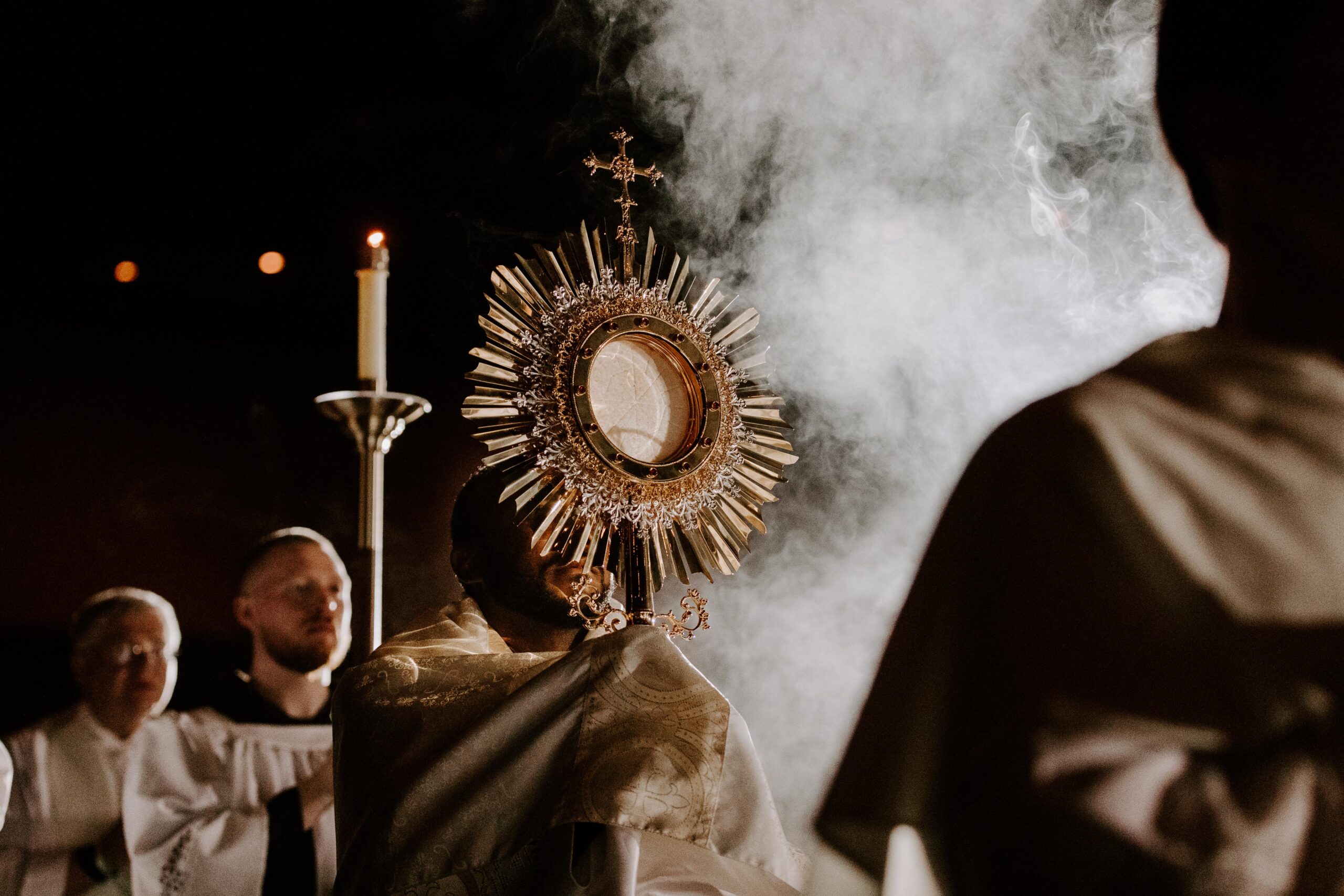
My little boy’s senses are filled with candles, and sacred art, altar rails, entrance antiphons and incense smoke (thank you, Father). These and the necklace of perhaps gaudy medals are a part of his catechism. He associates them with being Catholic.
His faith is still untainted, and so, the sight of someone kneeling before God in the Eucharist teaches him more about faith, reverence, and beauty than a well-worded textbook. And this is true, and right, because humans are made up of more than intellect, and even a five-year-old will know God in the smells and bells of his church. This is a proof of the rightness of authentic Catholicism.
Because certain family and friends aren’t necessarily papists, he wonders at certain catechism questions that talk about heaven, purgatory, and hell. Pictures of people making their way to salvation, holding tightly onto the Barque of Peter, from the outside, fill his mind. Up to this point, the word Christian has rightfully been equated with Catholicism, but now an awareness of the world’s spiritual problems has begun.
“Mommy, if someone stops at the crosswalk for us, does that mean they are Catholic?” The sincerity and depth of this question he really asked me last week as we walked, hand in hand, across the crosswalk to the library across town still fill me with awe.
What he was asking me was, Are all good people Catholic, and are all Catholics good?
I stuttered over my answer because, obviously, the answer to both is no. “Most people want to be good, Tommy, but that doesn’t mean they are Catholic. Hopefully, God is leading them on their way, but people get easily misled and confused. When the devil sees that our hearts are trying to be good, and that we’re thinking about God, he works hard to win us back. He’ll tempt us with selfishness and ingratitude.”
“What’s ingrintitude?”
“Ingratitude is when we choose to be unhappy or jealous, even though we have been given so much, even though we have been given more than we deserve. This is a really big sin, Tom.”
“Did God give us the flowers?”
“Yes, and the bees, (we like to lie on the grass and watch bees on the clover), the sunshine, ice cream, the blueberries, our house, and Daddy’s job. When we are grateful to God it means more than saying thank you. It means knowing that without him, we have nothing. Some people have lots of stuff, more stuff than us, but without God, it’s still nothing. And if they don’t feel like they should say thank you to him, they won’t know gratitude and happiness. You can’t be Christian without gratitude. But gratitude can help bring a person to Jesus.”
Maybe this all sounds a little romantic, a mother and son holding hands, bee-watching, and talking about gratitude. If someone thought this was the norm in our messy human family life, they would have been misled by a moment’s romance.
The conversations with a very much “more Catholicker” little boy probably make more of an impact on me than on him. Bees, ice cream, people stopping at crosswalks, and all of the things that make him thankful are things of the senses, things he sees and tastes and smells. They, like the candles and medals, are another proof of how God calls to us through our senses. They are God’s first primitive introduction to sacramentals. My son sees, smells, and tastes them and thinks of the goodness of God.
A Catholic church stripped of ancient sacramentals goes against the human nature he gave us. They speak to us of God and should make us more Catholicker. So this is a new thought to me, but not to Tommy.







