


Fourth Sunday of Ordinary Time, Year A
First Reading: Mal 3:1-4
Second Reading: Heb 2:10-11, 13b-18
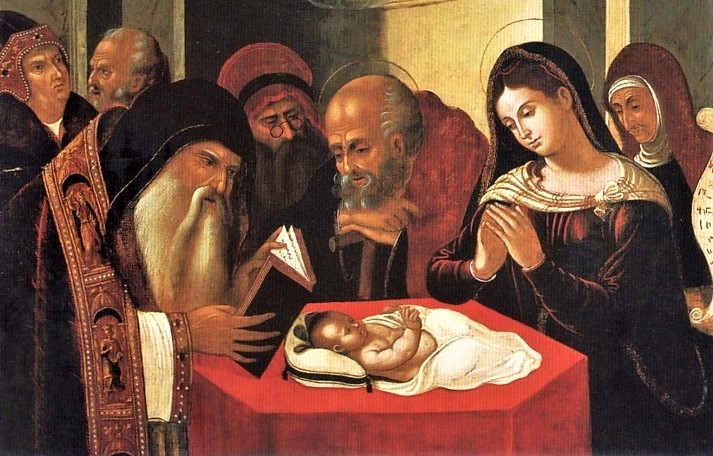
Gospel Reading: Lk 2:22-40
In this Sunday’s Gospel Reading, Mary and Joseph offer a sacrifice to the Lord in obedience to the old law.
Sacrifice is the offering of a victim to God to acknowledge his supreme dominion and our total dependence on him. It surrenders to God something precious, thereby making it holy. Sacrifice is the highest form of adoration.
“Consecrate to me every first-born that opens the womb among the Israelites, both of man and beast, for it belongs to me,” God told Moses. “I consecrated them to myself on the day I slew all the first-born in the land of Egypt.”
God also commanded that a woman undergo purification 40 days after the birth of a son, offering a lamb for a holocaust (if she could afford it) and a pigeon or a turtledove for a sin-offering.
Now Joseph was Jesus’ legal father, but Jesus was God the Son: he did not need to be consecrated to God. The Letter to the Hebrews says Christ came into the world and, in place of “sacrifice and offering,” he said to God, “Behold, I come to do your will.”
Nor did Mary need to be purified. Gabriel had called her “full of grace,” and in 1854 the Church proclaimed that her son had preserved her “immune from all stain of original sin.”
Why, then, did Mary and Joseph offer their son to God? Why did Mary undergo the purification ritual? The answer is that Jesus “had to become like his brothers and sisters in every respect.”
This Sunday’s Feast of the Presentation continues the wonder of Christmas by emphasizing how completely God became man. Christ is not ashamed to call us his “brothers and sisters.”
In assuming human nature, Christ took upon himself even our sins, atoning for them by the sacrifice of his own body. And when the soldier’s lance pierced his side, a “sword” pierced Mary’s heart.
At Mass, in place of lambs, we offer Christ himself to his father. John the Baptist called Christ the “Lamb of God.” That is why we say, “Lamb of God, you take away the sins of the world; have mercy on us.” And immediately afterward, the priest holds up the body of Christ, looking like a broken piece of bread, and says, “Behold the Lamb of God, who takes away the sins of the world.” Sacrifice is still an integral part of our religion.
Now the Catechism of the Catholic Church says that God the Son “became man so that we might become God.” The Son of God, “wanting to make us sharers in his divinity, assumed our nature, so that he, made man, might make men gods.” Indeed, God has “divinized” us.
It is fitting, then, that, at Mass, we make the same sacrifice Christ made: the sacrifice of ourselves. “Here am I,” Jesus says, “and the children whom God has given me.”
The sacrifices of the old law could never take away sins. The prophet Malachi said that only after God had purified the descendants of Levi “like gold and silver” could they present offerings to the Lord “in righteousness,” making them “pleasing to the Lord.”
“For in sacrifice you take no delight; burnt offering from me you would refuse,” says the psalm. “My sacrifice, a contrite spirit; a humbled, contrite heart you will not spurn. In your goodness, show favour to Zion; rebuild the walls of Jerusalem. Then you will be pleased with lawful sacrifice, holocausts offered on your altar.”
God became man, sacrificing himself to his father as a lamb. Christ has “divinized” us, making us his brothers and sisters. Now can we offer sacrifice pleasing to God.
As the priest blesses the candles this Sunday, let us, with Simeon, recognize Christ as the “light” of the nations. As the priest holds up the host and says, “Behold the Lamb of God,” let us exclaim with Simeon, “My eyes have seen your salvation.”
Father Hawkswell teaches “The Catholic Faith in Plain English” free of charge every week: Sundays, 2–4 p.m. at the John Paul II Pastoral Centre (33rd and Willow, Vancouver); Mondays, 11 a.m.–1 p.m. at St. Anthony’s Parish (2347 Inglewood, West Vancouver) and 7–9 p.m. at the John Paul II Pastoral Centre; and Tuesdays, 7–9 p.m. in St. Clare’s Parish Hall (2888 Delahaye Drive, Coquitlam).







