

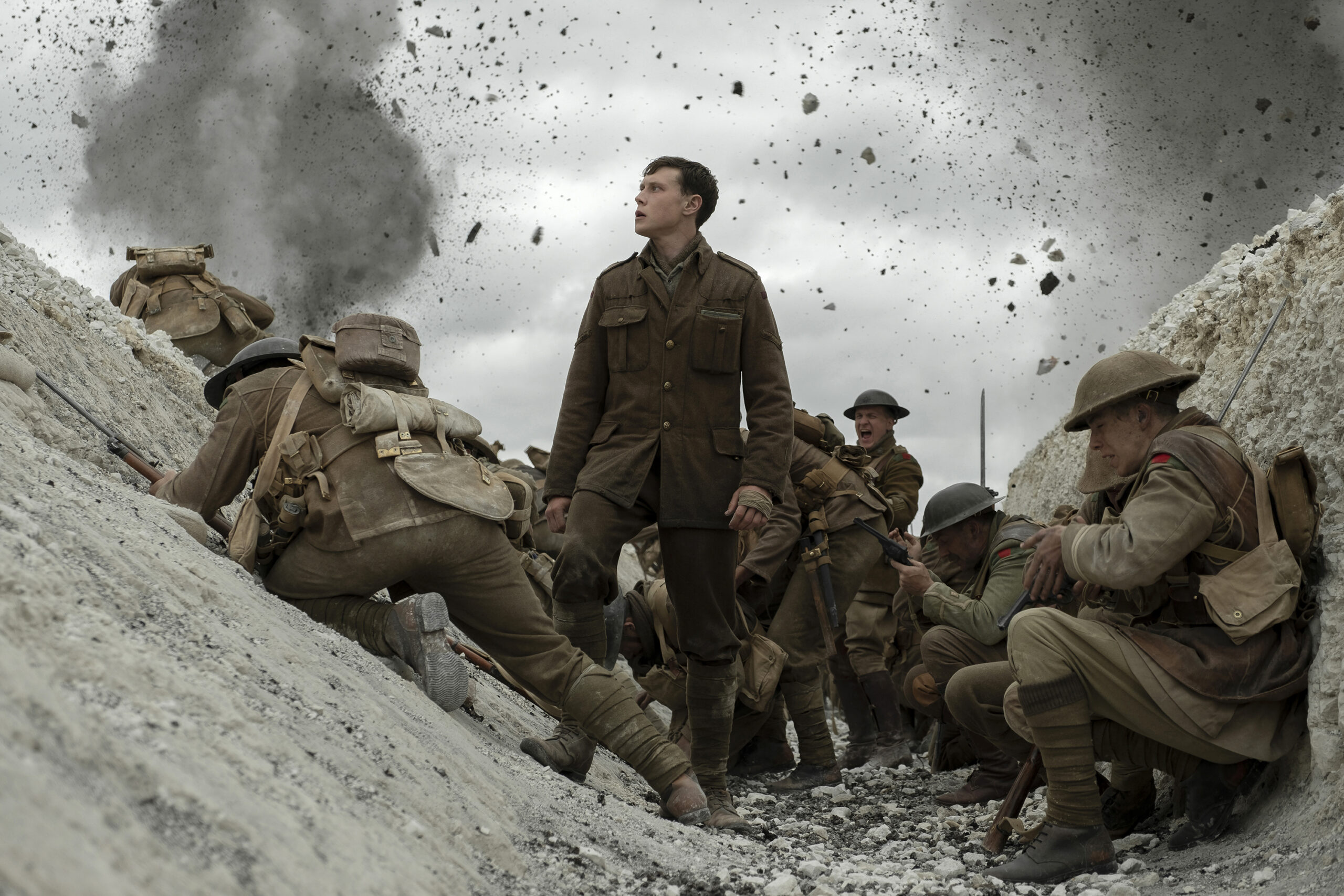

Films inspired by the First World War are many and varied. They range from the iconic 1930 version of All Quiet on the Western Front to the disastrously bad cinema version of the brilliant play Oh! What a Lovely War. From the heartbreakingly moving King & Country to the dramatically memorable Gallipoli. Now, perhaps inspired by the centenary of the end of that terrible conflict, there is 1917.
The opening minutes reveal the film’s straightforward narrative: Lance Corporal Blake (Dean-Charles Chapman) and Lance Corporal Schofield (George MacKay) are sent to cross former German-held territory to warn a battalion of British troops who are about to attack the Germans. What the commanding officer of the British troops does not know is that they would be advancing into a trap that would result in the loss of countless British lives, among them that of Blake’s brother. The remainder of the film simply follows the two young soldiers through hazards and setbacks, a structure used also in the suspenseful 1953 French film The Wages of Fear.
The audience is constantly kept on the alert for the next crisis. The drawback to this is that one knows in advance they have to survive or the film will be over. Unfortunately, there is little else at stake because one knows little of the character and background of the two soldiers, so it is difficult to invest much in them, except for sympathy for their plight.
Perhaps to make up for this, director Sam Mendes has chosen to make the film using only long cuts, some as long as nine minutes, spliced together to make them look like one long take. This puts the audience firmly into the action, participating with the protagonists in the ongoing perils they confront. One must admire the technological wizardry that made this possible, though of course the achievement pales in contrast with that of the superb Russian Ark, consisting as it does of one long take of almost 90 minutes.
Young audiences, however, may not necessarily appreciate such cleverness. After all, the average take in a movie today is approximately two seconds, as opposed to nine seconds in films of the ’30s and ’40s. Young audiences not only like action, but they like it punctuated by staccato images. Though there is plenty of action in 1917, it is perhaps less engrossing than one might expect.
The film builds almost to an anti-climax: an attempt to finally provide the personal touch and character development that till then it has largely lacked comes as too little and too late. Though well-made and well-intentioned in its anti-war theme, 1917 certainly does not merit the Best Film Oscar for which it has been nominated.
In that regard, Once Upon a Time … in Hollywood is an almost certain bet to win; after all, Hollywood loves films about Hollywood. Who today fondly recalls L.A. Story, a quintessential Hollywood film? For my money, the finely nuanced and sensitive The Two Popes or perhaps Marriage Story are far better examples of cinematic craft. Similarly, the subtle performances of Jonathan Pryce and Anthony Hopkins in The Two Popes and of Scarlett Johansson in Marriage Story are far superior to the flashier performances of the most likely winners, Joaquin Phoenix (Joker) and Renée Zellweger (Judy), though Brad Pitt’s performance in Once Upon a Time … in Hollywood is certainly award-worthy. Though the top awards are unlikely, then, the craft of 1917 might well earn it some of the less auspicious Oscars.







