


3rd Sunday of Ordinary Time, Year A
First Reading: Is 9:1-4
Second Reading: 1 Cor 1:10-13, 17-18 Gospel Reading: Mt 4:12-23
In this Sunday’s Second Reading, St. Paul appeals to the Corinthians to “be in agreement,” with no “divisions” among them.
He has heard, he says, of their quarrels. “Each of you says, ‘I belong to Paul,’ or ‘I belong to Apollos,’ or ‘I belong to Cephas,’ or ‘I belong to Christ.’”
“Has Christ been divided?” he asks. “Was Paul crucified for you? Or were you baptized in the name of Paul?”
Perhaps the same appeal and reproach can be addressed to us today.
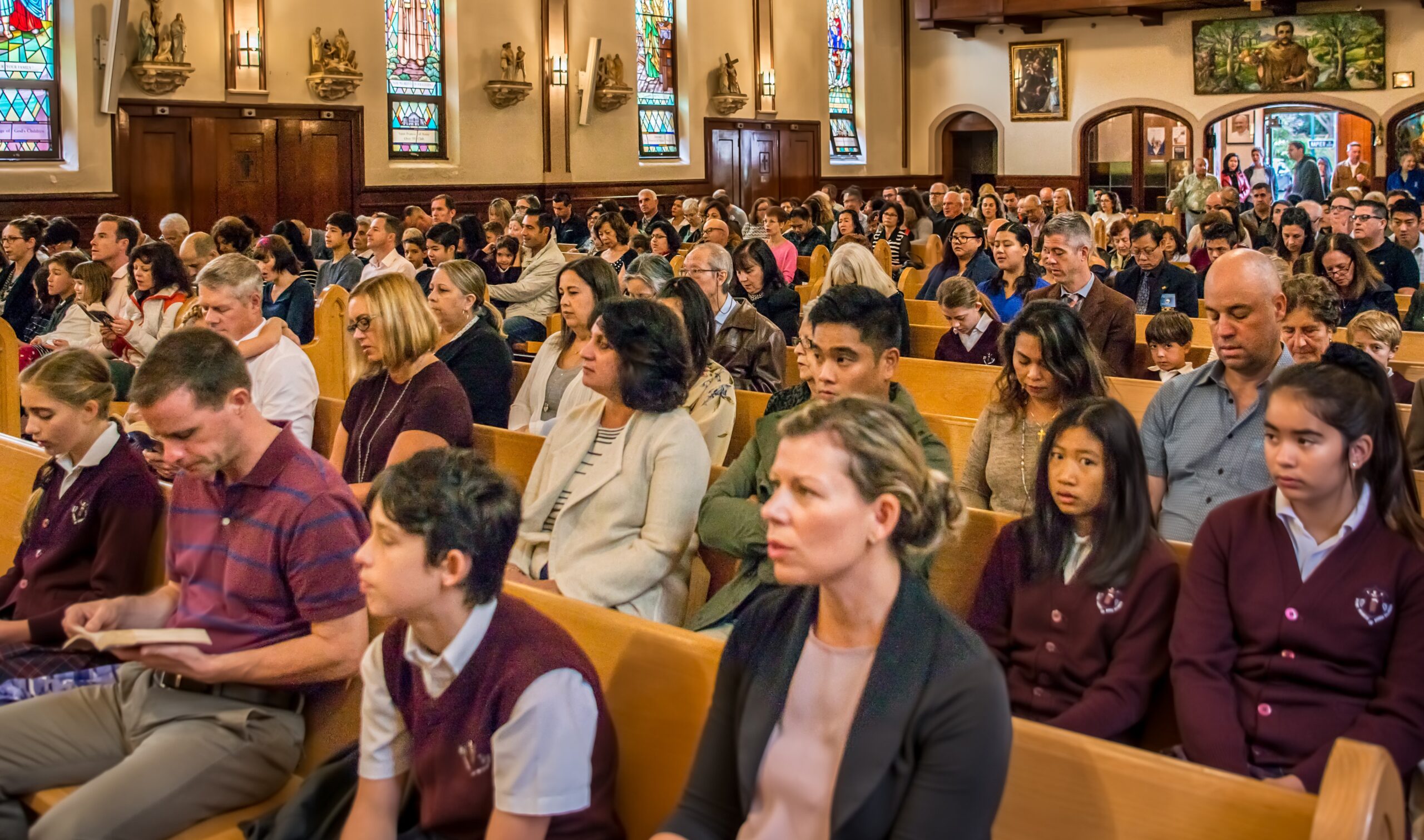
We are always tempted to hunt for the church building, or the style of liturgy, or the kind of music, or the length of homily, or the fashion of preaching, etc. that suits our taste.
Up to a point, this is not wrong. God has made us all individuals, “each to his own taste.” However, it can develop to the point where St. Paul’s reproaches are appropriate.
My mother, who was brought up Anglican, noted that non-Catholics would say to the clergyman as they left the church, “That was a lovely service, Father.” In contrast, Catholics did not, for what happens at Mass is independent of our feelings.
Scott Hahn, an evangelical Christian who became a Catholic in 1986, says he realized the truth of this as he made his first Communion. “I had received the body and blood of Christ whether I felt it or not,” he says.
I think C.S. Lewis is right when he says that “any tendency to a passionate preference for one type of service must be regarded simply as a temptation.”
“Surely you know,” writes Lewis’ imaginary devil Screwtape, “that if a man cannot be cured of churchgoing, the next best thing is to send him all over the neighbourhood looking for the church that ‘suits’ him until he becomes a connoisseur of churches.” If a man cannot “be kept out of the Church,” the devils want him “at least to be violently attached to some party within it.”
The devils do not want us to be faithful to our own parish churches, Lewis explains, for a parish, “being a unity of place and not of likings, brings people of different classes and psychology together in the kind of unity” God desires. In contrast, the “congregational principle” makes each church into a “club”: a “coterie” or “faction.”
Besides, he says, “the search for a ‘suitable’ church makes a man a critic where [God] wants him to be a pupil.” In church, God wants us not to appraise, or waste time thinking about what we reject, but rather to lay ourselves open “in uncommenting, humble receptivity” to any nourishment that is there.
Indeed, with this attitude, the things that seem to us most “false or unhelpful” about a liturgy can become the occasion of our nearest approach to God, as we “offer them up” to him.
“But I don’t get anything out of going to Mass at that church,” some people argue.
Well, why do we go to Mass, anyway? I like the answer given by Eddie Treadway, who celebrated his 100th birthday by doing what he did every day: walking to the 8 a.m. Mass at his parish church in Sacramento, Calif.. Asked why, he answered firmly, “To please God. We owe it to God.”
We please God in the fullest way possible by offering him the “holy and perfect sacrifice” of his son, really present on the altar under the appearances of bread and wine.
Mass, therefore, is always an occasion for the rejoicing described by Isaiah in the First Reading. At Mass, we who would otherwise walk in darkness see a great light.
“The kingdom of heaven has come near,” Jesus says in the Gospel Reading.
Surely we are never closer than at Mass – any Mass – with God the Son made present before us for us to see and taste: body, blood, soul, and divinity.







