


Scott has one of those computer hard-drive thingies that you plug in to broken computers to upload old stuff. He recently found some super-old videos of our two oldest, Andrew and Nicolas. The quality is that lamentable graininess of the early digital years, but they are such a treasure.
There is a kind of funny yet painful happiness watching videos of children who are now 17 and 15. To watch them toddle about together, lisp their sweet little sentences, and look about in wonder at snowfalls — it’s almost too much. How did the time pass?
One video shows Elijah, a couple of months old, hanging in his Jolly Jumper. Nicolas, 2, enters the scene in his little onesie and asks Scott if he can “cuddoh my baby budder?”
Scott tells him that, yes, he can cuddle him, if he promises not to pinch.
Nicolas looks up, wide-eyed, unable to make any such vow, but desperate to wrap his fuzzy arms around Elijah. His little hand raises, and his thumb and pointer finger start pulsing, as he continues to stare, unblinking at Scott. Scott has to tell him to leave and come back in a few minutes when he can promise not to pinch.
Most of the videos are Scott and the boys. When I am in them, I am either avoiding the camera, or lying on the couch. Not flattering footage. But the more and more I watched Scott interacting with these little guys, the more thankful I was that my sons have a father who… well, fathered. Having grown up without a father myself, I give thanks to God on behalf of my children.
They have a dad who takes them hiking and out into the snow, who plays Hot Wheels and Lego. He teaches them prayers – English and Latin. He reads them Bible stories and all kinds of tales with brave, noble, good protagonists.
He lets me nap. He cooked and rubbed my feet when nursing a baby was nearly as painful as labour. I mean, he’s only an imperfect human, but seriously? We are blessed to have a real man and father.
Fast-forward a week and I find myself reading an article in Crisis magazine entitled “No Church for Young Men” by Eric Sammons. It’s the type of column I’m coming across a lot lately, the type that will make many people uncomfortable because it doesn’t fit in with modern ideology, or with their own.
I know the feeling. I hate reading things that disprove an opinion I hold strongly to. But the article is important because it isn’t about opinions but about the salvation of our children and the Church. It’s about men, and the masculinity that’s needed in the Church.
The article is mathematical, in that it doesn’t simply say, “Hey, for nearly 2,000 years we did things like this, and we should keep doing it.”
It points to statistics that tell us less than 15 per cent of young people continue going to Mass after they graduate, regardless of having attended great Catholic schools and on-fire youth groups.
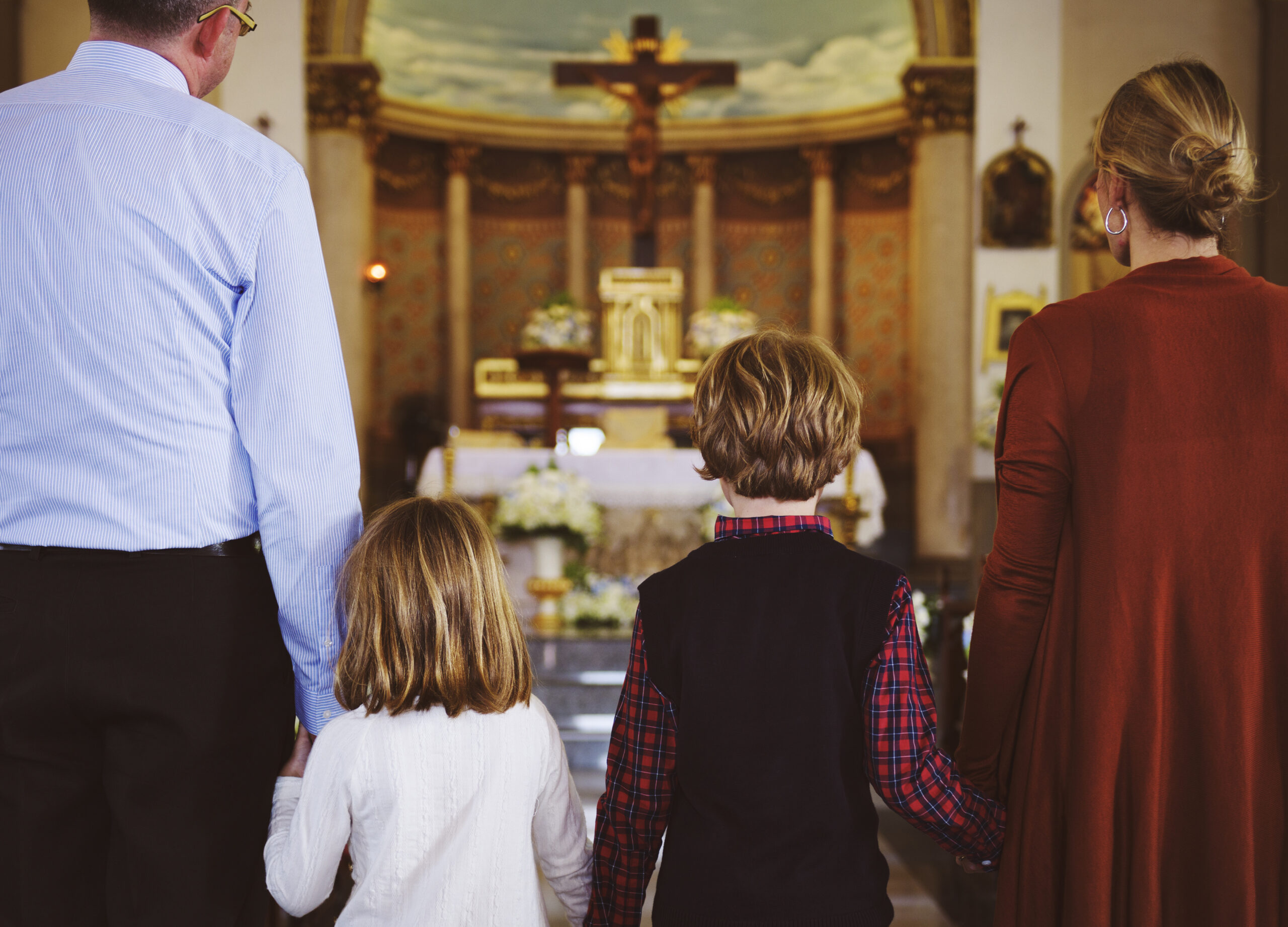
The numbers are in and consistently tell the same things. A child learns to love his faith at home, and more specifically (and frustratingly, for some) they learn to hold their faith through the practice of their fathers.
One study quoted in the article reads, “In short, if a father does not go to church – no matter how faithful his wife’s devotions – only one child in 50 (two per cent!) will become a regular worshipper. If a father does go regularly, regardless of the practice of the mother, between two-thirds and three-quarters of their children will become churchgoers (regular and irregular).”
I know we hate to hear it, but it isn’t just one person’s opinion. And if we care, we need to look at the math of these recurring stats. The article continues to say that, if we want to succeed, we need to look from a business point of view at these stats: we do not need to spend more resources on youth initiatives. We need to focus on our men first.
And it only gets worse, because what the data says will drive many “innovative Catholics” batty.
It shows that the modern Catholic parish with a more 1970s flavour tends to push men out. The numbers show an undeniable connection between the decrease of men’s faith and the ongoing, sometimes called emasculating, changes of the Mass and in the Church since the 1960s. For whatever reason, these sad statistics don't apply to men attending more traditional liturgies. If one plus one equals two, then …?
Sammons gives his thoughts on what needs to change, or, more appropriately, what needs to unchange.
Again, they are things I’ve read before and things I’ve witnessed myself. It has a lot to do with making the Mass and Church authentically Catholic.
Many people will, and have, debated very much about what that means – to be authentically Catholic. While I am not the one to answer, I would like to offer a thought. Whatever our differences, the presence of Christ in the Eucharist should be central to what we agree on. The fact that Christ on the cross is re-presented to us while we attend Mass, and that our response to that reality should be appropriate, should be obvious.
But recent polls show that less than 15 per cent of Catholics even believe in the real presence of Christ in the Eucharist. The source and summit of everything we profess isn’t even believed by the majority of Catholics.
While I myself do not attend the Latin Mass, the times I have I’ve noticed a few things. There are children everywhere and men everywhere. They certainly do not share the same degree of non-belief in the real presence. Regardless of the language at Mass, there is something going on that makes a difference. The numbers say it, not me, and I think it deserves more thought.
For whatever reason, stuff like this frustrates many people. Some think we’ve moved beyond the old smells and bells of a pre-modern world, so many people won’t like Sammons’ article. That's fine, but whether we like it or not isn’t what matters. What matters is whether it’s true and whether it can help save the souls of our families.
That goes for our entire faith.







