

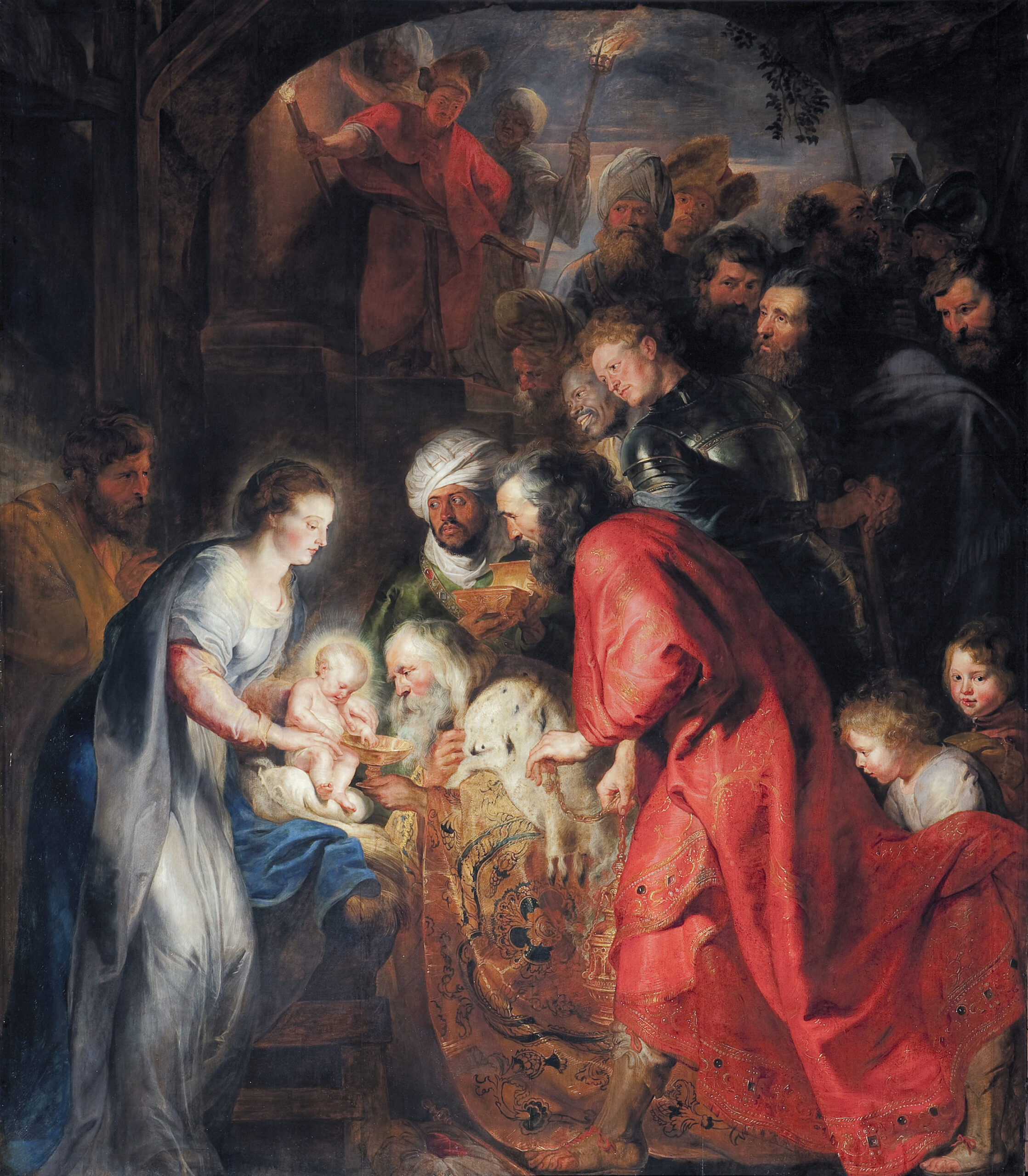

Epiphany of the Lord
First Reading: Is 60:1-6
Second Reading: Eph 3:2-3a, 5-6
Gospel Reading: Mt 2:1-12
“Epiphany” comes from the Greek epihaneia, which means “manifestation.” What we celebrate this Sunday – God’s manifestation to the “wise men from the East” (probably astrologers, magicians, and dream-interpreters from a priestly caste in Persia) – was not his first self-manifestation. He had manifested himself to humans for centuries: first by the prophets, and then, on Christmas night, to the shepherds, by his son.
However, those manifestations had all been to Jews, members of God’s people Israel, whom he had chosen from all the peoples on earth to be peculiarly his own. This Sunday, we celebrate his manifestation to the Gentiles, who, until now, had been covered in “thick darkness.”
Nevertheless, the First Reading is addressed to Israel: “Nations shall come to your light, and kings to the brightness of your dawn … They shall bring gold and frankincense, and shall proclaim the praise of the Lord.”
It should not surprise us. “After all,” Jesus told the Samaritan woman at the well, “salvation is from the Jews.”
It is a reminder we need. We tend to remember that those who rejected Christ and condemned him to death were Jews. However, we forget that the first Christians were Jews, that the first Pope and most of the first bishops were Jews, and that Christ and his mother, who occupy the highest places in heaven, are Jews.
To the Jews belong “the adoption, the glory, the covenants, the lawgiving, the worship, and the promises,” St. Paul reminded the non-Jewish Romans. “To them belonged the patriarchs, and from them came the Messiah.”
The Jewish Scriptures, whose prophecies Christ fulfilled and which he quoted and alluded to repeatedly, comprise 46 out of the 73 books of our Bible. “The Jewish faith, unlike other non-Christian religions, is already a response to God’s revelation in the old covenant,” notes the Catechism of the Catholic Church. That covenant has never been revoked, for “God’s gifts and his call are irrevocable.”
Paul compares the Jews to an olive tree that God has cultivated; he compares the Gentiles to branches of a wild olive tree which God has grafted on to the cultivated tree.
“If the root is consecrated, so too are the branches,” he says. “If some of the branches were cut off and you, a branch of the wild olive tree, have been grafted in among the others and have come to share in the rich root of the olive, do not boast against the branches. If you do boast, remember that you do not support the root; the root supports you.”
In his book Crossing the Threshold of Hope, Pope St. John Paul II quotes Nostra Aetate, the Vatican II document on the relations between Catholics and people of other religions. The Church cannot “forget that it draws sustenance from the root of that good olive tree on to which have been grafted the wild shoots, the Gentiles,” he says. He also remembers that he called the Jews “our elder brothers in the faith” when, as Pope, he first visited the principal Jewish synagogue in Rome.
“Spiritually,” said Pope Pius XI, “we are all Semites.” In the First Eucharistic Prayer of the Mass, we ask God the Father to accept the sacrifice of his son as he accepted “the sacrifice of Abraham, our father in faith.”
“Blindness has come upon part of Israel,” Paul says, “until the full number of Gentiles enter in, and then all Israel will be saved.” And if their rejection of Christ “has meant reconciliation for the world, what will their acceptance mean? Nothing less than life from the dead!”
Salvation, therefore, comes to us today not just as a gift from God, but also as a gift from the Jews, enriched by this double giving. Today, we Gentiles “have become fellow-heirs” with them, “members of the same body” and “sharers” in the promise God made originally to them.







