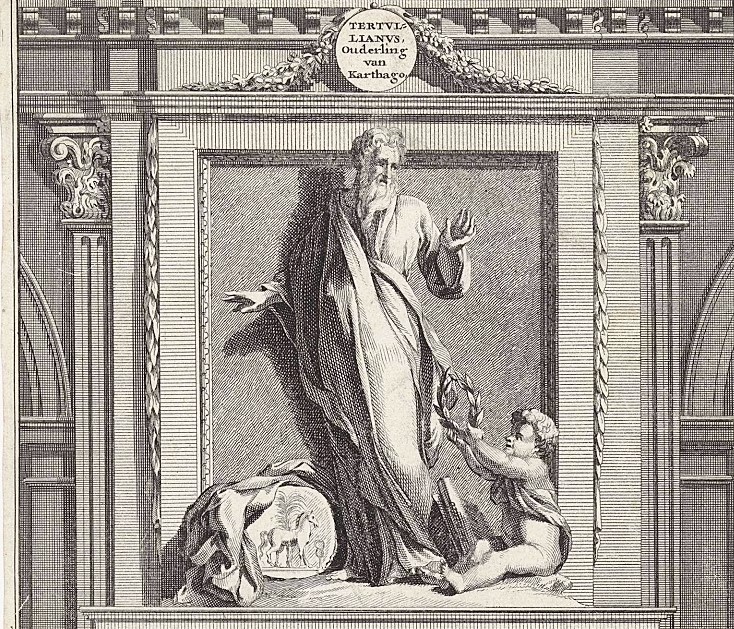

Tertullian (c. A.D. 160–220) was born at Carthage and was called the “Father of Ecclesiastical Latin.”
According to The Dictionary of Historical Theology, “Tertullian was probably the first Christian who wrote in Latin, and the number of his surviving works outstrips that of any Christian writer before the fourth century. Equally impressive is their extraordinary range, covering subjects as varied as the nature of the soul, the doctrine of the Trinity, chastity, and the Roman circus.”
During his General Audience on May 30, 2007, Pope Benedict XVI said, “Tertullian takes an enormous step in the development of Trinitarian dogma. He has given us an appropriate way to express this great mystery in Latin by introducing the terms ‘one substance’ and ‘three Persons.’ In a similar way, he also greatly developed the correct language to express the mystery of Christ, Son of God and true Man.” The Holy Father pointed out that Tertullian always recognized the Church as “mother.”
St. Jerome, in his book On Illustrious Men, wrote: “At Concordia, a town in Italy, I saw an old man named Paul, who said that, when he was still a very young man, he had seen in Rome a very old man who had been secretary of blessed Cyprian and had reported to him that Cyprian was accustomed never to pass a day without reading Tertullian and would frequently say to him, ‘Hand me the master,’ meaning, of course, Tertullian.”
The most famous work of Tertullian is Apology. In this work, Tertullian denounced the unjust treatment of political authorities toward the Church. He also defended the teachings and practices of Christians. Addressing the Roman governor, Tertullian wrote, “Refined as it is, your cruelty serves no purpose. On the contrary, for our community, it is an invitation. We multiply every time one of us is mowed down. The blood of Christians is effective seed.”
In his book Church History: A History of the Catholic Church to 1940, Father John Laux wrote, “Unfortunately, about the year 203 Tertullian fell under the influence of the Montanists and in 213 went over to them altogether; and henceforth he employed his great talents in defending and propagating the tenets of that sect of fanatic rigorists. Some of his favourite contentions after he had become a Montanist were that the Church could not absolve persons guilty of very grave offences, such as apostasy and adultery; that Christians were not at liberty to avoid persecution by flight or to purchase their safety with money; that second marriage was adultery; that amusements of all kinds were sinful, and that the power to rule in the Church depended on spiritual endowments and not on the Sacrament of Holy Orders.”
Reflecting on the spiritual downfall of Tertullian, Pope Benedict XVI commented: “From the human viewpoint one can undoubtedly speak of Tertullian’s own drama. With the passing of years he became increasingly exigent in regard to the Christians. He demanded heroic behaviour from them in every circumstance, above all under persecution.
“Rigid in his positions, he did not withhold blunt criticism and he inevitably ended by finding himself isolated … This great moral and intellectual personality, this man who made such a great contribution to Christian thought, makes me think deeply. One sees that in the end he lacked the simplicity, the humility to integrate himself with the Church, to accept his weaknesses, to be forbearing with others and himself.
“When one only sees his thought in all its greatness, in the end, it is precisely this greatness that is lost. The essential characteristic of a great theologian is the humility to remain with the Church, to accept his own and others’ weaknesses, because actually only God is all holy. We, instead, always need forgiveness.”
特土良用拉丁文寫神學
特土良(公元160-220年)在迦太基出生,被稱為「教會拉丁之父」。據「神學歷史字典」所載:估計特土良是第一位基督徒使用拉丁文寫作。第四世紀前,特土良尚存的箸作,數量多於當時任何基督徒作家,而他的箸作範圍涵蓋頗大,涉及靈魂的本質、天主聖三教理、貞潔,以及討論基督徒參與娛樂的對錯等。
2007年5月30日,在他公開接見群眾時,教宗本篤十六世說:「特土良在『天主聖三』的當信道理上,使教會邁進一大步。他用拉丁文給我們,帶出『一體』和『三位格』的詞語。他以近似的方法,大大地發展了描述基督奧蹟(天主聖子亦真人)的正確語言。」教宗指出:特土良常認定教會是「慈母」。
聖熱羅尼莫在他的「傑出人物」一書中寫道:「在意大利的康科迪亞小鎮,我遇到一位叫保祿的長者;他表示他年青時,在羅馬見過一位曾任聖啟廉秘書的老叟,證實聖啟廉每天都必定閱讀特土良的箸作,常叫人『把師傅遞給我』。他所指的『師傅』,自然是特土良。」
特土良最為人認識的是「護教」一書。他的箸作批評當時政治當權者對教會的不公平。特土良竭力維護基督徒的教導和實踐並告訴羅馬總督:「你的暴戾委實徒勞無功;對於我們的團體,這是一份邀請。每當我們當中一個倒下,我們卻在壯大。基督徒流的血,是繁衍的種籽。」
若望.勞克斯神父寫道:「不幸地,在公元203年,特土良受孟他努異端影響,且在公元213年,更加入他們一夥;自此,特土良用自己的天份,為極端死硬的異端信理,作出維護和宣傳。他成為異端徒後所持的論點包括:教會無權赦免一些諸如背教、行淫等嚴重的罪;基督徒不可逃避迫害或用錢來買安全;第二次段婚姻是奸淫;所有的娛樂是有罪的;在教會內的管治權是在於靈性的天賦而不在於神品聖事。」
反思特土良靈性的墮落時,教宗本篤十六世的評語是:「隨著歲月流逝, 他對基督徒的要求就愈來愈嚴格。他要他們在一切境況下,尤其是在受迫害時,要有英雄的行為。」
「他的固執,沒有停止他不客氣的批評,最終置自己跌入孤立的境地 …。這位道德和智慧高的人,曾對基督宗教思維作出莫大的貢獻,令我深刻反思。我們可以看到,他最後缺乏簡樸和謙遜來與教會整合,不願意接受自己的弱點,不寬容別人和他自己。」
「當我們見到這人思想的偉大, 到頭來正是這偉大失去了。一位偉大的神學家,必要的特徵,就是謙虛地留在教會內,接受自己和別人的軟弱,因為只有天主才是至聖善的,我們每個人都需要被寬恕。」