



When the giant stack of Black Friday / Cyber Monday flyers lands on my doorstep with quite a thud, it serves as the annual reminder that I have work to do for this column.
Once again then, here is our annual survey of digital cameras for sale in the Vancouver area, something we’ve been doing in this space since 2002, and, in a slightly simpler form, going all the way back to 1996, when a sub-megapixel camera went for around $1,000.
On average, the prices this year, slightly higher than they were last year for models still in production today, are perhaps due to less turnover in camera models compared with years past, and perhaps indicative of a decline in the field generally.
Those who do develop an interest in photography through their experience with today’s sophisticated smartphones are tending to migrate to advanced digital cameras, bypassing the point-and-shoot models that previously dominated the market.
High-end smartphone camera functionality, such as that in the Samsung Note 10 line, the new Apple iPhone models, Google’s Pixel units, and recent models from China such as the Huawei P30 Pro, is generally regarded as outstanding. However, there remains solid demand for stand-alone digicams, be they of the point-and-shoot or digital single-lens reflex (DSLR) varieties, or mirrorless interchangeable lens cameras (MILCs).
To serve that demand, we once again have our dedicated single-page website, http://vandigicams.ca, ready for you. As this column is written, the site contains information on more than 200 digital cameras, with updates being made each day through to January 6. Links are also provided to the surveys from previous years to enable price comparisons.
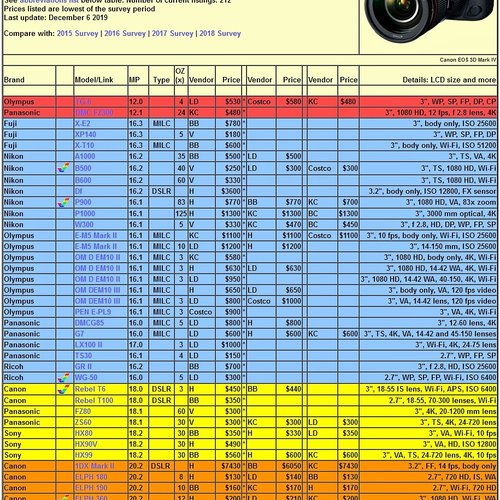
Cameras on the site are primarily those advertised in print flyers delivered across the Lower Mainland, and hence units most likely to be on sale below manufacturers’ suggested list prices. Additional entries come from retailer websites and from advertising in Vancouver’s major daily papers.
Prices on the site, rounded to the nearest $5 increment, are the lowest found in the November–December survey period, which often occur mid-November. If you decide to buy a unit on the list, you may be able to convince the salesperson to roll the price back to the earlier low point if it has risen in the interim.
Individual cameras in the survey are allocated a single line on the vandigicams.ca site. Each listing is hyperlinked to the corresponding manufacturer’s website for that camera’s full specifications. Along with the camera sensor megapixel rating, there is an optical zoom value, an overview of around half a dozen features, and “street” pricing from up to three local retailers.
Dominating this year’s survey once again is the 24-megapixel sensor class, representing just over 40 per cent of the cameras, followed by the slightly lower resolution 20-megapixel units, with around a quarter. These two classes together account for two-thirds of all the cameras in the survey. The once-dominant “16” class has dropped to third place. The remaining 20 per cent or so of the survey is fragmented across classes spanning from 12 megapixels all the way up to a staggering 100 megapixels.

As in years past, the survey identifies several cameras as best buys, the optimum combination of features and price within a given class. When considering buying a camera, do check out the manufacturer’s website (they are all listed at the bottom of the survey site) to be sure that the model remains current.
Want an inexpensive point-and-shoot digital camera? A Sony W800, with a 2.7″ screen and basic 720 HD video recording, is just $120, up from $90 last year. A starter DSLR camera such as Canon’s T6 with a basic kit lens can be picked up for around $440, up about 10 per cent from last year. At the other extreme, you’ll find models from historic Swedish manufacturer Hasselblad approaching $43,000!
Looking for a rugged camera? The Olympus TG line (shockproof, freezeproof, waterproof, dustproof, and crushproof) remains popular. Olympus offers two TG units, and Nikon has its W300 model. Fuji, Panasonic, and Ricoh also offer ruggedized units. Prices range from $150 up to approximately $500.
As for a solid general-purpose camera, how about something like the Nikon P900, with an incredible 83× zoom lens. Priced in the $770 range, this unit takes fine outdoor shots and perfectly acceptable indoor ones as well, something often lacking in lower-cost units. Its successor, the P1000, is the first unit to pass 100× zoom, offering an amazing 125×, at, mind you, a price almost double that of its predecessor.
Most of the manufacturers offer high-zoom models in their lineups. Examples include Panasonic’s FZ80 (60×, $300), Canon’s SX70 (50×, $325), and Sony’s HX400 (50×, $460).
Want a DSLR package with two lenses, say a basic 3× zoom and a telephoto? Canon and Nikon have several such packages. Consider, for example, the Nikon D5300 package with 18–55 and 70–300 mm lenses priced at $600, down a hundred dollars from last year’s price.
If you are just starting out with a DSLR, consider buying an inexpensive 50 mm f1.8 portrait lens. Such a lens does wonders in low-light situations, even with a modestly priced camera. With this combination, a beginner photographer can start taking decent indoor portrait shots for a price that is not too challenging.
It is worth noting that MILC units are fast catching up to DSLRs in popularity. Canon and Nikon, the big two in the camera business, have come late to the MILC party, first dominated by Fuji, and to a lesser extent by Olympus and Sony.
Do check out this year’s survey list: http://vandigicams.ca. You’ll find cameras at every price point, from around $100 all the way up to that multi-thousand-dollar Hasselblad. In between you’ll find cameras equipped with Wi-Fi, GPS, and organic light emitting diode (OLED) touch screens, and numerous other features.
Follow me on Facebook (facebook.com/PeterVogelCA) or on Twitter (@PeterVogel).







