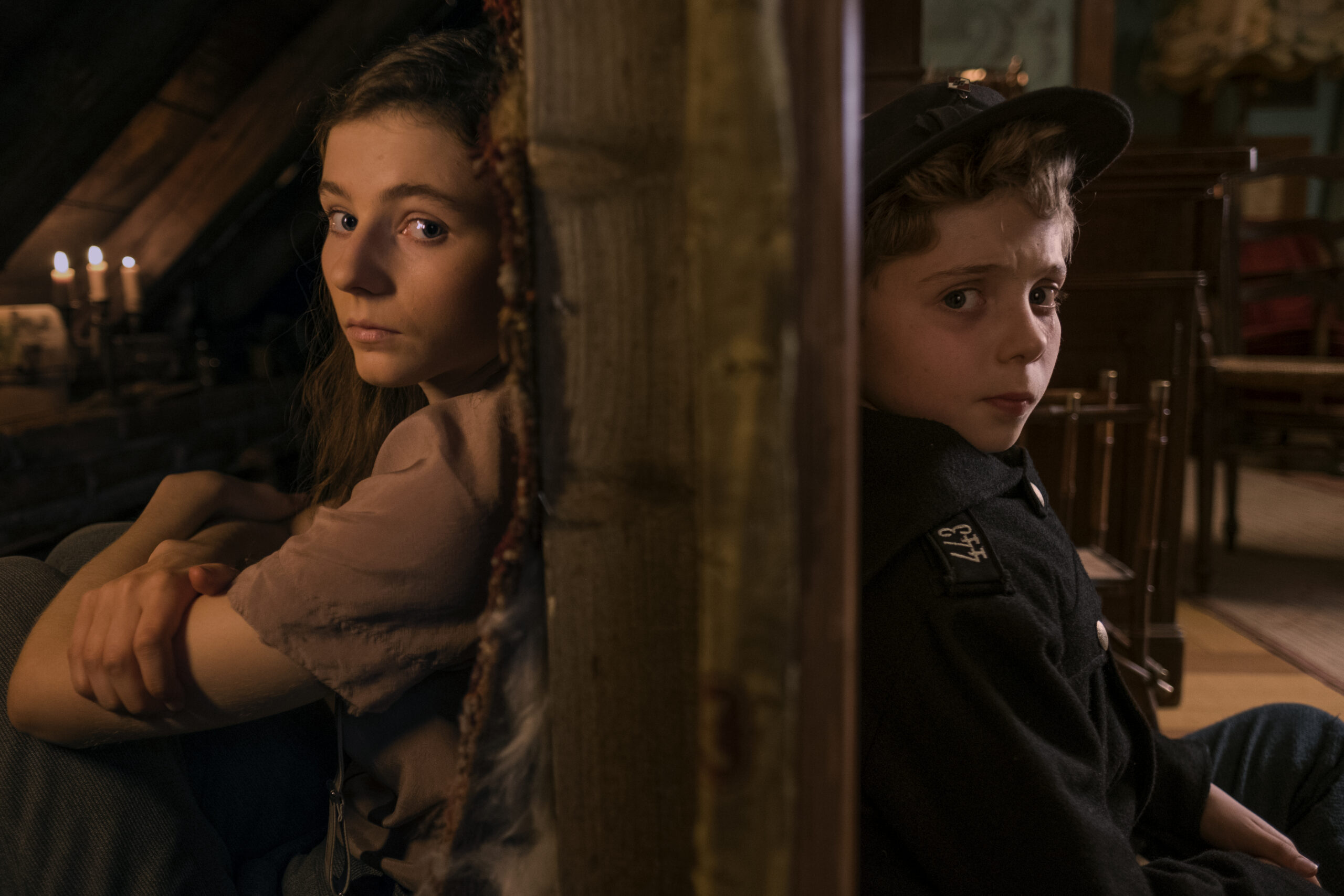

Taika Waititi’s film Jojo Rabbit has been very favourably received by critics and audiences alike. However, it should be approached with considerable caution and an open mind as to its genre. Though it is touted by many as a comedy-satire, it has very little comedy, while its satire has all the subtlety of a sledgehammer.
In the final years of the Second World War, Jojo, a 10-year-old German boy, has fully embraced the Nazi propaganda. (He is played by Roman Griffin Davis, who does excellent work showing a wide range of emotions.)
Other than a chubby pal, equally as physically inept, Jojo has conjured up as his only other friend none other than an imaginary Adolf Hitler (Taiki Waititi himself in a broadly buffoonish interpretation).
Loyal to this projection of his own imagination, Jojo attempts to become a member of the German Youth Movement, but at training camp he succeeds only in doing himself considerable harm. While all of this is supposed to be farcically comical, it reflects too much of reality for one to be able to forget the reality which gave birth to it.
So too with another plot development. Largely confined to his home and the tender care of his loving mother (the accomplished Scarlett Johansson), Jojo discovers, to his dismay, that she is hiding a Jewish girl.
Jojo has absorbed the ludicrous accusations and libels levelled against Jews by the Nazis; again, these are presented as being so ridiculous as to be farcically comical, but they are also a tragic reminder of the anti-Semitism of Hitler’s Germany. All of this is a set-up for Jojo’s journey through the remainder of the war. On the way, he discovers his own limitations, personal tragedy, the falsity of the promises of Nazism, and finally hope for the future.
Of course, the film is by no means the first to satirize Hitler and Nazism. Chaplin’s The Great Dictator and Mel Brooks’ The Producers showed that even something as grotesque as Nazism can be the cause of laughter, though that laughter is always accompanied by discomfiture as one is reminded of the horrors perpetrated under the swastika. Satire that makes the audience uncomfortable can be very effective – much as in Swift’s A Modest Proposal – but the result can hardly be called humour, and in the case of Nazism no one should be tempted to do anything but condemn that which is being satirized.
In the case of Jojo Rabbit, one sees the boy absorbing the ideologies of the Nazis, but they are obviously grotesque versions of evil realities; though some may find them amusing, others may find them horrible. It is therefore certainly not unreasonable to dismiss the comic ambitions of the film. What the film does do superbly, however, is to present an allegory of the Germany over which Hitler held such sway.
Jojo himself becomes that Germany in microcosm – a Germany of tragic history. His turn from innocent and understandable adulation of Hitler and Nazism, with all the unsubstantiated promises, to total disillusionment with and rejection of all that that represented is revealed in novel and compelling fashion.
Like all of Germany, he suffers loss: his father, presumed dead, symbolizes all those who died in the world wars; his mother, the very reverse of the mother figure lauded by Hitler, represents those many brave Germans who fought for what was right despite the danger inherent therein; the closeted little girl clearly stands for all those millions of Jews persecuted by the regime; the developing relationship between her and Jojo reflects Germany’s ultimate rejection of anti-Semitism and realization of the terrible fact of the Holocaust.
However, even from this viewpoint, perhaps the film does not completely fulfill the premise. Yes, Germans, like Jojo, survived and came to realize the horror in which they had participated and which they had embraced; like Jojo, sadly, they are scarred for life. However, the film ends there. It fails to show how post-war Germany not only rose above the past but has yet within it the seeds of its own disaster. The rise once again of the neo-Nazi movement keeps one from perceiving the world with the same optimism with which the film concludes.
Jojo Rabbit cleverly offers its audience an unusual insight into World War II. Many will leave the theatre, though, reminded of an evil that society – and by no means only that of Germany but of all nations – has yet to exterminate, and, though it needs to be said, that’s not particularly funny.