

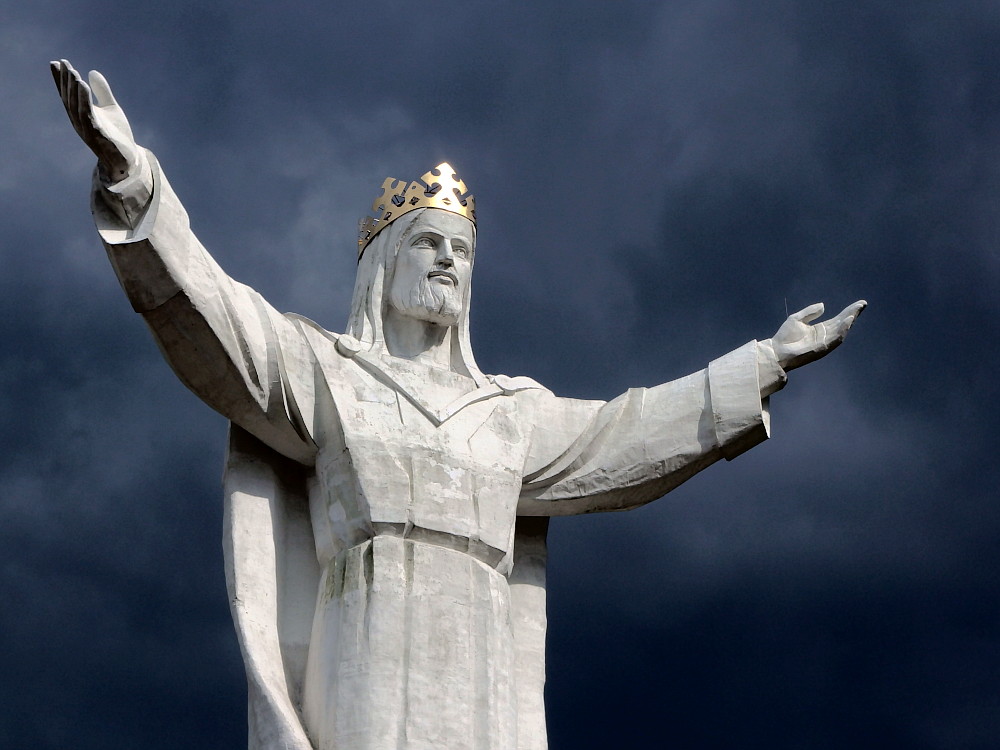

Feast of Christ the King, Year C
First Reading: 2 Sm 5:1-3
Second Reading: Col 1:12-20
Gospel Reading: Lk 23:35-43
This feast is a time to rejoice. Christ, our King, is King of heaven and earth! He is infinitely powerful: he has complete dominion over all creation – visible and invisible, spiritual and material, angel, human, animal, and inanimate.
He is infinitely good: on the cross, he reconciled us with God, so that he could promise the thief at his side, “Today you will be with me in paradise.”
His kingdom is a kingdom of “truth and life,” of “holiness and grace,” of “justice, love, and peace,” as we say in the Preface of the Mass.
However, this triumph and rejoicing is absent from the Gospel reading. The Jews had nothing against kings, as we see in the first reading, but (except for the brief frenzy of Palm Sunday) they could not accept Jesus as a king.
He was a carpenter, from Nazareth, in Galilee; and everyone knew that nothing good could come out of Galilee. They knew his mother and his relatives. How could he possibly be a king?
They handed him over to be killed because he claimed to be God’s Son. On the cross, over his head, they read Pilate’s inscription – “King of the Jews” – and taunted him: “If you are king of the Jews, save yourself!”
We should not be too hard on them. We have the benefit of the Church’s hindsight. To us, he is not simply a poor wandering preacher, a naked, condemned criminal, covered with blood, dying on a cross.
However, he asks us to do something equally difficult: to accept his government, no matter how human, imprudent, fallible, and stupid it may seem.
Our King, Jesus, is the head of the Church, as St. Paul says. However, while he was on earth, he instituted the office of regent, vicar to the king, so that when he returned to his Father, he could continue to guide us.
“You are ‘Rock,’” he said to Peter, “and on this rock I will build my Church, and the jaws of death shall not prevail against it. I will entrust to you the keys of the kingdom of heaven. Whatever you declare bound on earth shall be bound in heaven; whatever you declare loosed on earth shall be loosed in heaven.”
The apostles who heard him must have recognized the words with which God appointed Eliakim “master of the palace”: “he shall be a father to the inhabitants of Jerusalem, and to the house of Judah. I will place the key of the House of David on his shoulder; when he opens, no one shall shut; when he shuts, no one shall open.”
Scripture scholar Scott Hahn explains that in all the ancient kingdoms of the Near East, the king reigned through a cabinet of ministers, including a prime minister. In the Kingdom of Israel, the prime minister was distinguished by the keys of the kingdom, which he alone carried.
To this day, the pope’s flag displays the crown of a king and the keys of a kingdom.
Two thousand years have passed since Jesus became man and taught us personally, and since his followers wrote down what they could remember of his teaching. Jesus knew how soon we would ignore or misinterpret his words once he had returned to his Father.
Accordingly, he founded his government to teach and act with his authority, promising to support it until the end of time. “He who hears you, hears me,” he said to the apostles, his first cabinet. “He who rejects you, rejects me. And he who rejects me, rejects him who sent me.”
What Christ, our King, asks of us, today, is to believe that when we listen to the pope, his regent, his prime minister, we are listening to him, and to give “the assent of faith” to whatever the pope teaches with the King’s authority.
Do we still want Christ for our King?
Father Hawkswell teaches “The Catholic Faith in Plain English” free of charge every week: Sundays, 2–4 p.m. at the John Paul II Pastoral Centre (33rd and Willow, Vancouver); Mondays, 11 a.m.–1 p.m. at St. Anthony’s Parish (2347 Inglewood, West Vancouver) and 7–9 p.m. at the John Paul II Pastoral Centre; and Tuesdays, 7–9 p.m. in St. Clare’s Parish Hall (2888 Delahaye Drive, Coquitlam).







