

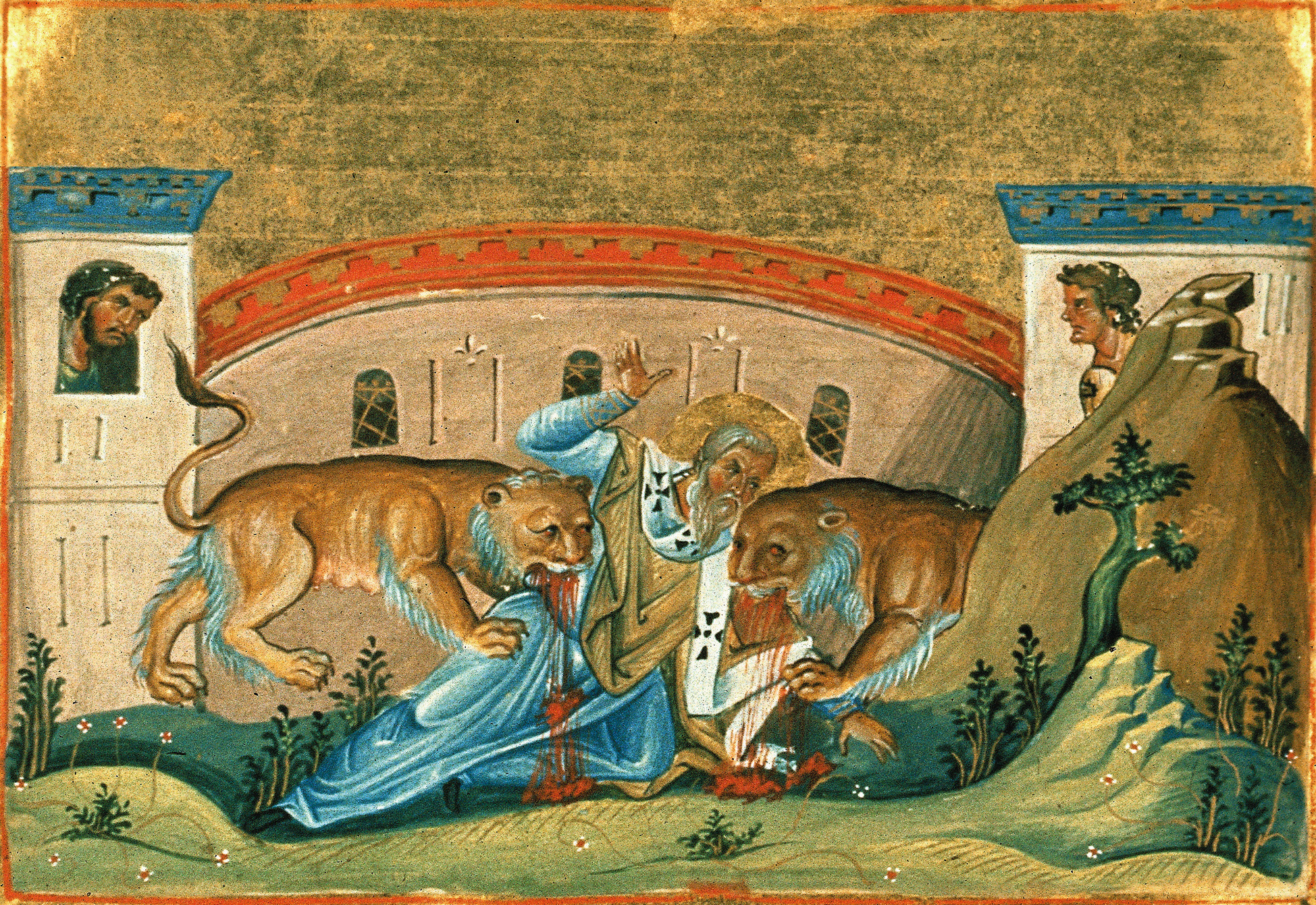

St. Ignatius of Antioch was Bishop of Antioch (in present-day Turkey) from the year 70 to 107. During a period of persecution under Trajan (Emperor 98–117), he was condemned to the wild beasts and sent under guard to Rome.
According to Pictorial Lives of the Saints, “In the year 107, Trajan came to Antioch, and forced the Christians to choose between apostasy and death. ‘Who art thou, poor devil,’ the emperor said, when Ignatius was brought before him, ‘who settest our commands at naught?’ ‘Call not him ‘poor devil,’’ Ignatius answered, ‘who bears God within him.’ And when the emperor questioned him about his meaning, Ignatius explained that he bore in his heart Christ crucified for his sake. Thereupon the emperor condemned him to be torn to pieces by wild beasts at Rome. St. Ignatius thanked God, who had so honored him, “binding him in the chains of Paul, His apostle.”
Eusebius of Caesarea, a fourth-century historian, dedicated an entire chapter of his Church History to the life and literary works of Ignatius. He wrote: “Report says that [Ignatius] was sent from Syria to Rome and became food for wild beasts on account of his testimony to Christ. And as he made the journey through Asia under the strictest military surveillance, he fortified the parishes in the various cities where he stopped by oral homilies and exhortations, and warned them above all to be especially on their guard against the heresies that were then beginning to prevail, and exhorted them to hold fast to the tradition of the apostles. Moreover, he thought it necessary to attest that tradition in writing, and to give it a fixed form for the sake of greater security.”
On his journey to Rome, Ignatius sent seven epistles to the Christians in various cities.
Pope Benedict XVI described it this way: “The first place Ignatius stopped on the way to his martyrdom was the city of Smyrna, where St. Polycarp, a disciple of St. John, was Bishop. Here, Ignatius wrote four letters, respectively to the Churches of Ephesus, Magnesia, Tralli, and Rome. ‘Having left Smyrna’, Eusebius continues, Ignatius reached Troas and ‘wrote again’: two letters to the Churches of Philadelphia and Smyrna, and one to Bishop Polycarp.”
Father Augustine Kalberer, OSB, of the Seminary of Christ the King, wrote in his Lives of the Saints, “An hour’s reading of these letters provides an historical perspective and a sense of Church continuity that can be had in no other way.”
Ignatius was the first person in Christian literature to attribute to the Church the adjective “catholic” or “universal.” He wrote, “Wherever Jesus Christ is, there is the Catholic Church.”
“Unity” is an important theme in the letters of Ignatius. To the Magnesians, Ignatius wrote, “Let there be nothing among you tending to divide you, but be united with the bishop and those who preside – serving at once as a pattern and as a lesson of incorruptibility.”
And to the Philadelphians, he wrote, “As for me, I played my part, like a mediator appointed to bring about unity. For, wherever there is division or anger, God has no place. Now God forgives all who repent, so long as their repentance turns to union with God and to communion with the bishop. I have faith in the grace of Jesus Christ; He will break all your bonds. I beseech you to do all in the light of Christ’s teaching and nothing in a party spirit.”
In the letter to St. Polycarp, Ignatius wrote, “Be concerned about unity, the greatest blessing. Bear with all, just as the Lord does with you. Have patience with all in charity, as indeed you do.”
Pictorial Lives of the Saints described the martyrdom of Ignatius: “He was devoured by lions in the Roman amphitheatre. The wild beasts left nothing of his body, except a few bones, which were reverently treasured at Antioch, until their removal to the Church of St. Clement, at Rome, in 637. After the martyr’s death, several Christians saw him in vision standing before Christ, and interceding for them.”
聖依納爵教導「團結」
聖安提約.依納爵從公元70年至107年,任安提約基雅(在今天土耳其境內)的主教;正是羅馬皇帝圖拉真(公元98-117年)發動教難的時期。他命令要把聖人押解到羅馬,拋給猛獸作食物。
在嚴密監控下,依納爵曾經在亞洲所經之處,都以講道形式,堅定了當地的堂區,警告信眾提防新興的異端,要他們緊遵承傳自宗徒的信仰;他甚至以特定的形式,寫下相關的承傳,以確保萬全。
「聖人圖文」一書記載:公元107年,圖拉真皇帝來到安提約基雅,強逼基督徒在背教及受死兩者中作出選擇。當依納爵被押解到他面前,他說:「你是誰,可憐的魔鬼,居然頑皮地嘗試對抗我的命令?」依納爵回答說:「別稱我為魔鬼,因為在我內有天主。」皇帝要他解釋,依納爵續說自己在我心中,常附著為我而被釘的耶穌。」皇帝下令把聖人押到羅馬喂食猛獸。聖依納爵多謝天主賜給他這個榮耀,這他能撘上「保祿宗徒的鎖鏈。」
公元四世紀,教會歷史學家、凱撒肋雅的歐瑟伯,用了一整章敘述了依納爵的一生及他的寫作:「報告稱(依納爵)為了作基督的見證,從敘利亞被解送到羅馬,充當了猛獸的食糧」
被押解往羅馬期間,依納爵向不同城市的基督徒,發出了七封書函。教宗本篤十六世說:「依納爵赴義時經過第一個城市,是土麥那,正是聖若望宗徒的門生、聖波利卡普任主教的地方。在這裡,依納爵分別給厄弗所、馬格尼西亞、特拉利和羅馬,發出牧函。」歐瑟伯亦記載著:「當他離開土麥那,依納爵到達外高加索後,又給非拉鐵弗的教會及土麥那寫了書信,並有一封是給波利卡普主教。」
本篤會會士、奧思定.卡伯勒評論道:「費了一小時閱讀依納爵的信函,給了對歷史和教會連續的感覺⋯⋯。」
依納爵是第一位用文字標誌著教會是「公教會」,或是「世界性的教會」。他寫道:「耶穌基督在那裡,那裡就有公教會。」
「團結」就是依納爵所有信函中的重要主題。致馬格尼西亞教會的牧函中,他強調:「別讓任何事情分裂你們,與主教或主禮的人聯合在一起。⋯」
致非拉鐵弗教會的牧函裡,依納爵說:「至於我,已經盡了我的責任,擔當合一的中介。而天主,不會在分裂和怒火當中。天主會寬恕那些悔改的人,讓他們回歸和天主合一,和主教共融。」
依納爵也給聖波利卡普寫了信:「要關心合一,這是最大的思?。要忍耐一切人,就如主忍耐了你一樣。正如你所作的,要以愛德對眾人有耐心。」
「聖人圖文」描述依納爵殉道:「在圓形劇場內,他被餓獅吞噬,只剩下幾根骨頭。那幾根骨頭被恭放在安提約基雅。公元637年,那聖髑被移放到羅馬的聖克勒孟堂內。他殉道後,幾名基督徒在神視中,看到他站在基督面前,為他們祈禱。」







