


First Reading: Mal 4:1-2
Second Reading: 2 Thes 3:7-12
Gospel Reading: Lk 21:5-19
I once watched barges moving slowly downstream directly in front of me. They were so huge that I could see hardly anything else; temporarily, they constituted my whole world. As a result, it seemed that they were stationary and I myself moving upstream.
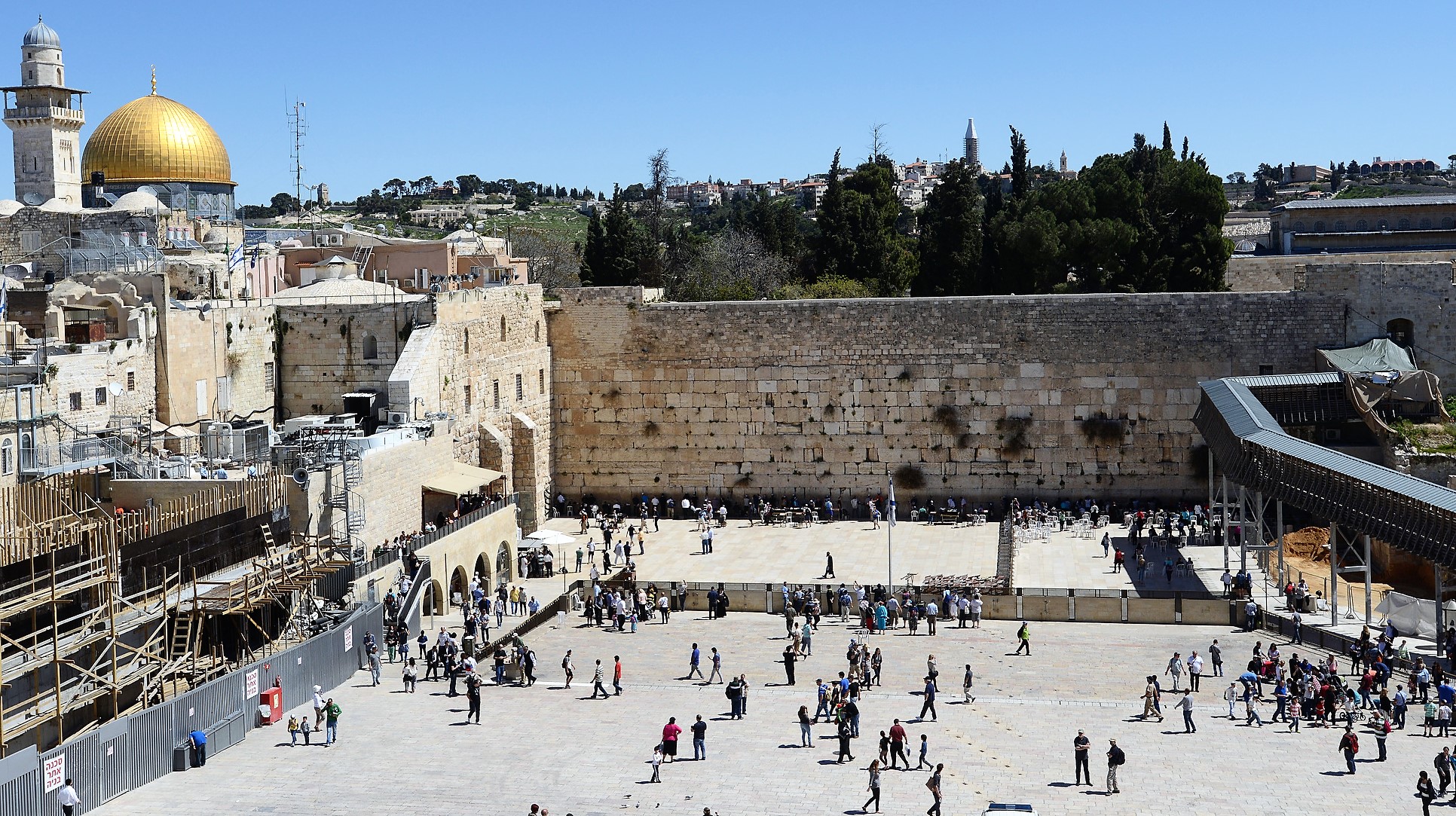
In this Sunday’s Gospel reading, the Jews must have felt the same as they looked at the Temple: that it was permanent, while they would pass away.
The first Jewish Temple was built by King Solomon (c. 970–c. 930 BC). Destroyed by the Babylonians in 586 BC, it was rebuilt in 520 BC. It was desecrated by Antiochus Epiphanes in 167 BC but was rededicated by Judas Maccabaeus two years later. In 20 BC, Herod the Great began the work of renovating and rebuilding it. This was the building the Jews were marvelling at in the Gospel passage.
Imagine, then, how they felt when Jesus said, “The days will come when not one stone will be left upon another; all will be thrown down.”
Perhaps it was similar to our shock and dismay when the World Trade Center was demolished by a terrorist attack. “It’s always been there,” I heard one New Yorker say, “and now there’s nothing.”
We suffer a similar delusion when we look at the world around us: it seems to be stationary and permanent, while our lives seem to be ephemeral and our position in the world tenuous.
We thought the world had put religious warfare and prejudice behind it, but now they seem to be resurfacing. We thought we had conquered infectious disease, and then we had to slaughter all the chickens in the Fraser Valley.
This Sunday’s readings warn us explicitly not to depend on anything in this world. “Nation will rise against nation, and kingdom against kingdom,” Jesus said; “there will be great earthquakes, and in various places famines and plagues; and there will be dreadful portents and great signs from heaven.”
“You will be betrayed … and they will put some of you to death,” he said. “You will be hated by all because of my name.”
Even the world will have an end. “See, the day is coming, burning like an oven, when all the arrogant and all evildoers will be stubble,” we hear in the First reading; “the day that comes shall burn them up.”
However, as we heard two Sundays ago, God loves everything that he has made. The “end of the world” will not be the end of everything. After the dead rise, Christ will come again to deliver the Last Judgment, revealing even to its furthest consequences the good each person has done or failed to do during his or her earthly life.
We shall know the ultimate meaning of the whole work of creation and understand the marvellous ways by which God’s providence has led everything towards its final end. We shall see that God’s justice has triumphed over injustice and that his love is stronger than death. Then the righteous will reign forever with Christ, glorified in body and soul.
Moreover, the universe itself will be renewed; creation itself will be set free from its bondage to decay. In the new universe, God will have his dwelling among us, and the human race will possess the unity God willed from the beginning, which even now is foreshadowed sacramentally by the Church.
As St. Irenaeus said, the world itself, “restored to its original state, facing no further obstacles,” will be “at the service of the just,” sharing their glory in Jesus Christ.
Knowing all this, we should care profoundly for the universe, the world, the environment, our neighbours, and ourselves; for (as Vatican II said) “when we have spread on earth the fruits of our nature and our enterprise … we will find them once again, cleansed this time from the stain of sin, illuminated and transfigured, when Christ presents to His Father an eternal and universal kingdom.”
Father Hawkswell teaches “The Catholic Faith in Plain English” free of charge every week: Sundays, 2–4 p.m. at the John Paul II Pastoral Centre (33rd and Willow, Vancouver); Mondays, 11 a.m.–1 p.m. at St. Anthony’s Parish (2347 Inglewood, West Vancouver) and 7–9 p.m. at the John Paul II Pastoral Centre; and Tuesdays, 7–9 p.m. in St. Clare’s Parish Hall (2888 Delahaye Drive, Coquitlam).







