

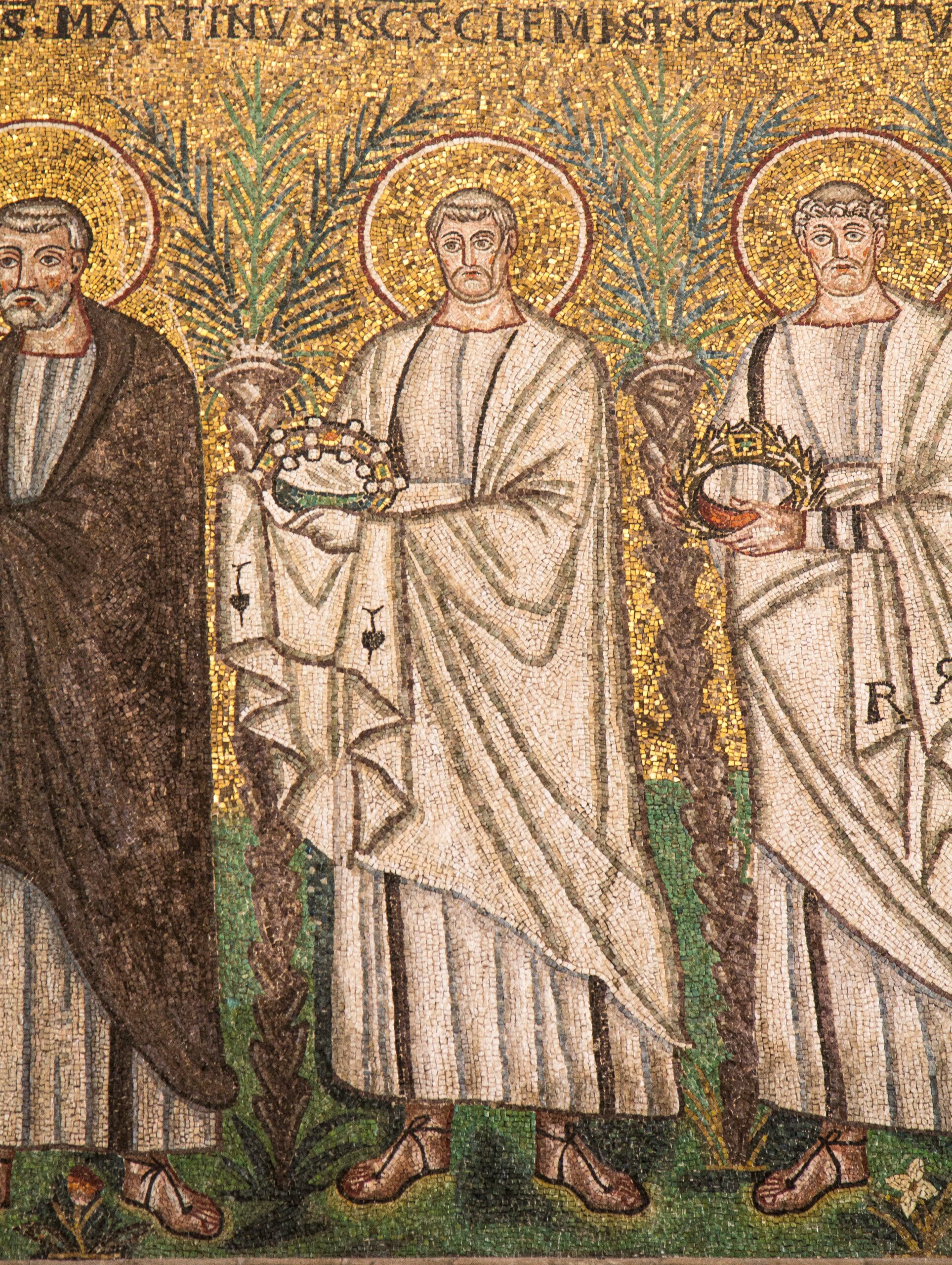

According to the Catechism of the Catholic Church, Fathers of the Church are “Church teachers and writers of the early centuries whose teachings are a witness to the Tradition of the Church.”
A Catholic Dictionary states: “The appellation of Fathers is used in a more general and a more restricted sense. In a general sense it denotes all those Christian writers of the first twelve centuries who are reckoned by general consent among the most eminent witnesses and teachers of the orthodox and Catholic doctrine of the Church. Taken in this sense, it includes some names on which there rests more or less the reproach of heterodox doctrine … In its stricter sense the appellation denotes only those ancient writers whose orthodoxy is unimpeachable, whose works are of signal excellence or value, and whose sanctity is eminent and generally recognized.”
In the stricter sense of usage of the title Church Fathers,” St. Clement of Rome is the Church Father of the 1st century. He was Bishop of Rome in the last years of the first century, and was the third successor of the Apostle Peter.
St. Irenaeus, a Church Father in the 2nd century, wrote about St. Clement: “This man, as he had seen the blessed apostles, and had been conversant with them, might be said to have the preaching of the apostles still echoing [in his ears], and their traditions before his eyes. Nor was he alone [in this], for there were many still remaining who had received instructions from the apostles.”
The Apostle Paul was concerned about the spirit of faction among the Corinthians. In the late first century, St. Clement of Rome wrote a letter to the Church of Corinth which was troubled by schisms. Fourth-century Church historian Eusebius of Caesarea wrote, “There is extant an epistle of this Clement which is acknowledged to be genuine and is of considerable length and of remarkable merit. He wrote it in the name of the church of Rome to the church of Corinth, when a sedition had arisen in the latter church.”
In the letter to the Corinthians, Clement rebuked them: “Take up the epistle of the blessed Apostle Paul. What did he write to you at the time when the Gospel first began to be preached? Truly, under the inspiration of the Spirit, he wrote to you concerning himself, and Cephas, and Apollos, because even then parties had been formed among you. But that inclination for one above another entailed less guilt upon you, inasmuch as your partialities were then shown towards apostles, already of high reputation, and towards a man whom they had approved. But now reflect who those are that have perverted you, and lessened the renown of your far-famed brotherly love. It is disgraceful, beloved, yea, highly disgraceful, and unworthy of your Christian profession, that such a thing should be heard of as that the most steadfast and ancient Church of the Corinthians should, on account of one or two persons, engage in sedition against its presbyters.”
Clement urged the Corinthians to return to the practice of fraternal charity. He wrote, “Let us therefore, with all haste, put an end to this [state of things]; and let us fall down before the Lord, and beseech Him with tears, that He would mercifully be reconciled to us, and restore us to our former seemly and holy practice of brotherly love.”
Saints and Feasts of the Liturgical Year states: “Tradition has it that Clement was exiled by Trajan (Emperor 98–107) to the Crimea, where he was forced to work in the quarries with other Christians. He was later thrown into the sea and drowned, having had an anchor placed around his neck. St. Clement has always been revered as a martyr.”
聖格肋孟捍衛合一
天主教要理闡釋,「教會的教父」是「初世紀教會內的導師與作者,他們的教導是教會聖傳中有效的見證。」
天主教字典亦強調:「教父」的稱號有較籠統和較狹窄的用法。較籠統的是標誌著十二世紀或以前,被公認為是對正統教會的正統及教義,作為卓越見證人和導師的基督徒作者。如此也包括一些因曾主張非正統道理而被指責的人。…較狹窄地說「教父」的稱號,只冠予早期教會在教義的正統上是無可指責的作者,並且,他們的作品是優越和有價值的,他們的聖德是卓著和被公認的。
羅馬的聖格肋孟是第一世紀的「教父」;他是第一世紀末的羅馬主教,聖伯多祿第三位繼承人。
在第三世紀,聖依勒內對格肋孟的評價是:「這人,目睹那些真福的宗徒,曾經和他們談過;也可以說,宗徒親授的講道,能在他(耳朵)內迴響;他們的傳承,展現在他眼前。當然,他不會是唯一親歷的人,亦會有其他曾領受宗徒們直接教導的人。」
保祿宗徒曾擔心格林多教會存有派系之爭。第一世紀末,格肋孟曾去信受裂教影響的格林多教會。第四世紀,凱撒肋雅的教會歷史學家歐瑟伯寫道:「流傳下來格肋孟的書信,被譽為是真確的;這書信是相當長的和相當卓越。當格林多教會發生煽動叛亂時,格肋孟以羅馬教會名義去函予格林多教會。」
在該書函中,格肋孟斥責格林多教會,說:「拿起真福宗徒保祿的書信,看看福音當初在你們間傳播時,他怎樣說!的確,在聖神啟示下,保祿曾寫信給你們,談及他本人、刻法、和阿頗羅,因為就在那時已在你們當中分黨分派。當時的比較高低的傾向是較為輕罪的,因為你們的偏愛是對那已負盛名的宗徒們,以及他們所認可的一個人;但是,如今,你們要反省是誰敗壞了你們,並減去你們有名的兄弟之愛。這真是可恥,親愛的,對, 非常可恥,並有辱於你們基督徒的身份:竟然在最堅定和古老的格林多教會,居然因一兩個人的原故而反叛教會的長老們。」
格肋孟敦促格林多人,恢復兄弟之愛。他寫道:「所以,讓我們趕快終結這事件;並讓我們俯伏在主前,以淚水懇求祂,以慈悲讓我們能與祂重修舊好,回復我們昔日合適的和神聖的兄弟之愛的實踐。」
「禮儀年的聖人及瞻禮」一書指出:「跟據傳统,格肋孟被羅馬皇帝圖拉真(98 – 107)放逐到克里米亞半島,強迫他和其他基督徒在採石場做苦工;後來用船錨纒繞他的頸項,拋到海中溺斃。聖格肋孟被尊為殉道者。」







