


30th Sunday in Ordinary Time, Year C
First Reading: Sir 35:15-17, 20-22
Second Reading: 2 Tim 4:6-8, 16-18
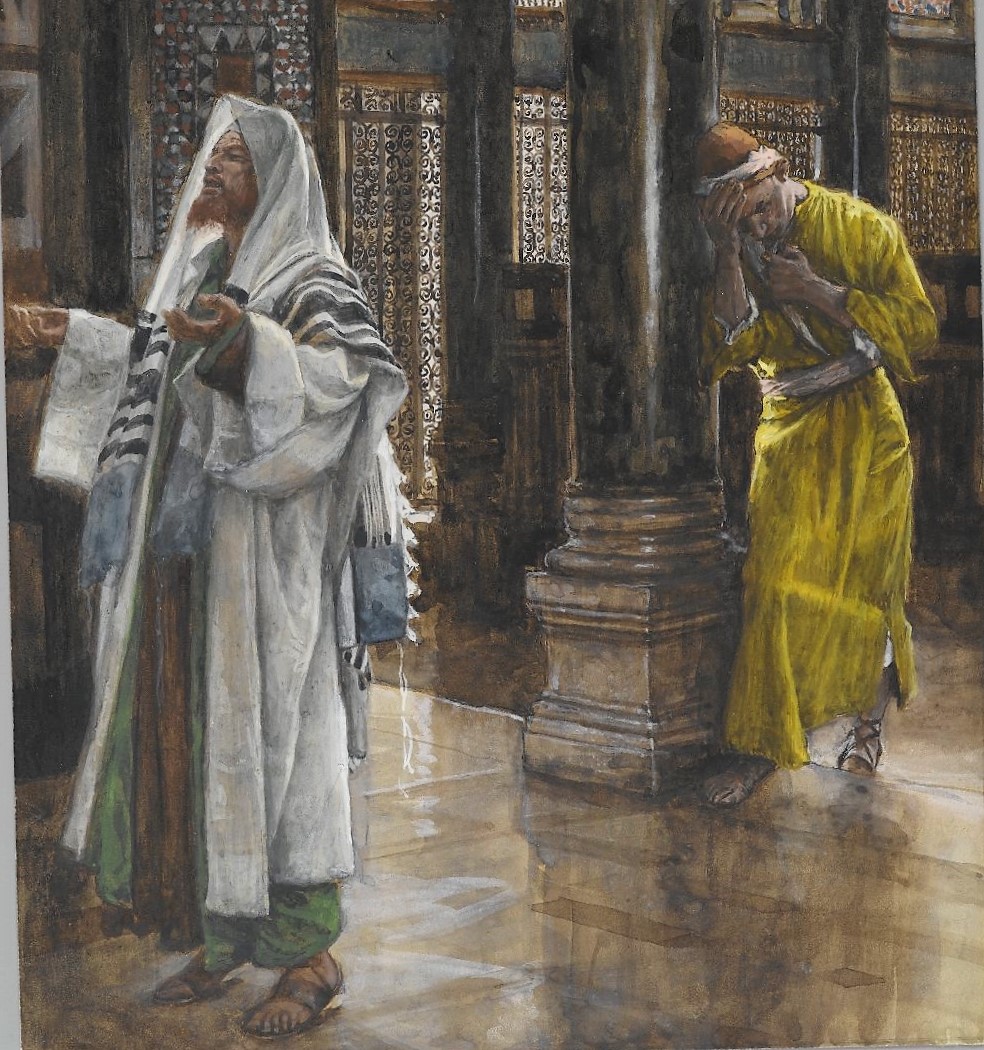
Gospel Reading: Lk 18:9-14
Absent in the Spring, by Mary Westmacott (aka Agatha Christie), starts with a chance meeting of two women who knew each other in school. Joan has been successful, but Blanche has gone down in the world.
Describing her busy life, and mentally thanking God that she is not like Blanche, Joan says how she wishes for time just to think.
“I wonder what you’d think about?” Blanche muses. “One can always think of one’s sins – only that wouldn’t give you occupation long!”
The shortest prayer is “O God, be merciful to me, a sinner,” she notes. “The trouble with you, Joan, is that you’re not a sinner. That cuts you off from prayer!”
The rest of the book describes how Joan becomes isolated in the Syrian desert, waiting for a train, with nothing to do but think, gradually becoming aware of her sins. She remembers that her teacher warned her against being “too pleased” with herself.
We are all too prone to think ourselves good enough for heaven. A man once said to me, like the Pharisee in the Gospel Reading, “Father, I don’t steal; I’ve never murdered anyone; I’m faithful to my wife. Do I have to be a saint to go to heaven?”
Christ answered, “You must be made perfect as your heavenly Father is perfect” – not be perfect, but be made perfect.
We will not be good enough for heaven until God the Father can say without reservation that he is well pleased with us, as he was with his Son. He does not want 50 per cent, 75 per cent, or even 95 per cent of our time, money, and work: he wants us to hand ourselves over to him so he can make us perfect.
He will not do it unless we let him, but if we do not stop him, he will make us perfect. In fact, that is all he will do; he will not let us settle for less. That is why he warned people to “count the cost” before becoming his follower.
Unless we know that, we will start pulling back and resisting him as soon as we think we are good enough. However, this is a fatal mistake. The important thing is not what we want to be, but what he intends us to be. He made us. We are pictures he is painting; how can we know what he intends the finished product to be?
If we do not recognize and admit that we are sinners, we remain “cut off” from prayer – contact with God – as Blanche told Joan. Christ says only the tax collector went home “justified.” The First Reading says only “the prayer of the humble pierces the clouds.”
“When we pray, do we speak from the height of our pride and will, or out of the depths of a humble and contrite heart?” asks the Catechism of the Catholic Church. “Humility is the foundation of prayer … Man is a beggar before God.”
Begging forgiveness is “a prerequisite for righteous and pure prayer,” the Catechism says. “Asking forgiveness is the prerequisite for both the Eucharistic liturgy and personal prayer.” (That is why the Mass begins with the Penitential Rite.)
As God gradually perfects us, we become more and more aware of the defects that still divide us from him. It was clear sightedness, not false humility, that made the saints call themselves “unworthy.”
St. Thérèse of Lisieux wrote that she was “too small to climb the rugged staircase of perfection” by herself, but that she had found the necessary “elevator”: the arms of Jesus. “For that I do not need to grow bigger,” she said; “on the contrary, I have to remain small; I have to become smaller and smaller.”
If we do, and only then, we will be able to claim, with St. Paul in the Second Reading, the “crown of righteousness” God has reserved for us.
Father Hawkswell teaches “The Catholic Faith in Plain English” free of charge every week: Sundays, 2–4 p.m. at the John Paul II Pastoral Centre (33rd and Willow, Vancouver); Mondays, 11 a.m.–1 p.m. at St. Anthony’s Parish (2347 Inglewood, West Vancouver) and 7–9 p.m. at the John Paul II Pastoral Centre; and Tuesdays, 7–9 p.m. in St. Clare’s Parish Hall (2888 Delahaye Drive, Coquitlam).







