


26th Sunday in Ordinary Time, Year C
First Reading: Am 6:1a, 4-7
Second Reading: 1 Tim 6:11-16
Gospel Reading: Lk 16:19-31
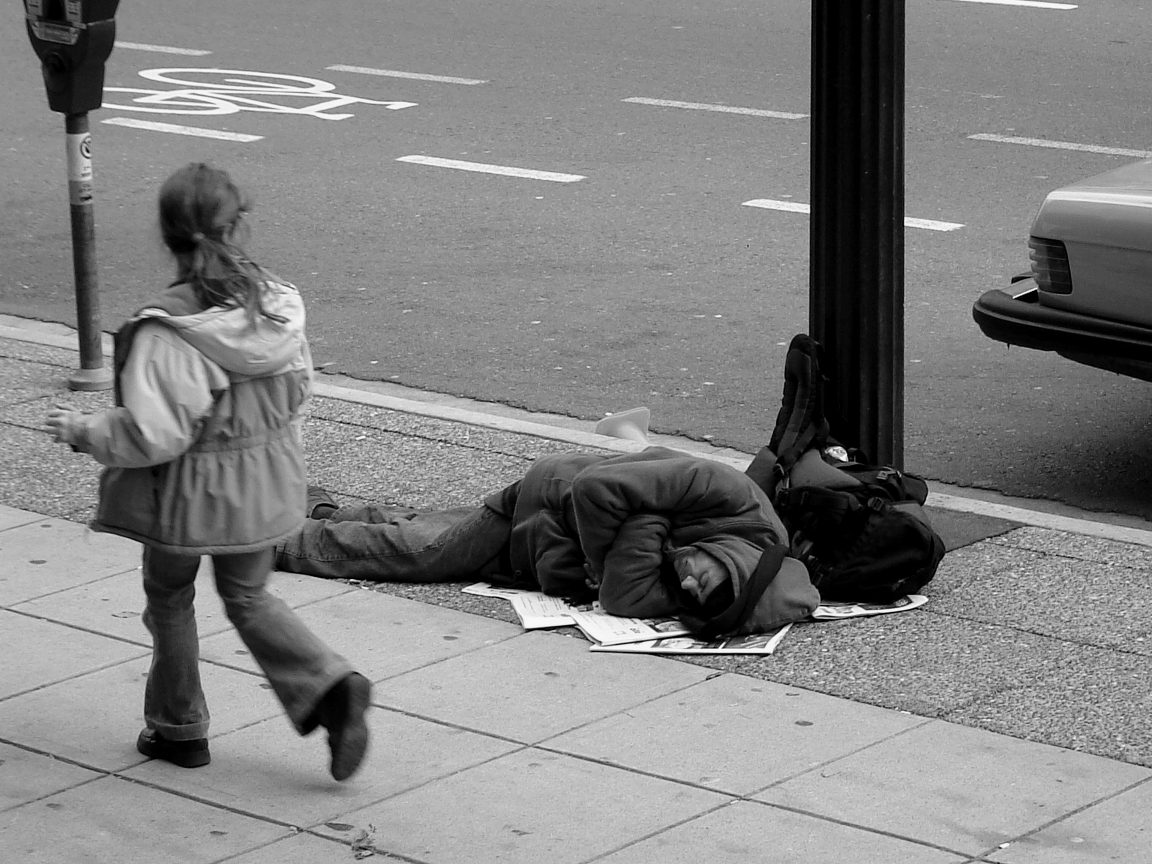
Alas for those of us who are well-off and “are not grieved” over the plight of the less fortunate, the prophet Amos warns in this Sunday’s first reading. Jesus echoes this warning in the Gospel reading, promising that the poor in this world will be blessed in the next.
The message is that of the beatitudes, or blessings: Blessed are the poor, the hungry, the sad, and the marginalized, Jesus said. “Rejoice and exult, for your reward shall be great in Heaven.” Woe to the rich, the well-fed, the happy, and the famous.
In his book Jesus of Nazareth, Pope Benedict XVI calls the beatitudes paradoxes. “The standards of the world are turned upside down as soon as things are seen in the right perspective, which is to say, in terms of God’s values, so different from those of the world,” he explains. “It is precisely those who are poor in worldly terms, those thought of as lost souls, who are the truly fortunate ones, the blessed, who have every reason to rejoice and exult in the midst of their sufferings.”
The beatitudes are promises, the Pope notes, but the joy they proclaim is not “postponed until some infinitely remote future”; they do not apply “exclusively to the next world.” On the contrary, he says, when we become “a companion on Jesus’ way,” we live by “new standards” and something of “the reality to come” is already present: “Jesus brings joy into the midst of affliction.”
In following Jesus, we follow the way of the cross, but the splendour of the Resurrection shines through, bringing a joy, a blessedness, greater than the happiness the world offers, the Pope says. We realize what real happiness, true blessedness, is, and we become aware of the “paltriness” of conventional satisfaction and happiness.
God did not create the world evil, with the intention of afflicting those who followed his way. No; it became evil when our first parents, seduced by Satan, rebelled against God. Thus Satan acquired a certain domination over the world, becoming what Jesus called him: “the prince of this world.”
The standards of Christ, therefore, are bound to conflict with the standards of the world. How, then, should we live in this world as followers of Christ?
First, we must consciously reject the world’s goals: riches, popularity, physical beauty, and immediate satisfaction and happiness in food, drink, recreation, etc. Instead we must pursue “righteousness, godliness, faith, love, endurance, [and] gentleness,” as St. Paul says in the second reading.
We must be people “who do not run with the pack, who refuse to collude with the injustice that has become endemic, but who suffer under it instead,” Pope Benedict says. We may not be able to change things overall, but we must “counter the domination of evil through the passive resistance” of our suffering. It was about such people that Jesus said, “Blessed are they who mourn.”
However, grieving over evil is not enough: we must also use this world’s goods with God’s reign in mind. That means sharing them with those who have less. As the Pope says, we must master the inner tension between our natural life and our supernatural life by owning goods as if we owned nothing. We are not all called to give up everything, like St. Francis, but his example should wake us up to how “possession is all about service” and make us reject “the culture of affluence” in favour of “the culture of inner freedom.”
We must cultivate the attitude of Maria von Trapp, who, when her husband lost his fortune helping a friend, ran to him and hugged him. “I am so happy to know that we don’t belong to those for whom it is so hard to enter the Kingdom of God,” she explained. “We were not really rich; we just happened to have a lot of money!”
Father Hawkswell teaches “The Catholic Faith in Plain English” free of charge every week: Sundays, 2–4 p.m. at the John Paul II Pastoral Centre (33rd and Willow, Vancouver); Mondays, 11 a.m.–1 p.m. at St. Anthony’s Parish (2347 Inglewood, West Vancouver) and 7–9 p.m. at the John Paul II Pastoral Centre; and Tuesdays, 7–9 p.m. in St. Clare’s Parish Hall (2888 Delahaye Drive, Coquitlam).







