


Jesus said, “You shall love the Lord your God with all your heart, and with all your soul, and with all your mind. This is the great and first commandment. And a second is like it, you shall love your neighbour as yourself. On these two commandments depend all the law and the prophets.” (Mt 22:37–40)
Thierry Maertens, OSB, author of Bible Themes, wrote, “To imitate the divine morality in the human condition is to practise fraternal charity, without which there is no love of God.”
St. John wrote, “If any one says, ‘I love God,’ and hates his brother, he is a liar; for he who does not love his brother whom he has seen, cannot love God whom he has not seen” (1 Jn 4:20).
From this obligation of fraternal charity follow both negative and positive duties toward others. Negative duties are summed up: “Do not unto others what you would not have them do to you.” Positive duties are summed up: “Do unto others as you would that they should do to you.”
“Neighbour” means all those who are capable of enjoying eternal life, or are already enjoying it. Hence, all the angels and saints in heaven, all people on earth, and all souls in purgatory are our neighbours.
The devils and the damned are excluded from fraternal charity, because they have forever voluntarily separated themselves from God, who is the centre of charity.
We love God directly in himself because he is infinitely lovable. We love God indirectly in others because we recognize in our neighbour a reflection of the lovableness of God.
Fraternal charity and works of mercy are inseparable. St. Faustina Kowalska (1905-1938) is an apostle of Divine Mercy. Our Lord said to her, “I am giving you three ways of exercising mercy toward your neighbour: the first, by deed; the second, by word; the third, by prayer. In these three degrees is contained the fullness of mercy, and it is an unquestionable proof of love for me. By this means a soul glorifies and pays reverence to my mercy” (Diary, 742).
Our Lord told Faustina to write about the value of spiritual works of mercy: “But write this for the many souls who are often worried because they do not have the material means with which to carry out an act of mercy. Yet spiritual mercy, which requires neither permission nor storehouses, is much more meritorious and is within the grasp of every soul. If a soul does not exercise mercy somehow or other, it will not obtain my mercy on the day of judgment. Oh, if only souls knew how to gather eternal treasure for themselves, they would not be judged, for they would forestall my judgment with their mercy” (Diary, 1317).
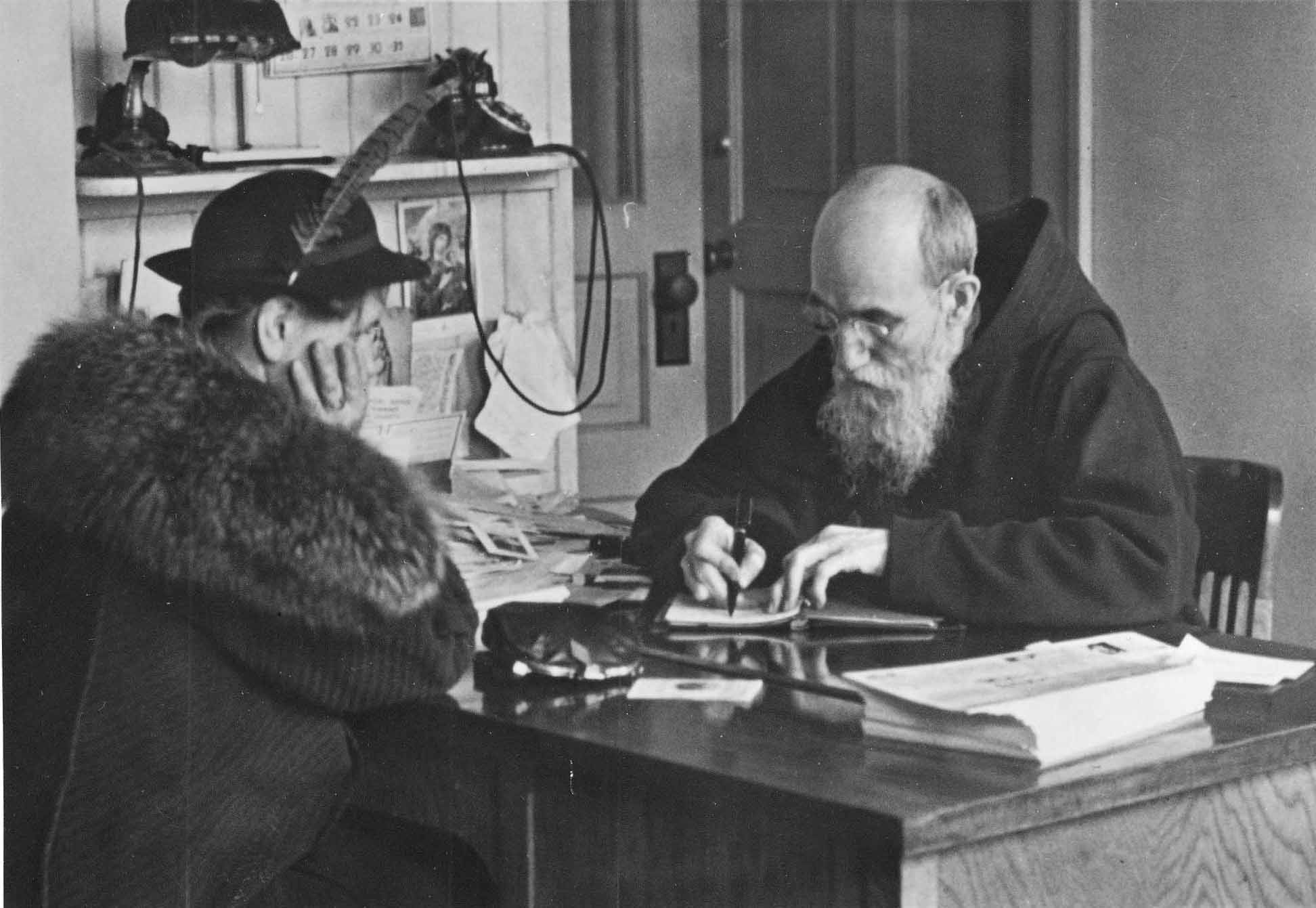
Both St. Faustine and Blessed Solanus Casey (1870-1957) served as porters in their communities and practised mercy toward people. Solanus’ childhood name was “Barney.”
He entered the seminary in Milwaukee at 21 to study for the diocesan priesthood. Barney loved the life in seminary, however, he had difficulty learning German and Latin, the languages in which theology was taught at the time. Finally, his superiors advised that he was not likely to succeed and suggested he enter a religious order.
In December 1896, Barney travelled through a snowstorm for three days to arrive at the door of St. Bonaventure Friary in Detroit on Christmas Eve. Later, as a Franciscan priest, he spent 21 years serving as porter.
Father Solanus said, “I have two loves: the sick and the poor.” He was always available to the poor, the sick, and troubled souls and gave spiritual guidance to many people.
During his final illness Father Solanus remarked, “I’m offering my sufferings that all might be one. If only I could see the conversion of the whole world.”
“Blessed are the merciful, for they shall obtain mercy” (Mt 5:7).
慈悲彰示愛德
耶穌說:「你應全心、全靈、全意愛上主你的天主。這是最大也是第一條誡命。第二條與此相似:你應當愛近人,如你自己。全部法律和先知,都繫於這兩條誡命。(瑪竇福音22:37-40)」
「聖經主題」作者、本篤會會士泰利.梅爾騰斯神父寫道:「在人的境況中去效法神性的道義,先是實踐兄弟之愛,欠缺這種愛,說不上愛天主。」聖若望宗徒亦記載:「假使有人說:我愛天主,但他卻惱恨自己的兄弟,便是撒謊的;因為那不愛自己所看見的兄弟的,就不能愛自己所看不見的天主。(若望一書4:20)」
兄弟之愛有正反兩方面的撮要。反方是「己所不欲勿施於人」;正方是「己所盼欲則施於人」。
「近人」是泛指可享有永生和已享有永生的人。因此,「近人」是指天朝諸神聖、煉獄的聖靈魂,和在塵世間的人;卻把地獄的惡靈及人靈摒棄於外,因為他們已經自願與愛的核心——-天主——-分離。
我們直接愛天主,因為天主是無限可愛的;我們也通過愛近人而間接愛天主,因為我們認識到,近人反映著天主的可愛。
兄弟的愛,與慈悲的善功不可分割。吾主向「神聖慈悲宗徒」聖傅天娜修女(1905-1938)說:「我給你向近人實踐慈悲的三種方法:以行動、以言語、以祈禱。這三種方法包含著豐富的慈悲,和對我的愛不可置疑的証明。靈魂藉此光榮及恭敬我的慈悲。(日記742)」
吾主向聖傅天娜修女指出有多人憂慮自己缺乏物資去施行慈悲。但是靈性上的慈悲善工,並不需要別人批准,亦不需要有充足的儲備;這些善工是更有功勞和每個人靈都可以實踐。不施行慈悲的靈魂,在審判之日,也不會得到主的慈悲。(日記1317)
聖傅天娜修女及真福蘇朗諾.卡西(1870-1957),均在他們的社群中,擔負門房的工作,並此向多人行慈悲的善功。
蘇朗諾.卡西兒時乳名「巴尼」,二十一歲時進入密爾沃基修院,學習堂區牧民;雖然他喜愛修院生活,但對用德語和拉丁語教授的神學應付不來,被長上勸諭放棄,改入修會修道。
1896年12月,巴尼在暴雪中行了三天,在聖誕節前夕,抵達底特律的聖文德修院。他成為司鐸後,用了二十一年當門房的工作。蘇朗諾神父說:「我有兩個愛——-生病的人及貧苦的人。」任何時候或光景,蘇朗諾神父隨時照顧貧病和情緒不安的人,給很多人神修的指導。在臨終時,這位聖善的司鐸強調他為眾人合一而奉獻痛苦。他盼望整個世界的皈化。」
「憐憫人的人是有福的,因為他們要受憐憫。(瑪竇福音5:7)」







