
19th Sunday of Ordinary Time, Year A
First Reading: 1 Kgs 10:9, 11-13
Second Reading: Rom 9:1-5
Gospel Reading: Mt 14:22-33
“Stand on the mountain before the Lord, for the Lord is about to pass by,” God told Elijah. There followed great wind, earthquake, and fire, but the Lord was in none of them. Then there came “a sound of sheer silence,” and Elijah “wrapped his face in his mantle and went out and stood at the entrance of the cave.”
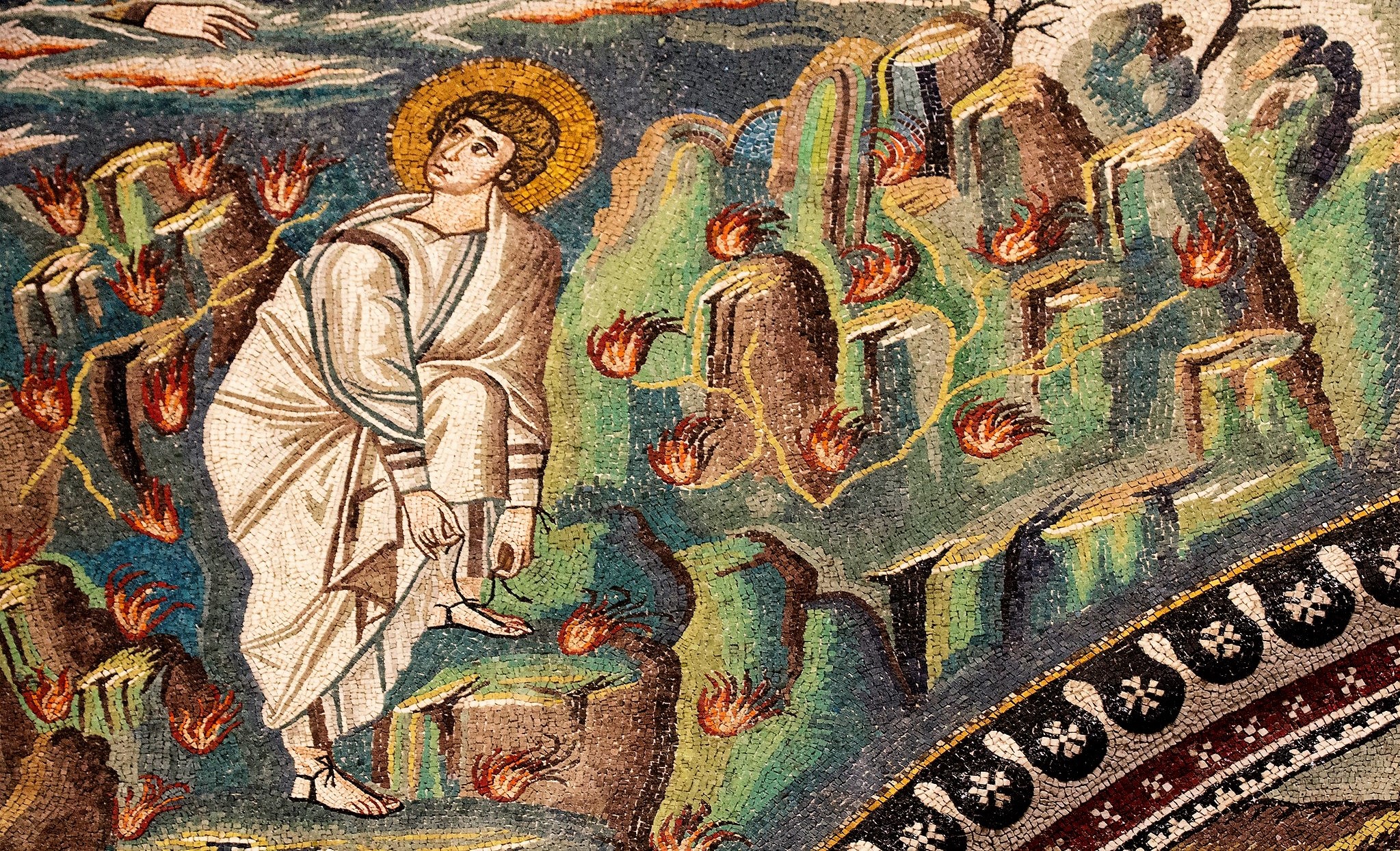
Also on a mountain. Moses begged God, “Do let me see your glory!” and God replied, “I will make all my beauty pass before you, and in your presence I will pronounce my name, ‘YHWH.’”
However, “my face you cannot see, for no man sees me and still lives. Here is a place near me where you shall station yourself on the rock. When my glory passes I will set you in the hollow of the rock and will cover you with my hand until I have passed by. Then I will remove my hand, so that you may see my back, but my face is not to be seen.” When God passed by, Moses “bowed down to the ground in worship.”
God’s name, written Yahweh in English, means I am who am. It contains the truth that only God simply is; he alone is the fullness of being and every perfection, without origin or end. His creation receives its being from him, but he is all he is of himself. He alone is his very being.
“I am” is both “the revelation of a name and something like the refusal of a name,” says the Catechism of the Catholic Church. Like God himself, it is mysterious and so better expresses what God is: infinitely above anything we can say or understand.
Like wind, earthquake, or fire, God is powerful. In fact, he is omnipotent: he can do all things. However, it is his holiness, not his power, that overwhelmed Elijah and Moses.
The proper reaction to the holy is “fear of the Lord.” This is what made the apostles “worship” Jesus, saying, “Truly you are the Son of God,” when they saw him walking on the sea.
“Fear of the Lord” is a gift from the Holy Spirit. It is not flight from threat, pure terror, or simply alarm or fright. Rather, it is knowledge and experience of God as utterly holy, totally other, incomprehensible, absolute, almighty, all-powerful, all-knowing, and absolutely majestic.
Jesus identified himself as God when he said, “I solemnly declare it: before Abraham came to be, I am.” However, in Jesus, God became familiar with us: one of our family, our “kindred according to the flesh,” as St. Paul says.
With Jesus, “God is no longer the wholly other, the incomprehensible one,” said Pope Benedict XVI. “He is now also the one who is near us, who has become identified with us, who touches us and is touched by us, whom we can receive and who will receive us.”
It is hard for us to keep the holy and the familiar together in our minds. Today, we tend to downplay the holy. For example, we often talk or sing all through Mass, even though the Church instructs us to observe “sacred silence” as “part of the celebration” at “the designated times.”
One of those times is after Communion, when we are to “praise and pray to God” in our hearts. However, “even before the celebration itself, it is commendable that silence be observed in the church, in the sacristy, in the vesting room, and in adjacent areas, so that all may dispose themselves to carry out the sacred action in a devout and fitting manner.”
To know Jesus as God the Son, we need “a revelation from above,” Pope John Paul II said. “Attentive listening is indispensable,” for “only the experience of silence and prayer offers the proper setting for the growth and development of a true, faithful, and consistent knowledge of that mystery.”