

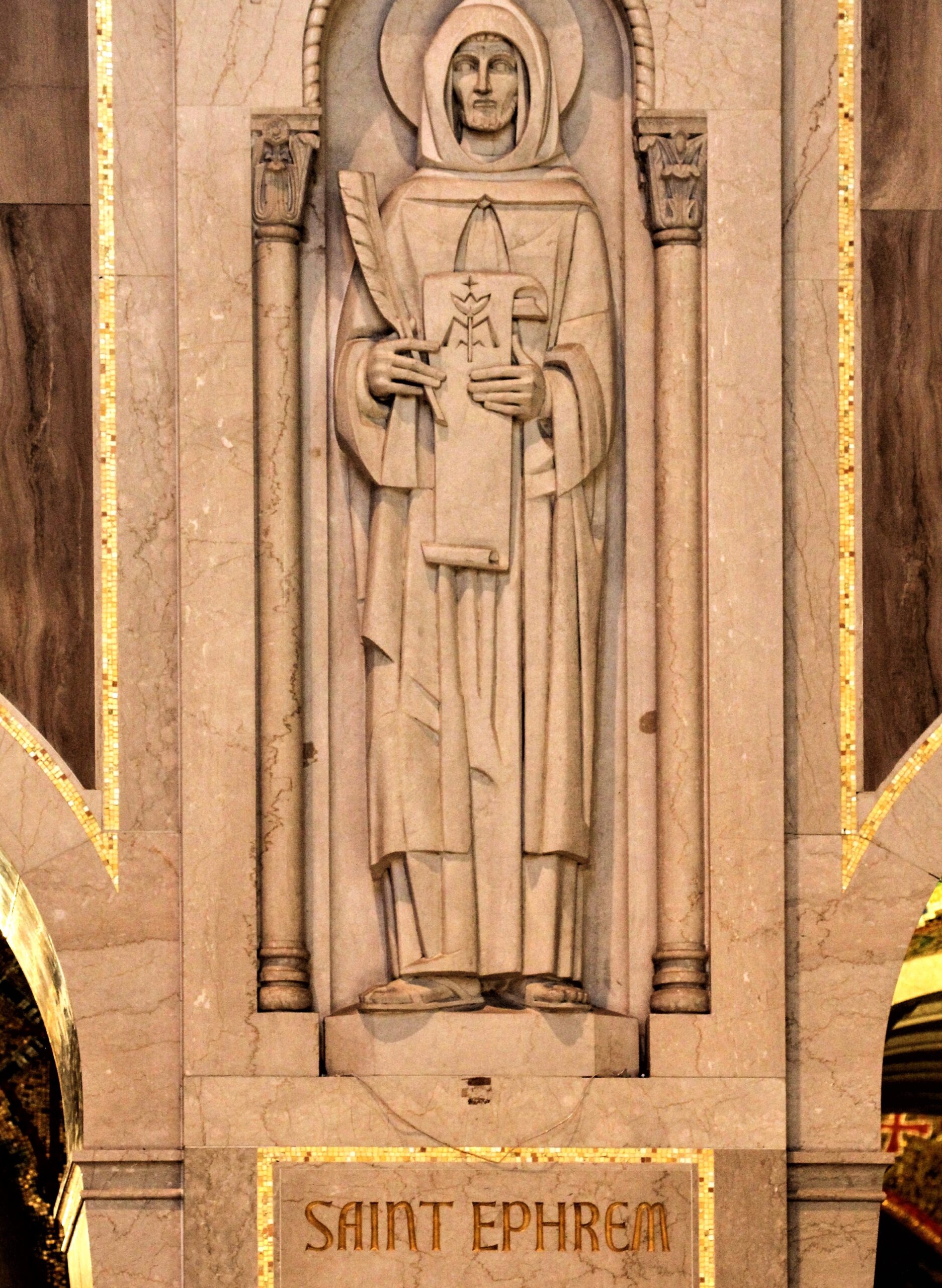

St. Ephrem was born in Nisibis (modern Nusaybin, Turkey) around 306. He was educated and grew up beside James, Bishop of Nisibis (303–338), and with him founded the theological school in his city. He was ordained a deacon and was very active in the local Christian community until the cession of Nisibis to Persia in 363. He then moved to Edessa, Greece, where he continued to teach.
Ephrem remained a deacon all his life. When St. Basil of Caesarea wanted to make him a bishop, he feigned madness to escape episcopal consecration.
Ephrem preached repentance like St. John the Baptist. People loved listening to him. Tears would stop his voice when he preached. St. Gregory of Nyssa said, “We cannot call to mind his perpetual tears without melting into tears. To weep seemed almost as natural to him as it is for other men to breathe. Night and day his eyes seemed always swimming in tears. No one could meet him at any time, who did not see them trickling down his cheeks.”
Ephrem wept for the slight sins which he committed when he was young, and he trembled at the thought of God’s judgments.
Pope Benedict XVI said, “St. Ephrem has left us an important theological inheritance. His substantial opus can be divided into four categories: works written in ordinary prose (his polemic works or biblical commentaries); works written in poetic prose; homilies in verse; and lastly, hymns, undoubtedly Ephrem’s most abundant production.” The Holy Father added: “Theology, reflection on the faith, poetry, song and praise of God go together.”
Ephrem wrote in Syriac, and the Syrian Church refers to him as “the Harp of the Holy Spirit.” Ephrem wrote about the perfect sinlessness of Our Lady and thus he was one of the earliest Fathers of the Church to teach the Immaculate Conception.
Here is a section from one of the hymns of Ephrem on the Nativity of Christ:
A wonder is Your mother: The Lord entered her
and became a servant; He entered able to speak
and He became silent in her; He entered her thundering
and His voice grew silent; He entered Shepherd of all;
a lamb he became in her; He emerged bleating.
About 372, Ephrem went to visit St. Basil. He told Basil, “I am that Ephrem who have wandered astray from the path of heaven.” Then bursting into tears; he cried out, “O my father, have pity on a sinful wretch, and lead me into the narrow path.”
Father Alban Butler wrote, “St. Ephrem was always filled with grief, indignation, and confusion when he perceived others to treat him as a saint, or to express any regard or esteem for him. In his last sickness he laid this strict injunction on his disciples and friends: ‘Sing no funeral hymns at Ephrem’s burial: suffer no encomiastic oration. Wrap not my carcase in any costly shroud: erect no monument to my memory. Allow me only the portion and place of a pilgrim; for I am a pilgrim and a stranger as all my fathers were on earth.’”
Ephrem died in Edessa on June 9, 373, a victim of the disease he contracted while caring for those infected with the plague.
He trusted in the mercy of God, and, regarding his own death, said, “I am setting out on a journey hard and dangerous. You, O Son of God, I have taken for my Viaticum. When I am hungry, I will feed on You. The infernal fire will not venture near me, for it cannot bear the fragrance of Your Body and Your Blood.”
義範以詩篇演譯神學
約在公元306年,聖義範出生於尼西比斯(今天土耳其的奴西本),與尼西比斯主教雅各伯(303-338年)一同接受教育和長大,並且一起創辦一間神學院。義範被晉升為執事聖職後,在基督徒團體間非常活躍,直到363年尼西比斯被割讓給波斯為止。他移居希臘的埃德莎,並繼續教授神學。
雖然曾有地區屬意義範當主教,但他裝傻扮懞地避免成為主教,樂於終身負起執事聖職。
義範會因年輕時不太嚴重的罪而飲泣,想到天主的審判而顫抖。無怪像聖若翰洗者一樣,義範講道時,常強調悔改;而他的講道能觸動人心並深受歡迎。聖國瑞.尼沙形繪道:「哭泣對義範來說,似乎像呼吸一樣與生俱來;他眼眶日夜都含著淚水,有時看到他的面頰留著淚痕。」
教宗本篤十六世說:「聖義範留給我們很重要的神學傳統。他充實的作品可分為四大類:普通的散文箸作(包括辯解及聖經詮釋)、詩篇體的散文、詩篇般的講道,和聖詠。無疑,他的作品是最多元化。」「信德、神學反思、詩詞、歌詠和讚頌天主都集合在一起。」
聖義範用敘利亞文寫作,敘利亞禮的天主教會稱他為「聖神的豎琴」。
義範寫及聖母無罪的完美,是教會中最早訓導「聖母始胎無玷」的教父。以下節錄他論及耶穌聖誕其中一首聖詠:
「祢的母親就是奇妙:上主進入她內,竟遜服為僕;祂進入能説話,卻在她內沉默;祂煌然降進入她內,而祂的聲音成靜黙;祂為眾牧之牧,竟在她內委為羔羊,微弱低鳴地出來。」
約在公元372年,義範往訪聖巴西略,對他說:「我就是那個偏離了天堂之路迷途的義範 。」然後淚如泉湧地喊著:「我的父啊,請可憐我這個不幸的罪人,領我到狹窄之路罷。」
雅伯.本勒神父指出:當人們視義範為聖人、或對他顯示特別的尊敬時,他反而悲傷、憤慨和迷茫。在最後一次患病時,義範特別叮囑門生和朋友們,在他的殯葬禮上,不要詠唱葬禮歌,不作追思陳情,不用昂貴的殮布,不立紀念碑,只讓他容身於為朝聖者的地方;因為他就如先祖們,在這世上只是陌路的朝聖者。
義範因照料疫症病人而受感染,死於373年6月9日。他信賴天主的慈悲;對於自己的死亡,義範說:「我要在一個艱辛又危險的路途上進發。噢!天主子,我已領受臨終聖體。我饑餓時,以祢為食糧,使地獄之火不敢靠近我,因為它不能承受祢體血的馨香。」







