

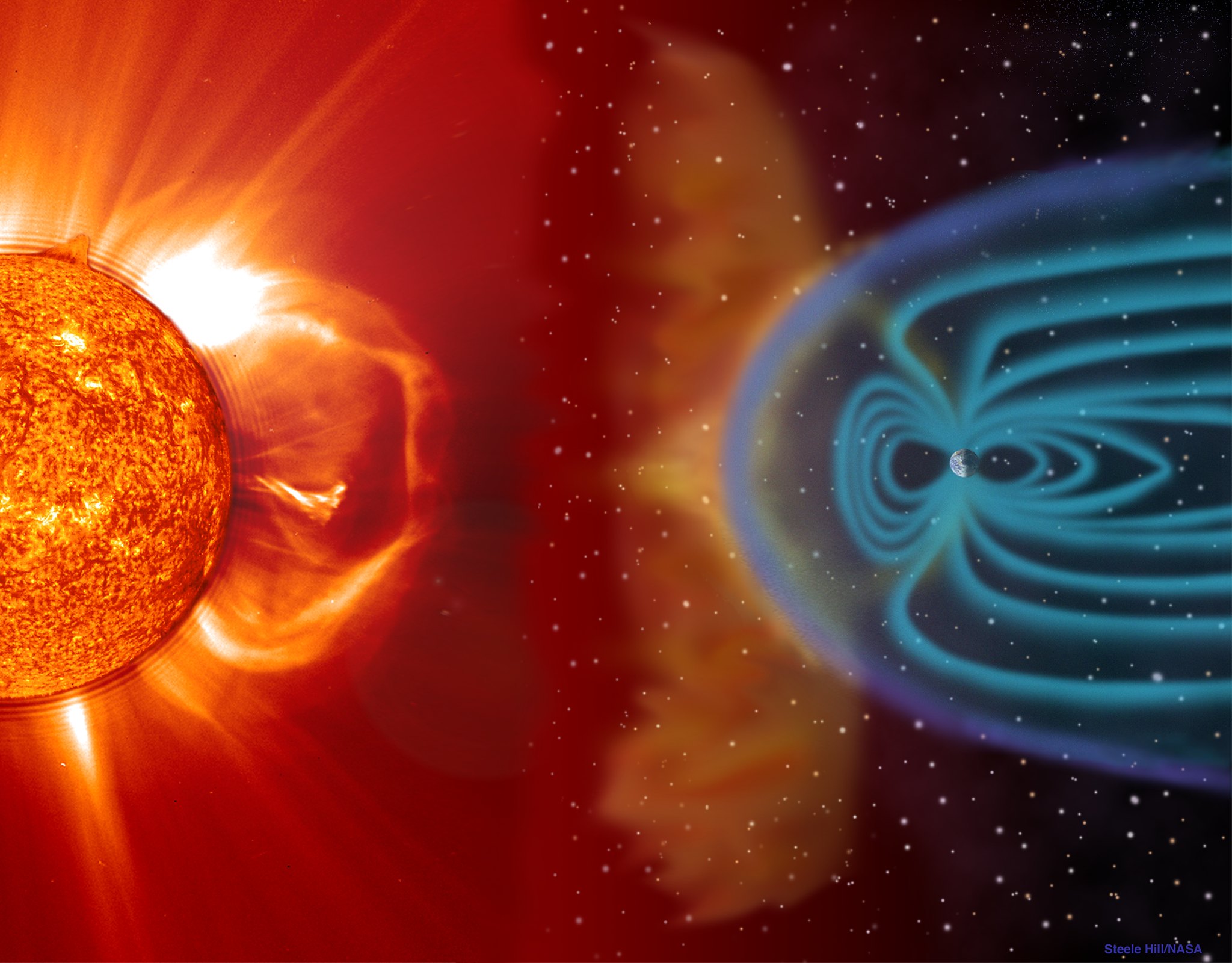

Recently there was a flurry of discussion about variations in earth’s magnetic field, and in particular about two areas where the field’s strength has diminished appreciably in recent years.
When I first made a public post about what is known as the South Atlantic magnetic field anomaly, I was met with skeptical replies. The first respondent wanted to know if this was fake news. I assured him it wasn’t, and noted that the actual news source was the European Space Agency (ESA), which has a constellation of spacecraft that constantly map earth’s magnetosphere.
The respondent then said the story worried him. He wanted to know if this was a man-made event or issue, and what could be done to mitigate its effects. I quickly replied that he should not be concerned, and that this matter was completely beyond human control.
Why does earth’s magnetic field matter in the first place? It’s an essential factor supporting life here by protecting much of the planet from charged particles, solar winds, and cosmic rays that could otherwise harm living cells.
This solar wind consists of electrons, protons, and alpha particles ejected from the sun’s plasma, the superhot gaseous region that forms part of the corona. And this solar wind is impressively fast, travelling about a million miles per hour!
Earth’s magnetic field extends outward from the planet for a great distance, interacting with the solar wind, which compresses the field on the side facing the sun, and leaving a tail, as it were, on the side away from the sun. It is this region of magnetic field that we call the magnetosphere.
Charged particles in the solar wind are deflected by earth’s magnetic field, particularly toward the polar regions. In fact, there is a slightly elevated risk of cancer in polar regions because of the increased radiation exposure caused by particles being deflected pole-wise.
Auroras (e.g., the Northern Lights) are an example of the solar wind interacting with earth’s atmosphere. Charged particles smash into atmospheric molecules, ionizing or exciting them, with light being released when electrons drop back to their normal levels or when the ions re-form as atoms with full electron complements.
Does it matter that there are anomalies in Earth’s magnetic field? Yes, to a degree. For one, low-orbit satellites in the regions of the anomalies experience higher than typical solar flux, a term for the collective of particles that impact the earth. Such particles can damage delicate electronics or damage components, potentially destroying a satellite.
These regions would be more vulnerable to the effects of geomagnetic storms that result from flares on the surface of the sun.
There are also implications for high-flying aircraft. Crew and passengers in aircraft flying through regions of reduced magnetic field are also subject to increased radiation. In the days of the Concorde, which flew particularly high, the crew were restricted in the number of flights per month based on the increased radiation exposure.
Increased solar flux penetrating earth’s atmosphere causes it to heat up and expand. Space platforms such as the International Space Station (ISS) orbit just 420 or so kilometers above earth’s surface. Earth’s atmosphere actually extends to this region and exerts a drag on the ISS and other low orbit satellites. For this reason, the ISS must continually be boosted back to slightly higher orbits to combat this drag.
I explained to my reader that in fact much of the physics behind earth’s magnetic field is not well understood. It is not as if the earth has a giant bar magnet buried in its core. In simple terms, earth’s magnetic field is believed to originate from the movement of molten nickel and iron in earth’s core. This movement is akin to a massive electric current, and we know from basic physics that electric currents have associated magnetic fields.
It is in this sense that the earth is like a giant generator – a dynamo, if you will – and in fact we use the term “dynamo effect” to describe this production of magnetic fields by planets.
Finally, we know from geology that earth’s magnetic field has undergone not merely variations in strength, but entire pole reversals, in which the magnetic north pole and magnetic south pole switch places.
Furthermore, it appears that such pole switches occur with some regularity, about every half a million years. And using that figure, it seems that we are a couple of hundred thousand years overdue for another flip.
Might the South Atlantic magnetic anomaly be an indicator of an impending pole reversal? It could be. We really don’t know. Now the ESA spacecraft have detected another such anomaly, a region of diminished magnetic field strength, also in the South Atlantic, this one closer to Africa, the other being nearer South America. It may even be that the original anomaly is splitting into two segments.
One model of a possible pole reversal suggests that multiple north and south poles could appear across the globe, with the overall magnetic field diminishing appreciably before returning to the normal value.
It is good that the ESA project continues to enhance our understanding of magnetic field anomalies and ultimately perhaps to better understand just what is going on inside the earth.
Internet service speed battle heats up
In a subsequent column we’ll take a look at the gigabit wars as the two major providers here in B.C. argue over whose network is faster.
Follow me on Facebook (facebook.com/PeterVogelCA), on Twitter (@PeterVogel), or on Instagram (@plvogel)







