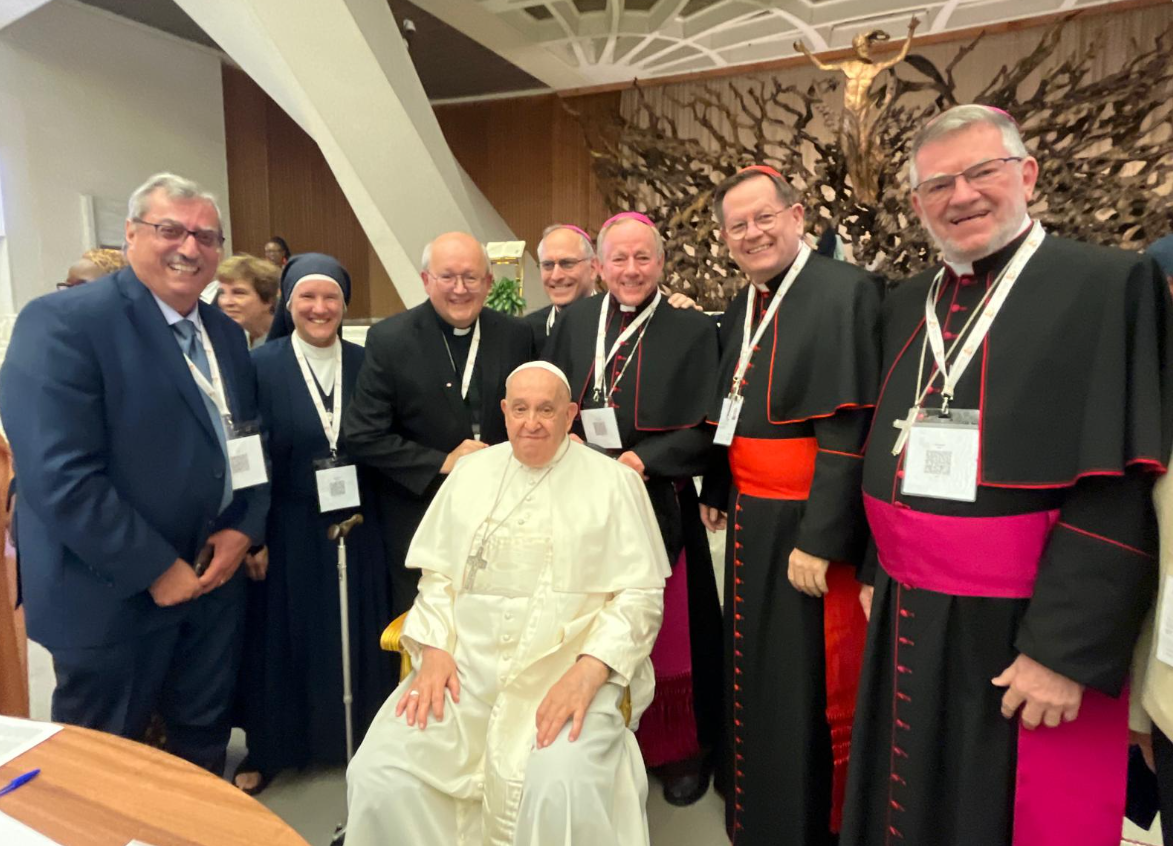

On April 22, CBC’s Stephen Quinn interviewed Archbishop Miller about the life and legacy of Pope Francis. Here is an edited transcript.
CBC: Good morning, Archbishop. How are you reflecting today on the life of Pope Francis?
Archbishop Miller: “Well, he left us a great legacy. His departure wasn’t totally unexpected, but when it came, it came in a peaceful way. He had been active and blessing the faithful right up to the day before.
“It was the kind of death worthy of a man who was humble and gave himself totally to the people. He will surely be missed throughout the world — perhaps especially in Canada because of his historic visit to us in 2022.”
CBC: It was remarkable that he was able to give an Easter blessing before he died, considering his ailing health.
Archbishop Miller: “Right. His last words were almost, ‘Fratelli e sorelle, buona Pasqua’ — ‘Brothers and sisters, Happy Easter.’ That sums up the kind of man he was and the papacy he embodied.”
CBC: How do you think the Church evolved under Pope Francis’ leadership?
Archbishop Miller: “The Church is always evolving, always picking up new tones from the Gospel. Certainly, Pope Francis put front and centre solidarity with the poor, with migrants, refugees, prisoners — with the dispossessed. He’ll long be remembered for those traits, along with his concern for human ecology. His famous encyclical Laudato Si’ placed new emphasis on the care for our common home.
“Each Pope brings a different emphasis. The Gospel is so rich that no one person can highlight everything at once. For Pope Francis, compassion and solidarity with the poor were the great gifts he offered.”
CBC: He certainly set a new tone for the Church over his 12-year tenure. He apologized for harms committed by Church members in residential schools, permitted blessings for same-sex couples, allowed transgender people to be baptized, and called laws criminalizing homosexuality unjust. In his final public address, he called for an end to the war in Gaza. How do you reflect on the tone he set, especially compared to his predecessors?
Archbishop Miller: “I think the word ‘shift’ applies to every Pope. Each brings a shift in emphasis — a highlighting of certain parts of the Gospel. That’s expected. Pope Francis had the right emphasis for the moment.
“The world needed a push into compassion, mercy, and hope. He declared this a Jubilee Year of Hope, because he knew so many in the world are saddened, frustrated, disappointed. And hope — because Christ is risen — is the Good News the world needs to hear.”
CBC: The papacy is a 2,000-year-old institution. And yet Pope Francis seemed especially willing to confront modern issues — perhaps more so than any Pope in recent memory.
Archbishop Miller: “He certainly confronted the issues of our day. But if you recall, Pope John Paul II confronted communism and authoritarianism in Europe. Each Pope responds to the needs of the times. That’s to be expected. Pope Francis had the slant — the focus — needed for this moment.”
CBC: Where does the Church go from here?
Archbishop Miller: “As always, the Church keeps going. Succession is built into the fabric of the Church. There will be a conclave. The cardinals will elect a new successor of Peter, who will bring his own particular gifts and charisms — certainly carrying forward the legacy of Pope Francis, but also shedding his own particular light on the world and the Church.”
CBC: Do you expect the next Pope to build on Pope Francis’ legacy, or could we see a return to a more conservative approach?
Archbishop Miller: “I think the new Pope will certainly build on Francis’ legacy. Popes nearly always do. And then they offer their own particular perspective. The new Pope might, for example, be even more focused on economic justice — I don’t know. We’ll see who it is.”
CBC: I want to end with a quote from Pope Francis that crossed my desk. He once said:
“As long as the problems of the poor are not radically resolved by rejecting the absolute autonomy of markets and financial speculation, and by attacking the structural causes of inequality, no solution will be found for the world’s problems — or, for that matter, to any problems.”
Archbishop Miller: “That certainly resonates. The Pope had his finger right on the problem. What he wasn’t able to do — and it wouldn’t have been his role — was determine the practical policies needed to resolve it. But identifying the moral root of the issue — that was his prophetic role.”
Your voice matters! Join the conversation by submitting a Letter to the Editor here.