The immigrant experience through the camera’s eye
Canadian Catholic News
The sword of justice sometimes takes the form of a sliver of light that slips into a camera for just 1/60th of a second.
Since the camera’s invention, it has been used to document the lives of the poor and the injustice of their conditions. That tradition lives on in Toronto in the photographs of Vincenzo Pietropaolo.
“He is a very fine photographer who has made a significant contribution to documentary photography in Canada,” said Ann Thomas, senior curator at the Canadian Photography Institute.
When 18-year-old Pietropaolo began photographing his Italian immigrant neighbourhood of Toronto in the 1960s, he didn’t know he was stepping into a long tradition of photojournalism on behalf of the poor. The poor were just his neighbours and friends and he was learning photography.
By the time he was 40, Pietropaolo walked away from a successful career as a city planner in Toronto. As a freelance photographer, he sought work with unions and social justice organizations, documenting the immigrant and working class experience.
“Photography was always in my heart and I was photographing all along,” he said. “Then I thought I should either stop thinking about photography and concentrate more on my planning career or, you know, one or the other. So I gave up my job.”
He put years of work into his 2009 book, Harvest Pilgrims, documenting the lives of migrant labourers working on Ontario farms. His 2006 book, Not Paved With Gold, illustrates the lives of Italian immigrants in the 1970s. Celebration of Resistance brings together three years’ worth of protest photographs from the early years of Premier Mike Harris’ “Common Sense Revolution” in Ontario. Invisible No More presents the ordinary lives of people with Down’s syndrome, autism and other disabilities.
“In looking back on my work, I realize that much of my work has a religious connotation to it,” said Pietropaolo. “My migrant workers, I called them Harvest Pilgrims. They’re like pilgrims who come every year for harvest . . . But in this case, these guys are pilgrims to their workplace.”
The other theme that comes up over and over again is migration, displacement and life in exile. His latest book, Ritual, presents a 50-year history of the Good Friday procession through Toronto’s Little Italy neighbourhood.
“I started photographing this as part of an immigrant identity,” Pietropaolo said. “Before you can integrate anyone you have to accept their immigrant identity . . . The Church is oftentimes the most visible part of your immigrant identity.”
As a boy born in Italy, who grew up in Toronto and whose parents were working class, Pietropaolo doesn’t document immigrant experience from the outside.
“Being an immigrant marked me. My experience in Canada is from the point of view of an immigrant,” he said. “That marked my life as a photographer. I started photographing the immigrant experience — not just the Italian immigrant experience but other groups.”
One project for the Royal Ontario Museum featured refugee families, while another offered a comprehensive history of the waves of immigration that washed through the Kensington Market neighbourhood of Toronto.
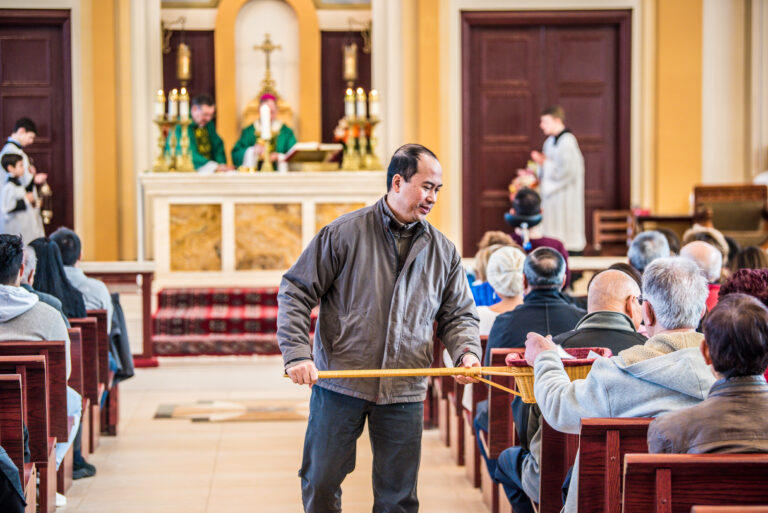
When Pietropaolo went looking for places where migrant workers gather, he found them in churches. The same is true of his work documenting the lives of permanent immigrants.
“Historically, churches have always been at the forefront of helping immigrants with all sorts of programming. I can speak from experience with the Italian Church in Toronto. It was the Italian parish of St. Agnes in the 1930s, historically acting as the major community centre, helping immigrants find jobs, helping them with bureaucratic problems they might have had, finding rents. Long before soup kitchens became fashionable, churches were already doing that,” he said.