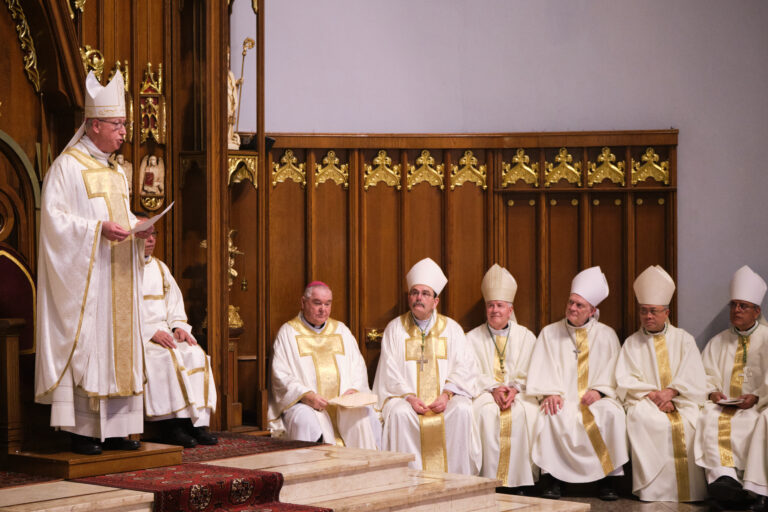
Father Menezes will address the topic at an Ottawa conference in October
By Deborah Gyapong
OTTAWA (CCN)
A focus on the four last things to be ever remembered: death, judgment, hell, and heaven, may seem odd in the Jubilee Year of Mercy, but Father Wade Menezes says the teachings “tie in beautifully.”
Father Menezes will speak on the four last things at a conference in Ottawa Sept. 30 to Oct. 1 put on by the Spiritual Motherhood of Priests (SMOP).
For SMOP co-founders Maria Pirrone and Maria Nicastro, the legalization of euthanasia and assisted suicide in Canada this year and their experience in accompanying sick and dying family members and friends confirmed the decision to hold their annual conference on this topic, said Pirrone.
“Also, it’s good for every person to feel repentance and not take God for granted,” she said. “Everyone is going to die and everyone will have a life review. We will all have different experiences, but I believe these talks will help us to understand in the process.”
Pirrone said she hopes the talks will help those attending to understand their need to release the bonds of hurt and resentment and to “accept death as a natural process for each of us.” She recalled the example of her mother, who when she was dying was filled with gratitude.
“Her last words were ‘I embrace everything God sends me.’ I believe she died with a joyful heart and a spirit of peace,” Pirrone said. “That is what would be great for all us to experience at the end and not what euthanasia tells us.”
Pirrone had seen Father Menezes on EWTN presenting teaching on the Four Last Things on EWTN, so she and Nicastro invited him to speak on this topic.
“We have God’s mercy precisely because of the reality of sin,” said Father Menezes, a member of the Fathers of Mercy, a missionary preaching order based in Auburn, Kentucky. “If there is no such thing as sin, there is no need for mercy.”
“Mercy is a gratuitous gift, but it has to be asked for,” said Father Menezes in a phone interview. “Part of asking is acknowledging one’s woundedness or sinfulness before God.
Father Menezes quoted Pope Francis from his book The Name of God is Mercy as saying: “Mercy exists but if you don’t want to receive it, if you don’t recognize yourself as a sinner, it means you don’t want to receive it. It means you don’t feel the need for it.”
Father Menezes noted the Catechism of the Catholic Church says that before Christ’s Second Coming, the Church “will pass through a final trial” of persecution and “religious deception.”
The Catechism speaks of the “supreme religious deception,” that of the Antichrist, “by which man glorifies himself in place of God, (CCC #675)” / Father Menezes said.
“It’s either a false notion of Christ, a spirit of Antichrist or where we put ourselves in place of God, through such things as euthanasia and the redefinition of marriage, where both divine law and natural law speak so clearly,” he said.
Father Menezes said each one of us will experience three of the Four Last Things: We will all die; we will all experience judgment and we will all end up in either heaven or hell.
The Church teaches hell “does exist and it is very possible for souls to go there,” he said. “And if one does go there, it is by his or her own choosing. In other words, it’s not enough to simply say ‘I don’t want to go to hell; but one has to have authentic conversion of heart as the best guarantee not go there.”
Purgatory is not one of the Four Last Things because it “ceases at the end of the final judgment,” he said.
“Yet, while hell is real, and Our Lady of Fatima warned we should fear hell in her Church-approved apparitions to the three shepherd children, we should not be unhealthily preoccupied by it, Father Menezes said. “Instead, let us all focus on God’s greatest attribute, His mercy.”
“Mercy is who God is,” Father Menezes said. “It’s Love’s second name. God is more interested in our future than in our past. He’s more interested in the kind of person we can yet become, than in the kind of person we used to be.”
“While indeed taking our sins seriously no doubt –whether mortal or venial, because mortal sin severs our supernatural relationship with Him and venial sin wounds our supernatural relationship with Him–
God never ever takes those sins as the last word,” the priest said. “Why? Because He made us in his image and likeness; He knows he calls us constantly to Himself through a life of sanctifying grace, which comes primarily through the seven sacraments; and He knows He is our God. He knows He wants to elevate us to become the best version of ourselves that He wills us to be.”
“God’s Plan A for us is to be saved and to go to heaven immediately,” he said. “Instead of suffering the temporal punishment for our sins in Purgatory, God wishes us to embrace redemptive suffering, and atone for our sins through corporal and spiritual works of mercy, prayer, almsgiving, and fasting while we are still alive.”
“This is why suffering is seen as salvific and redemptive while we are still living,” he said. “That’s why euthanasia is so evil. It denies the meritorious reality of suffering.”
The Church teaches that even if our sins are forgiven, there’s still a debt owed, he said. “There’s a messiness of sin that needs to be atoned for. This is where the reality of temporal punishment comes in. Suffering and illness can be offered up as atonement for that temporal punishment.”
“Show me three different persons who want euthanasia and chances are one thread holds them together: they surely are not seeing their suffering as salvific or redemptive or united to the Cross,” he said.
Information about the conference can be obtained by emailing spiritualmotherhoodottawa@gmail.com.